17 Small Entryway Organization Ideas With a Drop Zone

Seventeen ways to turn a cramped doorway into a drop zone that actually works — wall hooks, a slim console, a bench with shoe storage, a mail sorter, and a reset that keeps it clear.
Table of Contents (17 Ideas)
- 1.Start With a Wall Shelf and Hooks: the Cheapest Real Drop Zone
- 2.Squeeze in a Slim Console Table, 10 Inches Deep or Less
- 3.Use the Back of the Door When the Wall Is Already Full
- 4.Add a Floating Shelf and a Mail Sorter So Paper Stops Piling Up
- 5.Put a Bench With Shoe Storage Underneath by the Door
- 6.Pair a Peg Rail With a Mirror for a Last Look on the Way Out
- 7.Hide the Whole Drop Zone Inside a Tall Narrow Cabinet
- 8.Float Shoe Shelves Low on the Wall and Keep the Floor Clear
- 9.Give Every Person a Hanging Basket, Not a Shared Pile
- 10.Drop the Hooks to Kid Height So Children Can Hang Their Own Stuff
- 11.Roll a Small Cart Into the Corner When Nothing Can Be Fixed to the Wall
- 12.Let a Leaning Mirror and a Ledge Do the Work in a Dark Hall
- 13.Build a Wet-Weather Corner With an Umbrella Stand and a Boot Tray
- 14.Go Fully Renter-Friendly With Adhesive Hooks and a Stick-On Shelf
- 15.Keep One Valet Tray for Everything in Your Pockets
- 16.Hang a Pocket Organizer for Mail, Pens, and the Bits With No Home
- 17.Do a Seasonal Swap and a 5-Minute Reset So the Zone Stays Clear
You walk in with your hands full, and there is nowhere good to put anything down. Keys land on the nearest surface, the coat goes over a chair, shoes pile by the door, and by Friday the whole entryway looks like a small landslide. It is not that you are messy. It is that the doorway never got a proper job description.
These 17 entryway organization ideas drop zone setups are built for that exact problem, and for homes where the entryway is really just a wall and a bit of floor. Most of them cost little, take under an hour, and use the wall more than the floor, which matters when every inch counts. A good drop zone is not a whole mudroom. It is five small homes in one spot: coats, keys, shoes, mail, and the bag you grab tomorrow.
Start with the wall, because that is the space you are probably wasting. Then pick one place for shoes and one tray for the pocket stuff, and the rest of the list gets much easier to choose from.
Before you start
Stand in the doorway and watch yourself come home for a day. What do you carry in, and where does it actually land? That landing pattern is your drop zone. Build around it, not around a photo you liked.
Start With a Wall Shelf and Hooks: the Cheapest Real Drop Zone

If you do only one thing, mount a shelf with hooks under it. The shelf holds a bowl for keys and sunglasses, the hooks hold coats and bags, and the whole thing sticks out about 8 inches from the wall, so it works even in a hallway you can barely turn around in. Use proper wall anchors, not just the screws in the box, because a coat rail fails on the wettest, heaviest coat day. Leave one hook empty on purpose. That spare hook is where tomorrow's bag, the dog leash, or a guest's coat goes without starting a pile.
Squeeze in a Slim Console Table, 10 Inches Deep or Less

A console table sounds too big for a small entryway until you look at the slim ones. At 10 inches deep or less, it hugs the wall and still gives you a landing surface plus storage underneath. Put two baskets below for scarves, gloves, and the dog leash, and keep the top mostly clear except for one small dish and maybe a plant. The rule that keeps this working is simple: the top is for what you need today, not for everything you own. When in doubt about what else can fit in a tight home, these small apartment storage ideas help with the rooms beyond the door too.
Use the Back of the Door When the Wall Is Already Full

Some entryways have no usable wall at all, just a door and a walkway. That is when the back of the door earns its keep. An over-the-door hook rail holds coats, a cap, and a tote without a single screw, and a boot tray underneath catches the shoes that would otherwise spread across the floor. Put keys on the middle hook, not the end one, so they do not swing off when the door opens. This is entryway organization small space thinking at its simplest — use the surface that was already there. For more no-drill tricks, see our over-the-door storage ideas.
Add a Floating Shelf and a Mail Sorter So Paper Stops Piling Up

Mail is the quiet entryway villain. It arrives daily, it has no obvious home, and it breeds on flat surfaces. Fix it with a small floating shelf and a wall-mounted sorter underneath. Keys and sunglasses live in a dish on the shelf, and every envelope goes straight into the sorter, not onto the table. Sort once a week, not daily: junk goes in the recycling, bills go in one slot, and anything that needs an answer stays visible until it is done. A floating shelf also keeps the floor clear for shoes, which is half the battle in a narrow hall.
Put a Bench With Shoe Storage Underneath by the Door

Sitting down to put shoes on sounds like a luxury until you try it in a small entryway, and then it feels like common sense. A low bench, about 18 inches high, gives you a perch, and the open shelf underneath gives shoes a real home instead of a drift across the floor. Keep it to the pairs you actually wear this week — two or three per person, tops — and store the rest in a closet or a bin elsewhere. If space is truly tight, a bench that is 30 inches wide still works for one person at a time, which is how most of us get out the door anyway.
Three helpers worth the money
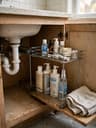
If you do buy, these three earn their space: a wall shelf with sturdy hooks that actually holds wet coats, a boot tray with a raised edge so mud stays put, and a small valet tray or dish for keys, coins, and sunglasses. Measure the wall and the floor space first, and skip anything else until you have lived with the setup for a month.
Pair a Peg Rail With a Mirror for a Last Look on the Way Out

A round mirror above a peg rail does two jobs in about a foot of wall. The mirror bounces light into a dark hallway and gives you that last check before you leave, and the pegs below hold the scarf, cap, and bag you grab most. This combo suits entryways with no table at all, because everything hangs and nothing needs floor space. One caution: peg rails fill up fast. If every peg is taken, that is your signal to move something to a closet, not to buy a longer rail.
Hide the Whole Drop Zone Inside a Tall Narrow Cabinet

Some people hate seeing coats and shoes, even tidy ones. If that is you, a tall narrow cabinet, about 20 inches wide, hides the entire drop zone behind one door. Hats go on the top shelf, coats hang on a short rail inside, and shoes line up at the bottom. The trick is keeping the inside as strict as the outside looks calm: one coat per person in season, shoes only for this week, and a small hook inside the door for keys. Closed storage like this is one of the best hidden storage ideas for a doorway that opens straight into a living room.
Float Shoe Shelves Low on the Wall and Keep the Floor Clear

Shoes on the floor make a small entryway feel half its size, but a shoe rack eats floor space too. Floating shelves solve both problems: mount two or three short shelves low on the wall, about 10 to 14 inches off the floor, and stand shoes on them heel-out so you can see each pair. Leave a gap of about 12 inches between shelves for boots. This is entryway organization wall thinking in its purest form — the floor stays open for walking, and the shoes are still right where you need them.
Give Every Person a Hanging Basket, Not a Shared Pile

Shared entryway storage always ends up belonging to one person and annoying everyone else. Hanging baskets fix that by giving each person a visible, limited home for their small stuff: gloves, a beanie, a dog leash, sunglasses. Hang them at different heights on the wall so they read as a group but stay separate, and keep each basket small enough that it cannot become a junk drawer. When a basket overflows, something in it has to move out — that rule alone keeps the system honest.
Drop the Hooks to Kid Height So Children Can Hang Their Own Stuff

If kids cannot reach the hooks, you become the hook. Mount a row of sturdy hooks at about 40 inches high, low enough for a small child to hang a backpack and rain jacket without help, and put open cubbies below for shoes and a lunch bag. Skip the fancy labels at first and use colour: one hook colour per child works even before they can read. It will not look perfect, and that is fine. A kid-height zone that gets used beats a beautiful high rail that only adults can reach.
Roll a Small Cart Into the Corner When Nothing Can Be Fixed to the Wall

Sometimes you cannot drill, and sometimes there is simply no free wall. A small three-tier rolling cart, about 13 inches wide, becomes a drop zone you can park by the door and roll away when guests come. Top tier: a tray with keys, wallet, and coins. Middle: sunglasses, sunscreen, and the bits you grab on the way out. Bottom: a reusable bag and the shoes you wear most. The cart also works as a trial run: live with it for a month, notice which tier fills up and which stays empty, and you will know exactly what fixed storage to buy later, if any.
Measure before you buy
Three numbers run this whole project: your wall width, your floor depth from the wall to the walkway, and the height of the lowest coat you own. A coat rail hung too low drags jackets on the shoe tray, and a console deeper than 12 inches turns a hallway into a squeeze. Write the numbers down before ordering anything.
Let a Leaning Mirror and a Ledge Do the Work in a Dark Hall

Dark hallways make small entryways feel smaller, and a leaning mirror is the cheapest way to fight that. Lean a tall mirror against the wall, put a slim ledge shelf under it for keys and a tiny vase, and suddenly the hall has light and a landing spot without a single screw in a stud. Anchor the top of the mirror to the wall if you have kids or a dog, because a leaning mirror in a busy doorway is a fall waiting to happen. Keep the ledge almost empty — keys, one small thing you like looking at, nothing else.
Build a Wet-Weather Corner With an Umbrella Stand and a Boot Tray

Rainy weeks are when entryways fall apart fastest, because wet things cannot go straight into a closet. Give wet gear its own corner: a tall umbrella stand by the door, a wide boot tray with a raised lip, and a small towel on a hook for wiping down. Put the tray right inside the door so muddy shoes never make it to the rug, and empty the tray once a week or it starts smelling like a puddle. The point is not fancy gear. It is a boundary: wet stuff stops here, dry house starts there, and the floor in between stays clean.
Go Fully Renter-Friendly With Adhesive Hooks and a Stick-On Shelf

Renters get told to just live with a bare entryway, which is bad advice. Adhesive hooks rated for a few pounds each can hold a tote, a light jacket, and keys, and a stick-on shelf and mail holder give you a landing spot with zero holes to fill later. The trick is surface prep: wipe the wall with rubbing alcohol, press firmly for 30 seconds, and wait a full day before hanging anything heavy. When you move out, warm the strip with a hair dryer and peel slowly, and most paint survives. This is also the safest way to try a drop zone layout before committing to screws. See our renter-friendly storage ideas for the rest of the flat.
Keep One Valet Tray for Everything in Your Pockets

Keys, wallet, coins, sunglasses, watch — the pocket dump is small, but it spreads everywhere if it has no home. One valet tray on the console or shelf fixes it, and the rule is that everything from your pockets goes in the tray the second you walk in. Pick a tray with a low divider so coins do not slide under the wallet, and empty the coins into a jar once a week or the tray fills up with small change. It is a tiny habit, but it is the one that ends the morning search for keys more reliably than any other idea here.
Hang a Pocket Organizer for Mail, Pens, and the Bits With No Home

Every home has a handful of small things that belong nowhere: the spare house key, a notebook, pens, dog treats, a mask. A hanging fabric pocket organizer gives each of them a slot on one narrow strip of wall, about 12 inches wide, and it hangs from a single hook or rail. Keep the heavy things low so the organizer does not pull forward, and check the bottom pocket monthly, because that is where the random bits quietly collect. It is not the prettiest idea on this list, but in a hallway with no table it is often the most useful one.
Do a Seasonal Swap and a 5-Minute Reset So the Zone Stays Clear

A drop zone only works if it holds this season, not every season. Twice a year, swap the coats and scarves: current season on the hooks, off-season in a labelled bin in a closet or under the bed. That one swap frees more hook space than any organizer you can buy. Then keep it clear with a 5-minute reset once a week, ideally on Sunday: shoes back on the tray, mail sorted, keys in the tray, anything that migrated to the entryway returned to its real room. If the reset keeps taking longer than five minutes, the zone is holding too much — move something out. Our Sunday reset routine pairs well with this habit.
A calm entryway is not really about furniture. It is about walking in, putting everything down in a spot you do not have to think about, and walking into the rest of your home with empty hands.
Pick the wall idea first, add one shoe home and one pocket tray, and let the rest of the list wait until you know what you actually miss. Then keep the weekly reset short and honest, and the doorway that used to greet you with a pile will start greeting you with a bit of calm instead.
Small Entryway Organization FAQs
Expert answers & styling advice
What is a drop zone in a small entryway? ▼
A drop zone is one small spot by the door where the things you carry in and out always land: coats on hooks, keys in a tray, shoes on a tray or shelf, mail in a sorter, and your bag on a hook or bench. It does not need a mudroom or a closet. A wall shelf with hooks and a shoe tray counts, and in a tiny home that is often the whole system.
How do I organize an entryway with no closet and no wall space? ▼
Use the door and the floor edge. An over-the-door hook rail holds coats and bags, a rolling cart parks beside the door for keys and small items, and a boot tray defines the shoe area.
How many pairs of shoes should live by the front door? ▼
Two or three pairs per person, at most, and only the ones worn this week. Everything else belongs in a closet, a bin, or another room. When the shoe tray is full, that is the limit working as intended. Adding a bigger tray just moves the pile somewhere else, so cap the pairs instead of expanding the storage.
What height should entryway hooks be? ▼
Adult coat hooks work well at about 66 inches high, with the shelf above them a little higher. For children, add a second row at about 40 inches so they can hang their own backpack and jacket. If coats drag on a shoe tray below, the hooks are too low or the coats are too long — raise the rail a few inches rather than moving the shoes.
How do I keep a small entryway tidy long term? ▼
Two habits do most of the work: a seasonal swap, so only this season's coats and shoes live by the door, and a 5-minute weekly reset where shoes go back on the tray, mail gets sorted, and stray items return to their real rooms. When the reset starts taking longer than five minutes, something needs to move out of the entryway, not into a bigger organizer.