15 Corner Pantry Ideas That Put Every Awkward Corner to Work

15 corner pantry ideas — lazy Susans, pull-out shelves, angled doors, tiered racks and labels — that turn the most awkward spot in your kitchen into the most useful one.
Table of Contents (15 Ideas)
- 1.Put a Two-Tier Lazy Susan in the Deep Corner
- 2.Run L-Shaped Shelves Around the Corner
- 3.Add Pull-Out Shelves to the Corner
- 4.Turn the Corner Into a Walk-In Pantry
- 5.Fit an Angled Door to Claim the Corner
- 6.Step Spices Up on a Corner Tiered Rack
- 7.Corral Snacks in Clear Corner Bins
- 8.Stack Cans in a Corner Gravity Rack
- 9.Build a Baking Caddy for the Corner Shelf
- 10.Give Produce a Ventilated Corner Home
- 11.Hang a Rack on the Pantry Door
- 12.Raise Cans on Tiered Risers in the Corner
- 13.Make the Corner a Coffee and Breakfast Station
- 14.Send Backstock to the Top Corner Shelf
- 15.Label the Corner Shelves and Keep a Use-First Basket
Every kitchen has one: the corner of the pantry where things go in and don't come out. You reach past the cereal, past the pasta, and somewhere back there is a jar of something you bought twice because you forgot the first one existed. Corner pantries aren't badly designed, exactly — they're just honest about a hard problem. The corner is the deepest part of the shelf and the hardest to see into, so it quietly collects whatever doesn't have a better home.
These 15 corner pantry ideas cost less than a weekly shop and take an afternoon at most — no renovation needed. The goal isn't a pantry that looks good in a photo. It's a pantry where you can find the cumin without moving four other jars, and where nothing expires in the dark.
Before you buy anything, empty the corner completely. Every jar, can and bag comes out onto the counter, and you check dates as you go. Most corner pantries hide at least a few things past their best — a stale box of crackers, a sauce from two moves ago — and there's no point organizing around food you're never going to eat. Wipe the shelves down while they're bare, then put things back by zone instead of by wherever they fit. If the cabinets next door need the same treatment, our corner cabinet organization ideas handle the dead space in the cabinets themselves, while this list stays with the pantry.
Measure the corner before you buy anything
Measure the depth from the front edge to the back wall, the width of the opening, and the height between shelves — then buy organizers a full inch smaller. A lazy Susan that can't spin and a pull-out that can't clear the door frame are the two most common mistakes, and a tape measure avoids both.
Put a Two-Tier Lazy Susan in the Deep Corner

The back corner of a pantry is where bottles go to be forgotten — the soy sauce you bought twice, the honey that crystallized sometime last year. A two-tier lazy Susan fixes the reach problem instead of fighting it. Set one on the corner shelf, load the bottom tier with cooking oils and vinegars and the top with sauces and dressings, and one spin brings everything to the front. Pick a turntable with a raised lip so nothing slides off mid-spin, and measure first: it should be about an inch smaller than the shelf depth so it actually turns. It takes about thirty seconds to install.
Run L-Shaped Shelves Around the Corner

Most corner pantries fail because the shelves stop at the wall and leave a dead triangle behind them. L-shaped shelves that wrap around both walls claim that triangle. The trick is keeping the shelves the same depth all the way around — 12 inches is the sweet spot for jars and canisters — so nothing sits two rows deep where you can't see it. Load the corner itself with things you grab least often, like the spare bag of rice, and keep daily items on the straight runs. Our small pantry organization ideas show how the same wrap-around thinking works in a straight closet pantry too.
Add Pull-Out Shelves to the Corner

A deep corner shelf is really a drawer that doesn't move, and that's the whole problem. Pull-out shelves on full-extension slides change that: the shelf rolls toward you, you take what you need, and it slides back. They're the best money you can spend in a corner pantry that already has fixed shelving, because they turn the back twelve inches from dead space into usable storage. Measure the opening, not just the shelf — the pull-out has to clear the door frame — and load heavier items like cans low. A 20-inch pull-out holds a surprising amount: a full row of canned tomatoes, beans and soup, all visible at once.
Turn the Corner Into a Walk-In Pantry

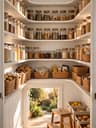
If the corner is big enough to step into, stop treating it like a cupboard and treat it like a room. A walk-in corner pantry uses U-shaped shelving — shelves along both walls and across the back — so you stand in the middle and everything is within arm's reach. Keep the shelves shallow, about 12 to 14 inches, so nothing hides behind anything else, and put the everyday stuff at eye level on the wall you face when you walk in. A small step stool lives in the corner for the top shelf, and the floor holds the bulky things: the big bag of rice and cases of drinks. This is the layout behind most of the walk in pantry ideas layout searches on Pinterest, and it's one of those corner pantry ideas that works because the shape does the organizing for you.
Fit an Angled Door to Claim the Corner

A corner pantry with a square door wastes the very corner it sits in, because the shelves behind the door frame are hard to reach and harder to see. An angled door — a door set diagonally across the corner, at 45 degrees — opens the whole space up. You walk up to the pantry facing it instead of sideways, and the shelves inside can run straight along both walls without a blind spot. A 24-inch angled door is wide enough to carry a basket through but narrow enough to keep the kitchen feeling open. Not ready to rebuild? A bi-fold door on the same opening gives you most of the same access, since it folds flat instead of swinging into the room.
Step Spices Up on a Corner Tiered Rack

Spice jars dumped on a flat corner shelf are a daily annoyance: you move three jars to find the cumin, and the paprika is always the one at the back. A tiered spice rack in the corner turns that shelf into stadium seating — three small steps, every jar visible, nothing buried. The corner is the best place for one, because the rack's triangular footprint fills the angle flat storage wastes. Decant into matching small jars if your collection is a jumble of brands; uniform jars line up tighter than you'd believe. Our spice organization ideas have more on jars and labels if your spice collection has outgrown one rack. If finding the smoked paprika takes more than five seconds, the rack has earned its place.



Corral Snacks in Clear Corner Bins

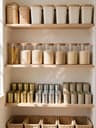
Loose snack bags are pantry chaos in its purest form — they slump, tear, and spill crumbs into everything around them. Drop them into clear stackable bins: one for sweet, one for salty, one for the kids' grab-and-go stuff. Clear matters, because a bin you can see into gets refilled, while an opaque box quietly becomes a snack graveyard. Stand chip bags upright like files in a drawer, and clip them shut first. Two bins fit neatly into most corner shelves side by side — a simple corner pantry idea, and all the snack zone most households need.
The two buys that do the heavy lifting
If the budget only stretches to two things, make it a two-tier lazy Susan and a set of clear stackable bins. Together they solve the two real problems of a corner pantry — things hiding at the back, and things toppling over each other — for less than a takeaway pizza.
Stack Cans in a Corner Gravity Rack

If your household runs on canned beans, tomatoes and soup, a gravity can organizer earns its keep fast in a corner pantry. You load cans in the top, take from the bottom, and the next one rolls down — rotation happens on its own, so the oldest can is always the one you use. The corner is a good home for one because the rack's depth fits the angle and it keeps the heavy cans low, where they belong. A two-tier rack holds about a dozen standard cans in the footprint of a shoebox. No room for a full organizer? A simple sloped shelf insert, with cans grouped by type, beats the single-file line that hides everything behind the front can.
Build a Baking Caddy for the Corner Shelf

Baking supplies are small, numerous, and weirdly shaped — vanilla, baking soda, sprinkles, cupcake liners, food colouring. Scattered across corner shelves, one of them is guaranteed to be missing mid-recipe. Load them all into one handled storage caddy that lives on the corner shelf: on baking day the whole operation comes out in a single trip, and when you're done it all goes back in a single trip. Pick a caddy with low sides so you can see everything at a glance, and keep the flour and sugar in their own canisters beside it. Corner pantries run on this principle: group by activity, not just by ingredient, wherever the two don't agree.
Give Produce a Ventilated Corner Home

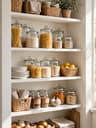
Onions, potatoes and garlic don't belong in the fridge, and they don't belong in a sealed bin either — they need air. The bottom corner shelf of a pantry is the right spot: cool, dark, and out of the way. Use ventilated woven baskets, one for onions, one for potatoes, and keep them apart — onions make potatoes sprout faster when they're stored together, which is one of those facts that sounds made up until you watch it happen. A basket with a loose weave keeps things tidy without trapping moisture, and the corner keeps the baskets from getting knocked around. The floor of the corner works too, if the shelf above it is too high to reach comfortably.
Hang a Rack on the Pantry Door

The back of the pantry door is the most underused real estate in a corner pantry, and it's free. An over-door pantry rack adds five or six shelves' worth of storage without touching a single wall — spices, packets, wraps, small jars, all in plain sight. It works especially well on a corner pantry because the door is the one surface that isn't fighting the angle. This one is for renters too: it hangs on hooks, no screws, no damage. Just check that the door still closes cleanly once it's loaded, and put the heaviest jars on the lowest rack so the door doesn't swing like a pendulum.
A quick word about heavy things
Cans, big jars and bags of rice belong low in a corner pantry — on the bottom shelf or the floor. High shelves are for light backstock in lidded storage bins. Keep the weight where your hands already are.
Raise Cans on Tiered Risers in the Corner

Cans are the worst space-wasters in a corner pantry: one row deep, and you can only see the front one. Tiered shelf risers fix that by turning one flat corner shelf into stadium seating — two or three levels, every label visible, nothing buried. Suddenly the chickpeas you bought twice because you forgot the first can are right there at eye level. The corner is where risers pay off most, because the back of the shelf is the deepest part of the pantry and the hardest to see into. Measure your shelf depth before buying; the stepped kind that expands to fit makes the neatest job of it.
Make the Corner a Coffee and Breakfast Station

The corner of a pantry is a natural home for a coffee and breakfast station, because everything you need in the morning lives in one place. Put the coffee maker on the counter or the lowest shelf, hang mugs on small hooks underneath the shelf above it, and keep the beans, tea boxes and sugar in matching jars right beside them. Add a basket for the breakfast things — granola, peanut butter, jam — and the whole morning routine happens without crossing the kitchen. A small tray under the coffee maker catches drips and lifts out for cleaning.
Send Backstock to the Top Corner Shelf

The top corner shelf of a pantry is prime real estate that usually holds a dusty appliance and good intentions. Reclaim it for backstock: the extra rice, the spare jar of peanut butter, the second bag of coffee beans. These are things you reach for once a month, so they earn the high shelf, while daily items stay between knee and eye level where they belong. Keep a small folding step stool in the corner, and store backstock in one or two lidded storage bins so a quick grab doesn't turn into an avalanche. This is one of the easiest pantry storage ideas to start with, because it only moves things you already own.
Label the Corner Shelves and Keep a Use-First Basket

Labels feel fussy right up until someone else puts the groceries away and everything still ends up in the right place. Use chalk labels on the shelf edge in a corner pantry, not just on the containers — that's what turns shelf zones from an idea into a habit, because the label stays even when the jar moves. Then add the one basket that makes the whole system pay: a use-first basket on the front of the middle shelf, holding anything that needs eating soon — the open bag of rice, the can expiring this month, the half-used taco seasoning. Cook from this basket first — it's the grocery store's first-in, first-out rule shrunk down for home.
A corner pantry will never hold everything a big walk-in can — and that's fine. What it can do is hold exactly what you use, in a way that lets you find it in five seconds instead of five minutes. Start with the empty-out, put a lazy Susan in the deep corner, give every shelf a job, and keep the labels honest. You don't need all 15 ideas at once. Pick the five corner pantry ideas that solve your biggest headache, live with them for a week, then add more. Small corner, calm kitchen — that's the whole goal. And for the rest of the room, our kitchen cabinet organization ideas finish the job.
Corner Pantry FAQs
Expert answers & styling advice
What is the best way to organize a corner pantry? ▼
Give the deep corner a job instead of letting it collect strays. A lazy Susan or pull-out shelf brings the back within reach, shallow 12-inch shelves stop things hiding two rows deep, and zones keep everything findable. Start by emptying the corner completely and only putting back food you actually eat.
How do I reach the back of a deep corner pantry? ▼
Don't reach — bring it to you. A two-tier lazy Susan spins the back row to the front, and a pull-out shelf on full-extension slides rolls the whole shelf out toward you. Both cost far less than rebuilding the pantry, and either one ends the daily stretch-and-guess.
Are lazy Susans good for corner pantries? ▼
Yes, they're the simplest fix for a corner pantry, as long as you size them right. Pick one about an inch smaller than your shelf depth so it spins freely, and choose one with a raised lip so bottles don't slide off.
How deep should corner pantry shelves be? ▼
About 12 to 14 inches is the sweet spot for most corner pantries. Shallower than 12 and big canisters won't fit; deeper than 14 and things start hiding behind each other, which is exactly the problem you're trying to solve.
How do I organize a small corner pantry on a budget? ▼
Start with the two cheapest fixes: a lazy Susan for the deep corner and a few clear bins for snacks and packets. Both together usually cost less than $30. Add chalk labels so everyone in the house puts things back in the right place, and use baskets you already own for produce and backstock.