15 Kitchen Pantry Ideas That Make Cooking Easier Every Day

15 kitchen pantry ideas — zones, canisters, pull-out drawers, lighting, and labels — that work for walk-in pantries, reach-in closets, and cabinet pantries alike.
Table of Contents (15 Ideas)
- 1.Give Every Shelf a Zone
- 2.Decant Staples Into Matching Airtight Canisters
- 3.Adjust Shelf Heights to Fit What You Actually Store
- 4.Plan a Walk-In Layout Around How You Cook
- 5.Add Pull-Out Drawers to a Cabinet Pantry
- 6.Step Cans Up on Tiered Risers
- 7.Put a Lazy Susan in the Deep Corner
- 8.Hang an Over-Door Rack for the Small Stuff
- 9.Corral Snacks in Clear Bins
- 10.Give Spices a Home of Their Own
- 11.Send Backstock to the Top Shelf
- 12.Build Meal-Kit Baskets for Busy Nights
- 13.Make the Corner Pantry Work
- 14.Add Lighting So Nothing Hides in the Dark
- 15.Keep a Use-First Basket and a Ten-Minute Reset
Here's the thing about a pantry: it doesn't have to be big, or new, or built-in to work well. The best kitchen pantry ideas aren't about ripping out shelves or buying a matching set of everything — they're about giving the space you already have a job to do. A reach-in closet, a tall cabinet, a proper walk-in: they all fail the same way, when everything gets shoved in wherever it fits and you end up buying a second bag of rice because the first one is hiding behind the cereal. And they all get fixed the same way, too: every shelf earns a purpose, every category gets a home, and nothing hides behind anything else.
These kitchen pantry ideas cover the full range — walk-in pantries, reach-in closets, and the tall cabinet doing pantry duty in the corner of the kitchen. Some ideas cost nothing at all: moving a shelf, grouping things by meal, keeping a basket where you can't miss it. Others cost less than a weekly grocery run and pay for themselves the first month you stop buying duplicates. Start with the first three and the rest falls into place. If your pantry is genuinely tiny, our small pantry organization ideas go deeper on tight spaces; if you don't have a pantry at all, start with our kitchen organization without a pantry guide instead.
What you'll need for most of these ideas
Most of this list runs on six things: airtight glass canisters, tiered shelf risers, a lazy Susan turntable, clear stackable bins, a few woven storage baskets, and chalk labels with a chalk pen. Buy them in that order if you're spreading the cost out — the canisters and the risers change the most, the fastest. Everything else here is just rearranging what you already own.
Give Every Shelf a Zone

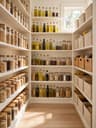
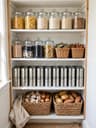
A pantry without zones is a junk drawer with a door. Decide what each shelf is for and defend it: top shelf for backstock and things you touch once a month, the shelves at eye level for the cans and jars you reach for every day, the lowest shelf for heavy things and kid snacks. Inside each shelf, keep categories together — all the baking in one spot, all the canned tomatoes in another. It sounds obvious until you realize most pantries are organized by 'wherever it fit on grocery day.' Zones end the daily treasure hunt, and putting the shopping away becomes a two-minute job instead of a puzzle.
Decant Staples Into Matching Airtight Canisters

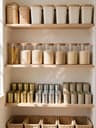
Flour, rice, pasta, oats, sugar — the bags and boxes they arrive in are all different heights, they slump, and they never stack. Pour them into airtight glass canisters in one or two matching sizes and two things happen at once: your shelves look calmer, and you can see at a glance when you're running low. Matching containers line up in straight rows instead of leaning towers, which quietly buys you a whole extra row of space. Don't decant everything, though — just the staples you touch every week. The once-a-month specialty grains are fine in their bags inside a bin. And stick a strip of tape with the cooking time and use-by date on the bottom of each jar so nothing gets lost.
Adjust Shelf Heights to Fit What You Actually Store

Most pantry shelves sit where the builder left them, which usually means a foot of dead air above the cereal boxes and a shelf too short for the tall olive oil bottle. If your shelves are on pegs or brackets, move them: tall things get a tall gap, short things get a short one. The rule is simple — no more than an inch or two of air above whatever lives on that shelf. Suddenly the same pantry holds a whole extra shelf's worth of food, because you're storing food instead of storing air. Measure your tallest items first and set the gaps around them. It's a Saturday-morning job with a screwdriver, and it changes the pantry more than any container will.
Plan a Walk-In Layout Around How You Cook

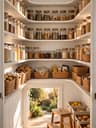
A walk-in pantry earns its keep when the layout follows your cooking, not the other way round. The classic U-shape — shelves down both sides and across the back, with a counter in the middle — works because it puts everything within two steps and leaves the center free for setting down bags or a slow cooker. Keep the everyday stuff on the side nearest the door and the baking and backstock at the back, where you go less often. If you're planning a new pantry or a proper pantry design from scratch, leave at least 90 cm of clear floor in the middle so two people can pass, and put the counter at a height you can actually work at. A walk-in you can stand in and think is a pantry you'll use every day.
Add Pull-Out Drawers to a Cabinet Pantry

A tall cabinet pantry looks tidy until you need the jar at the back — then you're pulling out six things to reach one. Pull-out drawers fix that: the whole shelf slides toward you, and nothing hides. Retrofit kits screw into most standard cabinets in under an hour, and they're worth it for the bottom two shelves at least, where the heavy stuff lives. Put the everyday jars and oils in the top drawer, the dry goods in the middle, and the heavy bags of rice and flour at the bottom where the drawer can take the weight. Our kitchen cabinet organization ideas cover the rest of the kitchen's cabinets if the pantry gets you started. One honest tip: measure the inside width of the cabinet, not the outside — the drawer needs a finger's width of clearance on each side.
Step Cans Up on Tiered Risers

Cans are the worst space-wasters in a pantry: one row deep, and you can only see the front one. Tiered shelf risers turn one flat shelf into stadium seating — three levels, every label visible, nothing buried. Suddenly the chickpeas you bought twice because you forgot the first can are right there at eye level. Risers work for spice jars and small bottles too, and the expanding kind that stretches to fit your shelf width wastes no edge space. Group the cans by type on each tier — beans on one level, tomatoes on the next — so you can scan the whole shelf in one glance. Measure your shelf depth before you buy.
Put a Lazy Susan in the Deep Corner

Every pantry has a dead corner where bottles go to be forgotten. A lazy Susan turntable brings that corner back to life: oils, vinegars, sauces, and honey all ride the spin instead of hiding behind each other. One turn and you can read every label without moving a single bottle. Get one with a small raised lip so things don't slide off mid-spin, and slightly smaller than your shelf depth so it actually rotates — measure twice, because a turntable that wedges is worse than no turntable at all. It's the cheapest fix in this whole list for the most annoying spot in the pantry.
The two buys that do the heavy lifting
If the budget only stretches to two things, make it clear stackable bins and a lazy Susan turntable. Together they solve the two real problems of any pantry — things hiding, and things toppling — for less than a takeaway pizza. Everything else on this list is refinement.
Hang an Over-Door Rack for the Small Stuff

The back of the pantry door is the most underused real estate in the kitchen. An over-door pantry rack adds five or six shelves' worth of storage without touching a single wall — spices, packets, wraps, small jars, all in plain sight. It's the single fastest way to make a pantry feel twice the size, and it hangs on hooks, so renters can use it too: no screws, no damage. Just check the door still closes cleanly once it's loaded, and put the heaviest jars on the lowest rack so the door doesn't swing like a pendulum. If your pantry door is a sliding or bifold door, the same idea works on the inside wall of the pantry or the side of a nearby cabinet.
Corral Snacks in Clear Bins

Loose snack bags are pantry chaos in its purest form — they slump, tear, and spill crumbs into everything. Drop them into clear stackable bins: one for sweet, one for salty, one for the kids' grab-and-go stuff. Clear matters, because a bin you can see into gets emptied and refilled, while an opaque box quietly becomes a snack graveyard. Clip chip bags shut, or stand them upright in the bin like files in a drawer. When kids or guests raid the pantry, they raid one bin — and the rest of your shelves stay exactly as you left them. For the containers themselves, our food container organization ideas go deeper on what actually keeps food fresh.
Give Spices a Home of Their Own

Spice jars dumped on a pantry shelf eat space and patience in equal measure. Move them to a dedicated spot: a tiered spice rack on a shelf, a slim stepped insert, or magnetic tins on the side of the fridge if the pantry is truly full. Whatever you choose, the rule is one layer deep — if you have to move three jars to find the cumin, the system has already failed. Decant into uniform small jars if your collection is a jumble of brands; matching jars line up tighter than you'd believe, and they all take the same label. Keep the five spices you use every week at the front and the rest behind them — the smoked paprika you use twice a year doesn't need front-row seating.
Send Backstock to the Top Shelf

The top shelf of a pantry is prime real estate that usually holds a dusty appliance and good intentions. Reclaim it for backstock: the extra rice, the spare jar of peanut butter, the second bag of coffee beans. These are things you reach for once a month, so they earn the high shelf, while daily items stay between knee and eye level where they belong. Keep a small step stool nearby if you need one, and store backstock in one or two lidded storage bins so a quick grab doesn't turn into an avalanche. When you open the last jar of something, the backstock comes down and the item goes on the shopping list — that's the whole system, and it works.
Build Meal-Kit Baskets for Busy Nights

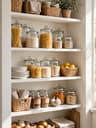
Instead of storing every ingredient by type, try storing a few by meal: one basket holds everything for taco night, another keeps the pasta, sauce, and parmesan for a fast weeknight dinner together. On a tired Tuesday you pull out one woven storage basket instead of hunting across five shelves. Baskets also tame the awkward stuff — onions, potatoes, bread — that never sits neatly on a flat shelf. Choose baskets with handles — in a deep pantry, pulling the whole category toward you is half the battle. Start with two or three meal kits for the dinners you make most — that's enough to feel the difference on a busy weeknight.
Label the shelf, not just the jar
Labels feel fussy until someone else puts the groceries away and everything still lands in the right place. Label the shelf edge too, not just the containers — that's what turns zones from an idea into a habit. Keep the chalk pen in the pantry itself, so relabeling takes ten seconds when the contents change.
Make the Corner Pantry Work

Corner pantries get a bad name because the deep angle swallows whatever you put in it. The fix is to stop fighting the shape and use it: triangular or angled shelves fitted into the corner hold jars and canisters in rows you can actually see, and a turntable on the lowest shelf handles the oils and sauces. That's where corner pantry ideas earn their keep — the awkward angle becomes the pantry's best feature when the shelves follow it instead of ignoring it. Keep the corner for things you use every day, not backstock: the worse the reach, the more often the item should earn its spot there, or it'll never get used. If the corner is deep, a pull-out basket on a runner does the same job as a turntable with less spinning.
Add Lighting So Nothing Hides in the Dark

A pantry with no light is a pantry where things disappear. A strip of warm LED lights under each shelf — the battery kind with a motion sensor, no wiring needed — turns the back row from a shadow into a shelf you can actually use. Stick them to the underside of the shelf above, not the wall, so the light falls down onto the jars instead of into your eyes. Warm white looks better than cool white in a pantry; cool white makes food look like a hospital corridor. A sensor light that switches on when the door opens is the kindest version.
Keep a Use-First Basket and a Ten-Minute Reset

Food waste in a pantry usually isn't overbuying — it's forgetting. Dedicate one small basket, front and center, to anything that needs eating soon: the open bag of rice, the can expiring this month, the half-used taco seasoning. Cook from this basket first when you're deciding what to make. It's the grocery store's first-in, first-out rule shrunk down for home, and it quietly saves real money over a year. Then give the pantry ten minutes once a week: strays back in their zones, the basket updated, the sticky spot wiped. Skip the reset and the mess wins back a little ground each week; keep it, and the pantry you organized here is still the pantry you have six months from now.
A good pantry isn't a big pantry — it's one where you can find the cumin in five seconds and you never buy a third bag of rice by mistake. Start with the empty-out, give every shelf a job, decant the staples, and keep the labels honest. You don't need all 15 kitchen pantry ideas at once: pick the five that solve your biggest headache, live with them for a week, then add more as you see what your pantry actually needs. Small pantry or walk-in, calm kitchen — that's the whole goal. And if there's no pantry in your kitchen at all, our kitchen organization without a pantry guide shows how to build the same system from cabinets and carts.
Kitchen Pantry Ideas FAQs
Expert answers & styling advice
Do these kitchen pantry ideas work for a walk-in pantry? ▼
Yes. Ideas 1, 4, 11 and 14 were written with walk-ins in mind, and the zone system matters more the bigger the pantry gets — a walk-in without zones just becomes a small grocery store you can't find anything in. Keep everyday things near the door and backstock at the back.
How much does it cost to organize a kitchen pantry? ▼
Most pantries on this list cost between nothing and about $60. Moving shelves, zoning, and the use-first basket are free. A set of airtight canisters, a couple of tiered risers, and a lazy Susan usually run $40–60 all in. The only idea that costs real money is retrofitting pull-out drawers, which run $25–50 per drawer — start with the bottom two shelves if you're doing it in stages.
Should I decant everything into matching jars? ▼
No — decant only the staples you reach for every week: flour, rice, pasta, oats, sugar, and your main grains. Things you use once a month are fine in their original packaging inside a bin. Decanting everything looks lovely but costs time and money, and half-empty jars of specialty items just become prettier clutter. The goal is visibility for the things you cook with constantly, not a showroom shelf.
How do I keep a pantry organized when I have kids? ▼
Give kids one shelf or one bin that's entirely theirs — snacks they can reach, in containers they can open, at a height that doesn't require climbing. Label it with pictures if they're little. Everything above that line stays adult-organized. The snack bin absorbs the daily chaos, and the rest of the pantry keeps its system. Refill their bin from backstock during your weekly reset.
How often should I reorganize my pantry? ▼
A full reorganization should only happen once — after that, it's maintenance. Ten minutes a week for the reset (strays back in their zones, use-first basket updated, shopping list checked against the shelves) and a proper fifteen-minute audit every three months to catch expired cans and forgotten backstock. The best pantry organization ideas are the ones you'll actually maintain, so if you find yourself reorganizing from scratch every month, the system — not you — needs adjusting. Usually a zone is simply in the wrong place.