17 Bedroom Storage Ideas That Hide the Clutter

17 bedroom storage ideas that hold up in real bedrooms — under-bed bins, a second closet rod, file-folded drawers, floating shelves and a self-sorting hamper.
Table of Contents (17 Ideas)
- 1.Slide Low-Profile Rolling Bins Under the Bed
- 2.Give the Nightstand Drawer a Job
- 3.Add a Second Hanging Rod in the Closet
- 4.Stand Sweaters Up With Shelf Dividers
- 5.Hang an Over-Door Organizer on the Bedroom Door
- 6.File-Fold the Dresser Drawers
- 7.Put Floating Shelves Where the Walls Are Wasted
- 8.Park a Storage Ottoman at the Foot of the Bed
- 9.Shrink Off-Season Clothes Into Vacuum Bags
- 10.Let the Headboard Hold the Bedtime Stuff
- 11.Give Shoes a Two-Tier Home on the Closet Floor
- 12.Hang a Shelf Organizer for the Foldables
- 13.Clip a Bedside Caddy Onto the Mattress
- 14.Run a Peg Rail Along One Wall
- 15.Stash Linens in a Window-Seat Bench
- 16.Box the Top Shelf for Seasonal Swaps
- 17.Split the Laundry With a Two-Bag Hamper
Open your bedroom door and look at it the way a guest would. Is there a clear path to the bed, or are you stepping around shoes, a pile of clean laundry on the chair, and a bag that never got unpacked? Most bedrooms aren't messy because the people in them are messy — the room just has no real plan — the closet holds whatever fits, the dresser holds whatever is left, and the floor quietly becomes the overflow shelf. These 17 bedroom storage ideas fix that without a renovation or a carpenter.
The bedroom storage ideas that actually hold up work on the whole room at once: the bed, the closet, the dresser, the nightstand, and the walls, all working together. Nothing here needs a tradesperson. Most of it costs less than a dinner out and goes up in an afternoon — a second rod, a few dividers, bins that roll under the bed.
Start with the three that solve your biggest headache and live with them for a week before adding more. If the closet is the worst of it, our small closet organization ideas go deeper on that one room, and if you don't have a closet at all, these bedroom ideas with no closet are built for you. Grab a bin bag first, though — a quick clear-out makes every idea on this list work twice as well.
 Save Pin
What you'll need for most of these ideas
Most of this list runs on six things: low-profile rolling bins, fabric drawer dividers, a second closet rod, clear shelf dividers, an over-door organizer, and a hanging shelf organizer. Buy them in that order if you're spreading out the cost — the bins and dividers change the most, the fastest. The rest is just rearranging what you already own.
Slide Low-Profile Rolling Bins Under the Bed

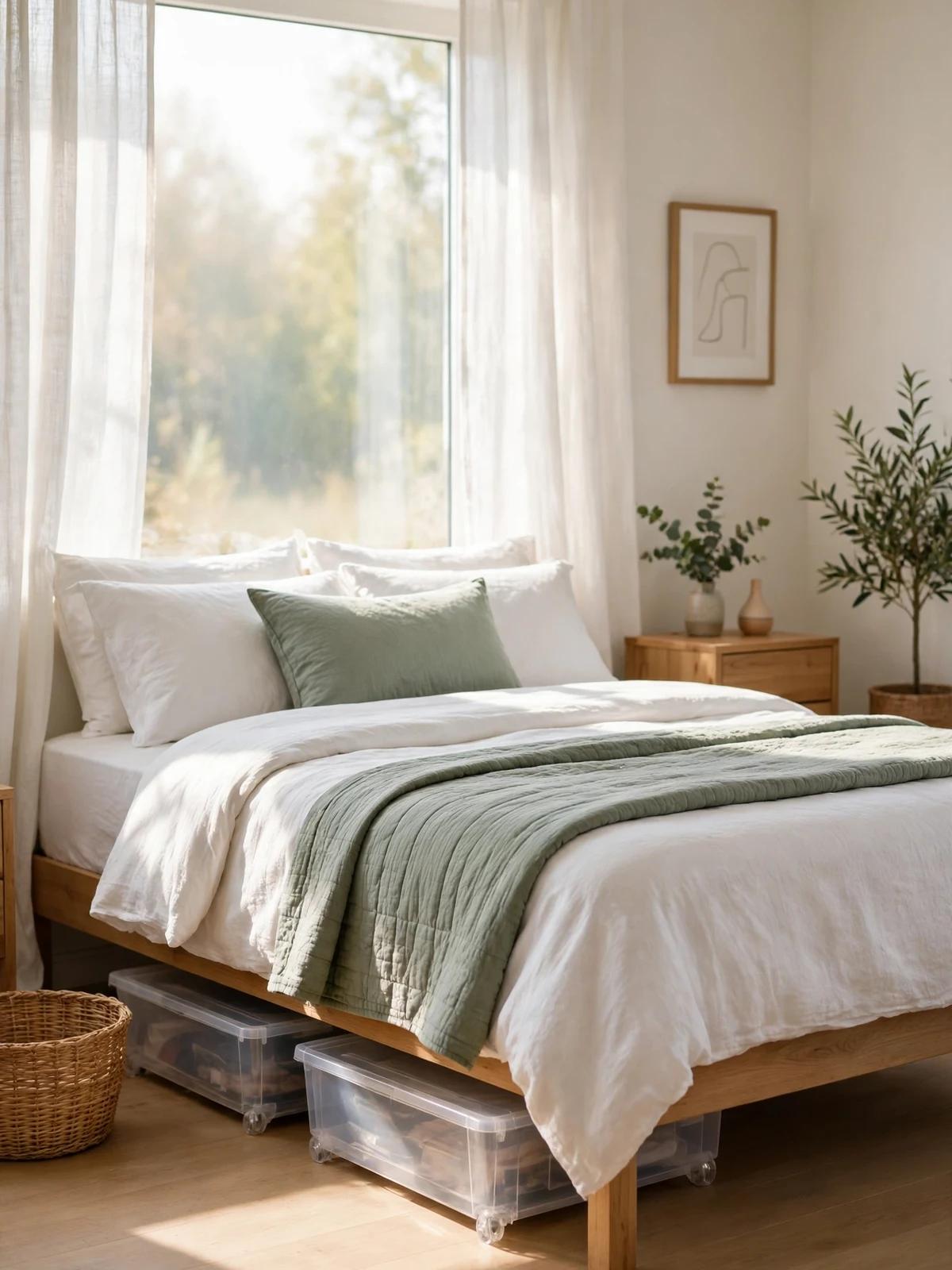
Most bed frames leave 6 to 8 inches of clearance underneath — the biggest unused storage in the room. Low-profile rolling bins — the kind that measure about 6 inches tall — slide straight in and hold off-season clothes, spare sheets, or the board games nobody plays in summer. Pick bins with lids and small wheels, so dust stays out and one hand pulls a bin out. Label the short end facing you, because once three identical bins are under there, guessing gets old fast. One bin per category, nothing loose.
Give the Nightstand Drawer a Job

The top drawer of a nightstand collects the strangest pile in the house: lip balm, chargers, painkillers, a notebook, three pens that don't work. Small fabric drawer dividers turn that one drawer into six compartments, and suddenly everything has a place you can find in the dark. Keep the phone charger in the front slot, so the cable threads out the back without tangling. The rule that makes it stick: nothing goes in unless you reach for it after getting into bed. Everything else belongs somewhere else in the room.
Add a Second Hanging Rod in the Closet

A standard closet rod hangs at about 66 inches, which leaves a whole lot of empty air below your shirts. A second closet rod, hung about 40 inches off the floor, doubles the hanging space for shirts, blouses, and folded-over trousers — the clothes that are too short to need the full drop. A screw-in rod holds more weight and won't sag under denim jackets. Hang your most-worn shirts up top and the next tier below, and keep dresses and coats on the one full-length section. It costs less than a takeaway and adds a closet's worth of hanging.
Stand Sweaters Up With Shelf Dividers

Folded sweaters are fine until the pile is five high and the one you want is at the bottom. Clear acrylic shelf dividers slide onto the shelf and act like bookends, keeping each stack standing on its own. Four sweaters per stack is the sweet spot — higher and the pile leans. Sort by type if you get dressed in a hurry: all the jumpers together, all the hoodies together. They also stop the slow sideways creep that turns a neat shelf into a leaning tower by laundry day. Measure shelf depth before ordering; a divider that is too deep sticks out past the edge.
Hang an Over-Door Organizer on the Bedroom Door

The back of the bedroom door is a full wall of storage nobody uses. A fabric over-door organizer with clear pockets holds scarves, belts, sunglasses, rolled-up ties, and the small things that live in a drawer pile. Hang it on the door you open least, or the closet door if the bedroom door swings into furniture. Clear pockets matter — you can see the belt you want without opening five pouches. Keep the heaviest things in the lowest pockets so the door still closes cleanly. It hangs on hooks, no screws — one of the few closet fixes renters can do in five minutes.


File-Fold the Dresser Drawers

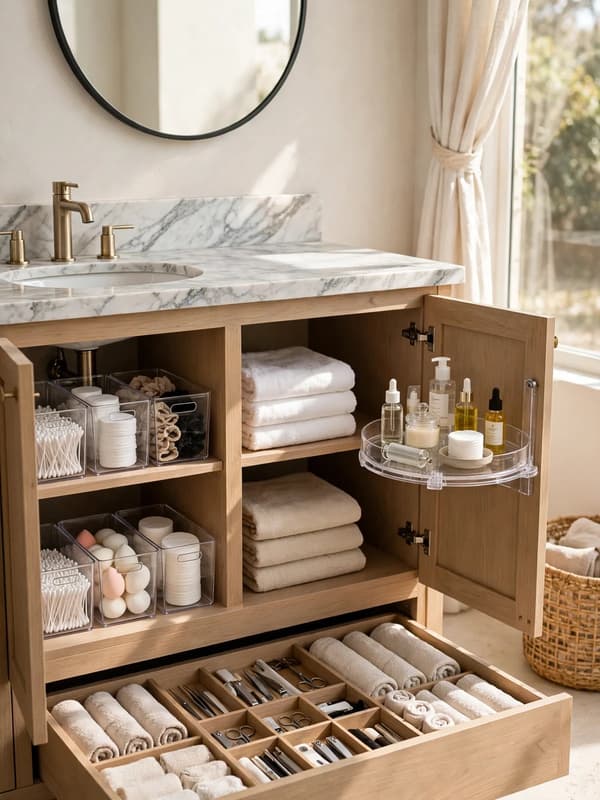
Dresser drawers fail the same way every time: clothes stacked flat, so you only ever wear the top two and forget the rest. File-folding fixes it: fold each item into a small rectangle and stand it upright, spine up, like files. You can see every t-shirt at once, and pulling one out doesn't disturb the rest. Small fabric drawer dividers keep the rows from flopping sideways when the drawer is half empty. One drawer per category works best: tops in one, bottoms in another, underwear and socks in the shallow top one. Our dresser drawer organization ideas walk through the folds step by step.
Put Floating Shelves Where the Walls Are Wasted

The wall above the bed and the strip beside the wardrobe are usually empty — wasted storage in a small bedroom. Two floating shelves, fixed into studs, hold folded blankets, books, a plant, and the things that used to live on the floor. Keep the shelves shallow — about 8 to 10 inches deep — so nothing sticks out far enough to bump your head. Weekly grabs go on the lower shelf, the pretty-but-rarely-touched things up high. The trick is restraint: three tidy stacks look calm; a shelf packed edge to edge just moves the clutter up the wall.
The two buys that do the heavy lifting
If the budget only stretches to two things, make it a second closet rod and a set of fabric drawer dividers. Together they solve the two real problems of a bedroom — nowhere to hang things, and drawers you can't see into — for less than a night out.
Park a Storage Ottoman at the Foot of the Bed

A storage ottoman at the foot of the bed earns its floor space twice: a seat for putting shoes on, and a deep box for the bulky things that fit nowhere else. Spare blankets, the extra duvet, board games, the handbag collection — all of it goes inside and the lid closes. Pick one with a hinged lid that stays open on its own, so you aren't holding it up while you dig with the other hand. Measure it against your bed frame first; an ottoman wider than the bed looks wrong and trips everyone walking past in the dark.
Shrink Off-Season Clothes Into Vacuum Bags

Winter coats and chunky knitwear eat a whole shelf for half the year, then sit untouched all summer. Vacuum-seal bags shrink a pile of jumpers to about a third of its size — four or five sweaters per large bag — and the flat packs slide under the bed or onto the top shelf. Use the roll-up kind to skip the vacuum cleaner, and don't overfill them or the seal pops. Wash everything first, because a stain left for six months becomes a permanent one. When the seasons turn, swap the bags — summer in, winter out — one afternoon twice a year.
Let the Headboard Hold the Bedtime Stuff

The headboard is usually just a board, but one with built-in shelves — or a slim shelf fixed just above it — puts bedtime things within reach without a nightstand. Books, glasses, the phone charger, a small lamp — all at arm's length, and the nightstand drawer is freed up for the things you don't need at midnight. Keep it one layer deep; a shelf crowded with mugs and chargers is just a nightstand on the wall. If you share the bed, give each side its own shelf section, so nobody's book ends up under somebody else's water glass.
Give Shoes a Two-Tier Home on the Closet Floor

Shoes on the closet floor become a pile the moment there are more than four pairs. A two-tier shoe rack, about 24 inches wide, holds six to eight pairs in neat rows and keeps them off the floor for sweeping. Sort by type — trainers together, flats together — with your most-worn pair at the front of the top tier. The bottom tier is for weekly pairs, not daily ones, so they don't block the door. On carpet, a rack with a solid base stops heels poking through, and a tray underneath catches mud before it reaches the carpet.
Hang a Shelf Organizer for the Foldables

If your closet has more hanging space than shelf space, a hanging shelf organizer borrows some back. It hooks over the rod and gives you six cubby compartments for folded t-shirts, jeans, and knitwear — the things that stretch out of shape on a hanger and slide off anyway. Fold each stack to fit its cubby, four or five items high, with the heaviest knits at the bottom so it doesn't swing. One organizer usually replaces a whole dresser drawer — the first fix in most small closet organization ideas for tight bedrooms.
Clip a Bedside Caddy Onto the Mattress

Not every bedroom has room for a nightstand; a bedside caddy costs almost nothing. It slips between the mattress and the base and hangs down the side of the bed, with pockets for a book, glasses, the phone, and the charger cable. Everything you reach for in the dark is right there. Pick one with a stiff backing board so it doesn't slide down the gap, and keep the pockets shallow enough that things don't vanish to the bottom. In a shared room, two caddies — one per side — end the fight over the one small table.
Run a Peg Rail Along One Wall

A wooden peg rail does the job of three hooks and a coat rack, and takes up no floor space at all. Hang tomorrow's outfit on it the night before, plus the daily bag, a hat, and a scarf — the things that otherwise land on the bed or the chair. Fix it into studs, not just plaster — a rail holding four bags and a coat carries real weight. Leave one peg empty; a rail with a spare peg stays useful, while a full one just becomes another place to drape things. At about 36 inches long it fits most bedrooms.
A quick word about the top shelf
The top shelf is for things you touch twice a year, not things you need on Tuesday. If the step stool comes out more than once a month, whatever is up there belongs lower — swap it with something seasonal.
Stash Linens in a Window-Seat Bench

A storage bench under the window turns a dead corner into the linen cupboard the bedroom never had. Spare sheets, the extra duvet cover, off-season throws — all inside, and the top is a seat with a cushion for reading. Baskets inside keep the categories separate, so you aren't digging past the winter duvet to find a pillowcase. If you buy rather than build, measure the window width first and leave a couple of inches of clearance each side. It is one of the few storage pieces that makes a small bedroom feel bigger, because it replaces the pile, not just hides it.
Box the Top Shelf for Seasonal Swaps

The top shelf is where storage goes to be forgotten, so give it a job that suits it: seasonal swaps in matching lidded storage boxes. One box for winter hats and gloves, one for summer swim things, one for the scarves you only wear twice a year. Label the short end you can see from the floor, and keep a small step stool in the closet so reaching them is easy. If you need it more than once a month, it lives lower. Everything up there should be something you touch twice a year and never in between.
Split the Laundry With a Two-Bag Hamper

The laundry pile on the bedroom floor is not a storage problem, it is a sorting problem. A slim two-bag hamper — one bag for lights, one for darks — sorts laundry the moment clothes come off, and laundry day is just carrying the full bag to the machine. Pick one with removable bags, so you aren't dragging the whole frame down the hall. It fits the gap between dresser and wall, usually about 18 inches wide, and holds a full week's worth for one person. The floor stays clear, and the chair stops being where clothes go to wait.
You don't need all 17 ideas. Most real bedrooms calm down with four or five bedroom storage ideas: something under the bed, a second rod, dividers in the drawers, and a home for the laundry before it hits the floor. Start there, live with it for two weeks, and add more only if a specific pile is still bothering you.
The test is a normal Tuesday night: find tomorrow's outfit, plug your phone in, and get into bed without moving a pile first, and the room is doing its job. And if the wardrobe itself is the problem, run through our bedroom declutter checklist first, or do a full wardrobe reset and clear the clothes you never wear.
Bedroom Storage Ideas FAQs
Expert answers & styling advice
How do I add storage to a small bedroom without buying new furniture? ▼
Use the surfaces you already have: bins under the bed, a second rod, an over-door organizer, and one or two floating shelves. Small bedroom organization is mostly about claiming dead space — under the bed, the back of the door, the air below your shirts — before buying anything big. Dividers in the drawers you own do more than a new dresser ever will.
What actually fits under a standard bed frame? ▼
Most frames give you 6 to 8 inches of clearance, so anything flat works: low-profile rolling bins about 6 inches tall, vacuum-sealed bags of off-season clothes, spare sheets in a zip bag, or a flat box of shoes. Measure first — platform beds can sit as low as 4 inches, and anything taller than the gap just becomes a dust trap. Our under-bed storage ideas cover the measurements in detail.
How do I organize a bedroom closet with no built-in shelves? ▼
Borrow shelf space from the rod: a hanging shelf organizer gives you six cubbies, a second rod doubles hanging, and a two-tier shoe rack owns the floor. Add an over-door organizer for accessories and a few lidded storage boxes on the top shelf for seasonal things. That covers most closets without a single screw in the wall — the backbone of most small closet organization bedroom plans.
How many clothes should fit in one dresser drawer? ▼
File-folded, a standard drawer holds about 8 to 10 t-shirts, 4 to 5 pairs of jeans, or 6 to 8 sweaters, depending on thickness. If you have to force the drawer shut, it holds too much — take out a third and the rest stays visible. One category per drawer is the rule; a mixed drawer is a junk drawer with better intentions.
How do I keep a shared bedroom organized? ▼
Split the room down the middle: each person gets their own closet rod section, their own drawer or two, and their own bedside caddy or nightstand. A two-bag hamper keeps laundry sorted by person or by colour, and labels stop the quiet borrowing that turns one person's shelf into a shared pile. Agree the split once, then leave each other's zones alone.