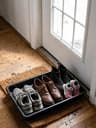
13 Front Door Shoe Organization Ideas That End the Entryway Pile

Thirteen fixes for the shoe pile by the front door — a tray that catches the mess, a bench with cubbies, over-door pockets, a slim cabinet for narrow halls, baskets per person, and a weekly reset that keeps it sorted.
Table of Contents (13 Ideas)
- 1.Start With a Low Tray With a Lip, Right Where Shoes Land
- 2.Put a Bench With Open Cubbies Underneath by the Door
- 3.Hang an Over-the-Door Organizer for Shoe Organization Behind Door
- 4.Try a Slim Tilt-Out Cabinet for Narrow Hallways
- 5.Mount Low Wall Shelves and Line Shoes Heel to Wall
- 6.Give Every Person One Basket, and Let the Basket Be the Limit
- 7.Keep a Separate Boot Tray for Wet and Muddy Days
- 8.Build Low Labelled Cubbies So Kids Can Do It Themselves
- 9.Hide Shoes in Bench Drawers When You Want a Clean Look
- 10.Move Off-Season Pairs Into Clear Stackable Boxes
- 11.Slide a Slim Rolling Cart Into the Gap Nobody Uses
- 12.Tuck a Low Rack Under the Console Table
- 13.Finish With a Landing Zone and a One-In, One-Out Rule
Here is the honest truth about entryways: the system has to be lazier than the pile. If putting shoes away takes more than five seconds, or means opening a lid, or crouching behind a door, the floor wins every time. That is why the best setups below are mostly open, low, and right where you naturally stop. A tray beats a cupboard. A cubby beats a box with a lid. And a bench you can sit on beats a rack you have to balance beside.
Before you buy anything, count the pairs that actually live by the door on a normal weekday. Not the whole shoe collection — just the daily rotation. Most families land on two pairs per person, and that number decides whether you need a tray, a bench, or a cabinet. Everything else belongs in a closet or a seasonal box, which is where idea ten comes in.
The five-second rule
Every idea in this list was picked because it takes under five seconds to use. If a setup needs lids, latches, or a step stool, it will not survive a rainy Monday. Open storage at the spot where you already stop wins over clever storage you have to walk to.
Start With a Low Tray With a Lip, Right Where Shoes Land

This is the cheapest fix on the list and the one I would do first. A low tray with a raised edge, parked exactly where shoes come off, catches dirt, drips, and the slow creep across the floor. Shoes go in the tray, not beside it, and the lip is what makes the boundary real — without it, pairs slide out one by one until the tray is decoration. Pick a tray about 30 inches wide for a family of four, and keep it shallow, under 2 inches high, so nobody trips over it in the dark. Wipe it out once a week and it never smells. If the tray fills up, that is your signal, not a failure: too many pairs are living at the door, and it is time to move a pair back to the closet.
Put a Bench With Open Cubbies Underneath by the Door

A bench solves two problems at once: somewhere to sit while you lace up, and a home for shoes that does not need a door opened. Open cubbies underneath beat a closed bench every time, because you can see what is there and toss shoes in from standing height. Give each person one cubby if you can, and keep the daily pairs there — the boots and the occasion shoes live elsewhere. A bench about 36 to 42 inches wide fits most entryways and holds three or four cubbies. This is the heart of good shoe organization front door entryway style: sit, slip off, slide in, done. Add a small basket on top for keys and sunglasses and the bench becomes the whole coming-home routine in one piece of furniture.
Hang an Over-the-Door Organizer for Shoe Organization Behind Door

When floor space is zero, the back of the door is still free. A clear over-the-door organizer with deep pockets holds a surprising number of pairs — flats, sandals, kids shoes, and slippers all fit, though tall boots do not. Clear pockets matter, because you grab the pair you can see. Hang it on a door that opens fully against a wall, and check it clears the handle and any trim before you load it up. This is shoe organization behind door at its simplest, and it costs less than a takeaway dinner. Renters love it because there are no holes to fill later, and our over-the-door storage ideas have more ways to use the same trick. One warning: a fully loaded organizer is heavy, so use the hooks that came with it and tighten them every few months.
Try a Slim Tilt-Out Cabinet for Narrow Hallways

Slim shoe cabinets look like a console table and hide a lot of shoes. Each drawer tilts out and holds pairs stored toe-down, so a cabinet only about 7 inches deep can swallow eight to twelve pairs. That shallow depth is the whole point — it fits hallways where a normal rack would block the walkway. Measure your widest shoes first, because chunky boots and big trainers sometimes need the deeper two-drawer version. Keep the everyday pairs in the top drawer, where hands reach without thinking, and the spares below. The flat top is a bonus: keys, a small plant, and the post all land there instead of on the shoe pile. If your hallway is truly tight, this is the upgrade that makes the entryway look like a hallway again instead of a shoe shop.
Measure the hallway before you buy
Two numbers decide everything: the clear walkway width you need to keep (about 36 inches so nobody sidesteps the rack) and the depth your storage can take. A rack that eats the walkway gets climbed over, then ignored. Measure both with tape, not by eye, before ordering a bench or cabinet.
Mount Low Wall Shelves and Line Shoes Heel to Wall

Wall shelves work when the floor is already full of other things — a pram, a dog bed, a radiator that cannot move. Two low shelves, mounted about 8 inches apart and close to the floor, hold four to six pairs with nothing on the ground at all. Line shoes heel to wall so the toes point out and you can grab a pair one-handed. Keep the bottom shelf at least 4 inches off the floor so the mop still fits underneath, and use proper wall fixings, because a shelf of boots is heavier than it looks. This setup shines in small flats where a rack would eat the whole entryway. It also keeps shoes visible, which sounds trivial until you realize half the morning hunt happens because pairs are hidden inside something with a lid.
Give Every Person One Basket, and Let the Basket Be the Limit

One basket per person is the kindest system for a shared house, because it ends the argument about whose shoes are whose. Each person gets a basket that fits two pairs, and the basket is the limit — if a third pair will not fit, something goes back to the bedroom. Seagrass or cotton rope baskets look soft next to a front door and forgive being kicked, which matters more than it should. Label them only if your household needs it; most people recognize their own basket by position within a week. The real magic is the rule, not the basket: when the basket is full, the door stops accepting shoes. Pair this with the tray from idea one underneath, and even the overflow has somewhere contained to sit.
Keep a Separate Boot Tray for Wet and Muddy Days

Everyday shoes and wet shoes should not share a home. A rubber boot tray with a raised grid base, parked closest to the door, is where muddy boots, wet wellies, and rain-soaked trainers go the second you walk in. The grid holds shoes above the puddle so they actually dry instead of sitting in dirty water, and the lip keeps the mess off your floorboards. This is shoe organization at the door doing its most useful job: the mud stops at the threshold instead of touring the house. In winter, keep an old towel draped over the tray's edge for a quick wipe, and empty the tray outside once a week. Come spring, the tray stacks in the garage and the everyday tray takes over again.
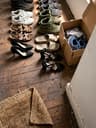
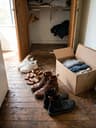
Build Low Labelled Cubbies So Kids Can Do It Themselves

Kids will not use a system built for adult height. A low cubby shelf, with openings about 8 inches tall, puts their shoes where their hands already are. Add a picture label or a name tag on each cubby — a photo of their own shoes works better than a written name for little ones — and suddenly tidying becomes a game they can win. Keep it to two pairs per cubby, school shoes and play shoes, and resist the urge to fill spare cubbies with outgrown pairs. The shelf lives right by the door, never in a bedroom, because the morning rush happens at the door. Parents who try this usually report the same thing: the pile shrinks, but more importantly, the 8 a.m. shoe hunt mostly stops.
Hide Shoes in Bench Drawers When You Want a Clean Look

Some people just hate looking at shoes, even tidy ones. A bench with pull-out drawers underneath gives you the sit-down spot and a completely clean front when the drawers shut. Shoes lie in rows inside, pairs together, and the entryway reads as a hallway instead of a shoe store. Drawers beat lidded boxes here because they pull toward you — no lifting a lid with full hands. The trade-off is real, though: drawers are slower than open cubbies, so keep only the daily pairs here and put the rest in the closet. This is the same hidden-storage thinking behind our hidden storage ideas, applied to the one spot every visitor sees first. If the drawer starts jamming, it is overfull, not broken.
The seasonal swap
Twice a year, spend twenty minutes swapping the door setup: winter boots and wellies in, sandals and light trainers out, and the reverse in spring. The pairs that leave go into labelled boxes on a closet shelf, not into a bag on the floor. A door setup sized for one season is half the size of one sized for all four.
Move Off-Season Pairs Into Clear Stackable Boxes

The fastest way to halve the door pile is to evict the shoes that do not belong to this season. Clear stackable boxes with drop-front lids are ideal for the closet shelf: you can see what is inside, pull one pair out without unstacking the tower, and the boxes protect good shoes from dust. One pair per box, no exceptions — cramming two pairs in is how boxes crack and shoes crease. Heels, dress boots, and the hiking boots you wear twice a year all belong here. Keep the boxes out of the entryway itself, though. The door only holds this week's shoes, and the boxes are the reason it can. When the season turns, swap the contents in one go, and the door never has to grow to fit everything you own.
Slide a Slim Rolling Cart Into the Gap Nobody Uses

Most entryways have a dead gap: between the door frame and the wall, beside the radiator, or at the end of a short hallway. A slim rolling cart, about 6 inches wide with two or three tiers, turns that gap into shoe storage that pulls out when you need it and vanishes when you do not. Slippers and sandals fit the top tier, sneakers the middle, and the bottom holds the pair you grab for the garden. Because it rolls, cleaning behind it takes ten seconds, which is more than can be said for most fixed racks. This trick is a favourite in tiny flats, and it sits nicely alongside our small apartment storage ideas if the rest of your place is tight too. Measure the gap twice — carts look slimmer online than they are in real life.
Tuck a Low Rack Under the Console Table

If you already have a console table by the door, look underneath it. That empty space is usually tall enough for a low two-tier rack, and it puts shoes exactly where you stand to drop your keys. The table top handles the small stuff — keys, post, sunglasses — while the rack below handles the shoes, so one piece of furniture runs the whole arrival routine. Keep the rack a couple of inches narrower than the table on each side so it reads as intentional, not shoved in. Two tiers hold four to six pairs, which is the daily rotation for most households. The best part is the price: a simple metal rack costs less than the console table it lives under, and it needs no drilling, no assembly drama, and no hallway remodel.
Finish With a Landing Zone and a One-In, One-Out Rule

The last idea is not furniture at all. A landing zone is the whole routine in one spot: hooks for coats and bags, the tray or cubbies for shoes, and a small basket for the off-season overflow that is waiting to go back to the closet. Set it up once, then protect it with a single rule — one pair in, one pair out. New trainers arrive, old ones leave the door that same day, either to the closet box or out of the house entirely. Tie a two-minute tidy to something you already do, like the Sunday reset in our cleaning routine checklist, and the zone holds. Without the rule, even the nicest bench fills up in a month. With it, the door stays the calm first thing you see when you come home, instead of the first chore.
A calm front door is not about owning fewer shoes. It is about the pairs you actually wear having a spot that is easier than the floor, and everything else living somewhere it belongs. Start with the tray tonight, add the bench or the cabinet when the tray proves the habit, and let the one-in, one-out rule do the quiet maintenance.
Pick the idea that fits your hallway, not the one that looks best in a photo. The right one is the one your household will still be using in three months, on a wet Tuesday, with their hands full. That is the whole test, and it is the only one that matters.
Front Door Shoe Organization FAQs
Expert answers & styling advice
How many pairs of shoes should live by the front door? ▼
Two pairs per person is the sweet spot for most households: the everyday pair and one backup for weather or work. Anything beyond that belongs in a bedroom closet or a seasonal box. If your tray or bench is always full, the answer is almost never bigger storage — it is fewer pairs at the door.
What is the best shoe storage for a very narrow hallway? ▼
A slim tilt-out cabinet or low wall shelves, because both use depth of under 8 inches and keep the walkway clear. Over-the-door pockets are the next best option since they use no floor at all. Skip freestanding racks in narrow halls — they narrow the walkway and get bumped every day.
How do I stop wet shoes ruining the entryway floor? ▼
Use a separate rubber boot tray with a raised grid, parked closest to the door, and make it the only landing spot for wet shoes. The grid holds shoes above the water so they dry, and the lip contains the mud. Empty and rinse the tray once a week, and keep an old towel nearby in winter.
Where do tall boots go in a front door setup? ▼
Tall boots rarely fit cubbies, cabinets, or door pockets, so give them their own spot: a tall boot tray by the door, or a pair of boot clips hung on a sturdy hook. Store them upright with a rolled newspaper or a boot shaper inside so they do not flop and crease at the ankle.
How do I get kids to actually put their shoes away? ▼
Make the system kid-sized and kid-obvious: low cubbies at their height, a picture label on their spot, and only two pairs to manage. Praise the habit for the first two weeks rather than policing it, and keep the cubby by the door, not in their bedroom, so the routine happens where the shoes come off.