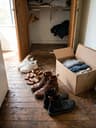
15 Shoe Organization Ideas for Small Closets

Fifteen fixes for the closet floor that eats shoes — count your pairs, use the door and the rod, box what you keep, and give off-season pairs a home on the top shelf.
Table of Contents (15 Ideas)
- 1.Count Every Pair Before You Buy Anything
- 2.Hang an Over-the-Door Organizer on the Closet Door
- 3.Stack Clear Boxes So You Can See Every Pair
- 4.Hang a Fabric Shelf Organizer From the Rod
- 5.Put a Low Two-Tier Rack Under Your Hanging Clothes
- 6.Squeeze a Tall Narrow Tower Into the Dead Gap
- 7.Hook Heels Over Cheap Tension Rods for a DIY Fix
- 8.Clip Tall Boots to Hangers on the Rod
- 9.Sort Shoes Into Labelled Bins by Person or Season
- 10.Stick Hooks on the Closet Wall for Heels and Flats
- 11.Spin a Turntable in a Deep Closet
- 12.Move Off-Season Shoes to the Top Shelf
- 13.Give Kids Their Own Low Bins
- 14.Angle Shoes on a Slanted Shelf So Nothing Hides
- 15.Do the Two-Minute Shoe Reset Every Sunday
Before you buy anything
You need a clear patch of bedroom floor, a bag for donations, and about twenty minutes. Pull every pair out first, count what you own, and only then measure the closet: floor width, door clearance, and the gap between the hanging clothes and the floor. Most shoe organizers fail for one boring reason — they were ordered a half-inch too wide or too tall for the space they were meant to fix.
Count Every Pair Before You Buy Anything

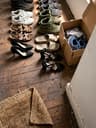
Pull all the shoes out of the closet and line them up in pairs on the bedroom floor. Count them honestly, and sort them into three piles: worn weekly, worn monthly, and not worn in a year. The weekly pile is your real collection, and it is usually half the size you expected. The monthly pile can live in boxes or on the top shelf. The untouched pile goes to donation today, while you are still in sorting mode, because those are the pairs eating your floor space. Once you know the true number, every later decision gets easier: a twelve-pair closet needs a rack, not a renovation. If the clothes side of the closet is just as crowded, our small closet organization ideas sort that half too.
Hang an Over-the-Door Organizer on the Closet Door

The back of the closet door is the biggest piece of unused space in a small closet, and an over-the-door organizer turns it into room for ten to twelve pairs. Clear pockets work best because you can see each pair without pulling anything out, and flats, sandals and lightweight trainers all sit happily in them. Heavy boots do not belong here — they stretch the pockets and drag the whole thing down. Hang it on the inside of the door so the closet still looks calm from the bedroom, and check that the door closes fully before you load it. A pocket that blocks the latch will drive you mad within a week. For more ways to use that same door, see our over-the-door storage ideas.
Stack Clear Boxes So You Can See Every Pair

Shoe boxes you cannot see through are just cardboard walls. Clear plastic boxes fix that: you spot the pair you want without opening three wrong boxes first, and the stack stays stable because every box is the same size. Keep the stack to three or four high so the bottom box still slides out easily, and put your most-worn pairs in the top two boxes. Boots and tall ankle boots usually need their own taller boxes, so measure your tallest pair before ordering a set. One box per pair sounds fussy, but it stops the classic small-closet problem where a pair at the bottom of a pile simply stops getting worn.
Hang a Fabric Shelf Organizer From the Rod

A fabric hanging organizer costs very little and uses the dead air under your hanging clothes. It hooks straight onto the closet rod, and each fabric cubby holds one or two pairs, which is perfect for trainers and everyday shoes that do not need a box. The bottom cubby usually ends up holding the pair you grab daily, because it sits right at hand height. One honest warning: soft cubbies sag if you overload them, so keep boots and heavy shoes out and let the rack or the floor handle those. In a shared closet, give each person their own column of cubbies and the morning argument about whose shoes are whose quietly disappears.
Put a Low Two-Tier Rack Under Your Hanging Clothes

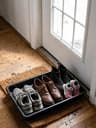
The strip of floor under hanging clothes is usually wasted on a loose pile, but it is exactly the right height for a low two-tier rack. Measure first: coats and long dresses hang lower than shirts, so the rack has to fit under your longest garment, not your shortest. Two tiers hold roughly six to eight pairs, which covers most people's weekly rotation on its own. Keep the everyday trainers on the bottom tier where you can kick them off straight onto it, and the smarter shoes up top where they stay clean. A wire rack beats a solid shelf here because dust and dirt fall through instead of building up under your shoes.
Three measurements that save a return
Write these down before you order anything: the floor width inside the closet, the height under your longest hanging garment, and the depth from the door to the back wall. A rack that is one inch too deep will stop the door closing, and a tower that is one inch too tall will not slide into its gap. Measure twice, order once.
Squeeze a Tall Narrow Tower Into the Dead Gap

Almost every bedroom has a dead gap: between the dresser and the wall, beside the closet frame, or at the end of a row of furniture. A tall, narrow shoe tower, about twelve inches wide, slides into that gap and holds seven or eight pairs without taking a single inch of closet floor. Heels go on the top shelves where they will not get knocked, trainers in the middle, and sandals at the bottom. Anchor it to the wall if you have kids or a wobbly floor, because a tall narrow tower tips more easily than a wide rack. This is the fix that surprises people most, because the gap was sitting there empty for years.

Hook Heels Over Cheap Tension Rods for a DIY Fix

This is the best shoe organization closet diy budget trick I know, and it costs less than a takeaway lunch. Fit two tension rods horizontally across a low closet nook, one above the other, and hook heeled shoes over them by their heels. The shoes hang in a neat row, visible at a glance, and the floor underneath stays free for flats and sandals. Tension rods need a snug fit to hold, so measure the gap and buy rods that extend a little past it, then twist them tight and test with your heaviest pair before loading the rest. No drilling, no damage, and a renter can take the whole thing down in two minutes on moving day.
Clip Tall Boots to Hangers on the Rod

Tall boots are the hardest shoes to store in a small closet because they flop over, crease, and eat floor space in pairs. Clip hangers solve all three problems at once. Clip each boot by its top edge to a sturdy hanger, or use a pair of boot clips on one hanger, and hang them from the rod like clothes. They keep their shape, they stay visible, and the floor underneath is free again for a rack or boxes. This works best for boots you wear weekly in winter; boots you wear twice a year belong in the top-shelf box from idea twelve instead. Check the clips grip firmly before you walk away, because a boot sliding off a clip at midnight is a startling noise.
Sort Shoes Into Labelled Bins by Person or Season

When a closet holds shoes for two people, or for four seasons, bins beat open shelves for one simple reason: you only open the bin you need. Use one woven or fabric bin per person, or per season, and tag it with a plain paper tag tied to the handle. Work shoes in one, weekend shoes in another, and the whole bin slides out when you need it and slides back when you do not. This is also the kindest system for a shoe organization closet small space setup shared with a partner, because nobody has to negotiate shelf territory — your bin is yours, and the boundary is obvious. Keep the bins on a low shelf, not the floor, so you are not dragging them across carpet every morning.
Stick Hooks on the Closet Wall for Heels and Flats

The side wall of a closet is usually blank paint, and a row of small adhesive hooks turns it into shoe storage without a single screw. Hang heeled shoes by their heel loop or strap, one hook per pair, spaced about six inches apart so the shoes do not knock each other. Flats hang by their heel tab too, though they sit flatter against the wall. This is a renter-friendly move: good adhesive hooks peel off cleanly when you leave, and they cost a few dollars for a pack. Put your prettiest pairs here if you like, because a wall of heels looks surprisingly good, but keep the everyday trainers on the rack — hooks are for pairs you grab a few times a week, not ten times a day.
The one-in, one-out rule
A small closet has a fixed number of shoe homes, and that number is your limit. When a new pair comes in, an old pair leaves the same week — donation bag by the door, not a vague plan to deal with it later. Without this rule, every idea in this article slowly fills up again. With it, the closet stays at the size you actually organized.
Spin a Turntable in a Deep Closet

Deep closets have a specific cruelty: the pairs at the back might as well not exist, because reaching them means moving everything in front. A large turntable on a low shelf fixes that with one spin. Arrange pairs in a circle, spin to the pair you want, and pull it straight out without disturbing the rest. This works best on a sturdy low shelf, not on the floor, where the turntable wobbles on carpet. Keep it to one layer of shoes — stacking on a turntable is how pairs end up on the floor. If your closet is deep and narrow rather than wide, a turntable at the back and a rack at the front make a surprisingly good team.
Move Off-Season Shoes to the Top Shelf

Winter boots do not need prime closet real estate in July, and sandals do not need it in January. Once a season, move the out-of-season pairs into one lidded box on the top shelf, where they are out of the way but still easy to swap back. Label the box by season, not by shoe type, so the swap takes ten minutes: winter box down, summer box up, done. If the top shelf is already full, the same box can live under the bed instead — our under-bed storage ideas cover that spot properly. The point is the same either way: only the shoes for this season get the easy-to-reach homes, and everything else waits its turn upstairs.
Give Kids Their Own Low Bins

Kids' shoes are small, numerous, and always in the wrong place, which is why they deserve their own system rather than a corner of yours. Put two low fabric bins on a shelf at their height: one for everyday sneakers, one for boots and wellies. No lids, no boxes to open, just toss the pair in when they come home. The rule that makes it stick is simple — shoes live in the bin, not on the floor beside the bin — and it works better if the bin is low enough that a small child can actually reach it without help. One stray shoe on the floor is not failure; it is a Tuesday. The system works if the bin is where most of the shoes end up, most of the time.
Angle Shoes on a Slanted Shelf So Nothing Hides

On a flat shelf, you see the toe of the front pair and guess at the rest. On a slanted shelf, every pair tilts up toward you, so you can see each shoe at a glance and grab the right one without pulling the row apart. You can buy a slanted insert for an existing shelf, or tilt a shallow tray against the back wall if the shelf is deep enough. This suits dress shoes and loafers best, because they hold their shape on a slope, while soft trainers tend to slide. Keep one slanted shelf for the smarter pairs you choose carefully in the morning, and let the rack handle the trainers you grab half asleep.
Do the Two-Minute Shoe Reset Every Sunday

No shoe system survives a real week without a tiny bit of upkeep, but upkeep only works if it is short enough to actually happen. Every Sunday, while the kettle boils, give the closet two minutes: pairs back in their homes, one stray shoe returned to its partner, and anything new that crept in either given a home or put in the donation bag. That is the whole job. Tie it to something you already do, like Sunday laundry or the weekly shop, so you do not have to remember it separately. Skip a week and nothing collapses. Skip a month and the floor pile is back, so keep it small, keep it weekly, and let the system do the rest. If the wardrobe around the closet needs the same treatment, our wardrobe reset guide pairs well with this habit.
A small closet does not need more space. It needs fewer pairs on the floor and a home for each pair that stays — the door for flats, the rod for boots, a rack for trainers, and a box on the top shelf for everything out of season.
Start with the count, pick the two or three ideas that fit your closet's actual measurements, and give the Sunday reset a month to prove itself. The first morning you open the door and reach straight for the pair you wanted, without moving anything else, you will know the system is working.
Shoe Organization FAQs
Expert answers & styling advice
How many pairs of shoes should a small closet hold? ▼
Most small closets work well with twelve to sixteen pairs in easy reach, plus one box of off-season pairs up high. If you have more than twenty pairs competing for the floor, something has to move: either the off-season pairs go to the top shelf, or the unworn pairs go to donation. The closet is not failing you — it just has a fixed number of homes, and the count has to fit them.
What is the best shoe storage for a tiny closet with no floor space? ▼
Use the surfaces that are not the floor: an over-the-door organizer for flats and sandals, a hanging shelf organizer from the rod for trainers, and adhesive hooks on the side wall for heels. Together those three hold around twenty light pairs without touching the floor at all, which is why they are the first fixes to try in a truly tiny closet.
How do I store boots in a small closet without them flopping over? ▼
Hang tall boots from clip hangers on the rod so they keep their shape and stay off the floor. Short boots and ankle boots do better standing in a box or on a low rack, with a rolled magazine or a boot shaper inside each one if they still slump. Never stack boots flat in a pile — that is how creases and crushed toes happen.
Can I organize shoes in a small closet on a tight budget? ▼
Yes, and the cheapest fixes are often the best. Tension rods for heels cost a few dollars, adhesive wall hooks cost less, and the pair count from idea one costs nothing at all. Spend money only after the count, on the one organizer that fits your biggest gap — usually the door organizer or a low rack — and skip the rest until you have lived with the setup for a month.
How do I keep a shoe closet tidy once it is organized? ▼
Keep the one-in, one-out rule and the two-minute Sunday reset. New pair in means an old pair out the same week, and Sunday means every pair back in its home before the week starts. Those two habits matter more than any organizer, because a closet without them quietly refills no matter how good the first setup was.