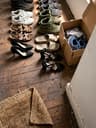
19 Shoe Organization Ideas for Small Spaces

Nineteen fixes for the shoe pile by the door — a ruthless audit first, then over-the-door racks, under-bed bins, slim cabinets, baskets and a seasonal rotation that keeps small entryways walkable.
Table of Contents (19 Ideas)
- 1.Start With a Shoe Audit: Line Them All Up and Be Honest
- 2.Hang an Over-the-Door Organizer on the Bedroom Door
- 3.Roll a Slim Bin Under the Bed for Off-Season Pairs
- 4.Put a Bench With Cubbies Where Shoes Come Off
- 5.Stack Clear Shoe Boxes So You Can See Without Opening
- 6.Squeeze a Tall Narrow Rack Into the Closet Corner
- 7.Mount Short Wall Shelves and Treat Shoes Like a Display
- 8.Hide Everything in a Slim Tilt-Out Shoe Cabinet
- 9.Give Each Person One Basket by the Door
- 10.Park Wet Shoes on a Boot Tray and Stop the Mud
- 11.Hang a Fabric Shoe Shelf From the Closet Rod
- 12.Claim the Under-Stair Space With Pull-Out Drawers
- 13.Double Your Shelf Space With Shoe Stacker Slots
- 14.Stash Slippers and Casual Pairs Inside a Storage Ottoman
- 15.Build a Crate Shelf in an Afternoon for Almost Nothing
- 16.Set Up a Low Kids Station They Can Actually Use
- 17.Turn One Entryway Wall Into Hooks Plus a Shoe Shelf
- 18.Fit a Wire Rack Inside the Closet Door
- 19.Run a Seasonal Rotation So Only This Season Lives Out
There is a particular kind of chaos that lives by the front door. You come home, kick your shoes off, and by Friday there are fourteen pairs in a drift across the hallway and nobody can find the left trainer. It is not that you own too many shoes, necessarily. It is that none of them has a proper home.
These 19 ideas for shoe organization for small spaces are the fixes I would try in order, starting with the honest clear-out and ending with the rotation system that stops the pile rebuilding itself. Most cost very little, and several need no drilling at all.
Start with idea one, even if you are tempted to skip straight to the shopping. Every rack and basket in this list works twice as well once the shoes you never wear are out of the way.
Before you buy anything
Do the audit in idea one first, then count what is left. That count tells you what to buy: under ten pairs, a basket or two will do; over twenty, you need a rack plus a rotation system. Measure first — a rack one inch too wide blocks the door.
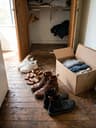
Start With a Shoe Audit: Line Them All Up and Be Honest

Get every pair out of every corner — the hallway, the closet floor, the back of the car, the pile by the bed — and line them up where you can see them all at once. Now be blunt. Shoes that hurt, shoes you have not worn in a year, the single lonely trainer whose partner vanished in 2023: they go. Donate the good ones, bin the broken ones. Most small homes lose a third of the pile here, and suddenly the storage problem shrinks with it. Keep a realistic daily rotation: two everyday pairs, one smart pair, one pair for sport or bad weather, plus seasonal boots. That number is your storage target.
Hang an Over-the-Door Organizer on the Bedroom Door

The back of a door is storage you already own and never use. A clear-pocket organizer hooked over a bedroom or closet door holds twelve to twenty-four pairs depending on size, costs very little, and needs no screws — which makes it a renter's best friend. Put everyday shoes at hand height and the rarely worn pairs up top. Clear pockets beat fabric ones here because you can actually see what is where instead of patting twenty pockets every morning. Skip heavy boots here — they stretch the pockets out of shape. If your door is already doing this job for other things, our over-the-door storage ideas show what else that surface can hold.
Roll a Slim Bin Under the Bed for Off-Season Pairs

Under the bed is the biggest flat storage surface in most small bedrooms, and it is usually wasted on dust. A low wheeled bin, about six inches tall, slides under most bed frames and swallows the pairs you do not need this season — winter boots in summer, sandals in winter. Wheels matter more than you would think: a bin you have to drag out by its handle will stay buried, while one that rolls out with one pull actually gets used. Label the end that faces out, not the top, because the top is the part you will never see. One bin per person is plenty.
Put a Bench With Cubbies Where Shoes Come Off

People take their shoes off where they stand, not where the storage is. So put the storage exactly there. A small bench with open cubbies underneath does two jobs at once: somewhere to sit while you lace up, and a cubby per person for the pairs in daily rotation. Open cubbies beat doors here, because nobody in a hurry opens a door — they just drop them. Keep it to one or two pairs per cubby or the cubby becomes a cave. If the bench is doing hallway duty in a tight flat, our small apartment storage ideas have more entryway-sized furniture that earns its floor space.
Stack Clear Shoe Boxes So You Can See Without Opening

Opaque boxes are where shoes go to be forgotten. Clear boxes fix that: you spot the pair you want through the front, pull one box out, and the stack stays standing. Stack them no more than four high, because five high is a tower that topples when you tug the bottom box. Keep the pairs you wear weekly in the boxes and the daily pairs out on the rack or bench — boxes are for storage, not for the shoes you grab half asleep. This is the tidiest answer for a closet shelf that currently holds a sliding pile.
Three measurements that save a return
Write these down before you order anything: your entryway width, the gap under your bed, and your closet shelf height. A slim cabinet needs about 6 inches of depth, an under-bed bin needs 6 inches of clearance, and a tall rack needs a shelf it can actually stand under. Most shoe storage returns happen because one of these three was guessed.
Squeeze a Tall Narrow Rack Into the Closet Corner

Every closet has a dead corner where hangers cannot reach and nothing fits — except a tall, narrow shoe rack, which was practically invented for that spot. A ten-tier rack about twelve inches wide holds ten to twenty pairs in a footprint smaller than a floor mat. Put the heaviest boots at the bottom so the rack cannot tip, and the lightest flats up top. Measure the corner first — rack widths differ by just enough to matter. If your closet is genuinely tiny rather than just awkward, our small closet organization ideas sort the whole space, not just the shoes.
Mount Short Wall Shelves and Treat Shoes Like a Display

If floor space is gone, go up the wall. Two or three short shelves in a hallway hold the pairs you actually love, and they double as decoration — a row of clean trainers on a wooden shelf looks intentional in a way a pile never will. Mount them at staggered heights so taller boots fit under the higher shelf. Keep this for six to eight pairs maximum, the ones you reach for most, and let the rest live in closed storage. Add a small lip to the shelf edge, or shoes slide off when the door slams. This one suits renters too if you use the sturdier adhesive strips rated for the weight, though screws into a stud are always safer.
Hide Everything in a Slim Tilt-Out Shoe Cabinet

Some people do not want to see shoes at all, and for them the slim tilt-out cabinet is the answer. It is only about six inches deep, so it fits hallways where a normal cabinet would block the walkway, and each tilted drawer holds shoes upright in rows. One cabinet holds eight to twelve pairs depending on size, and from the front it looks like a plain console table. Measure your bulkiest pair before buying — chunky boots can be too tall for the shallow drawers, and that is the one complaint people have about these cabinets.
Give Each Person One Basket by the Door

The simplest system in this whole list is also the one families stick to longest: one basket per person, right by the door, no lids, no sorting rules. Shoes go in the basket. That is the entire system. When a basket overflows, its owner knows instantly they have too many pairs in rotation — the basket is its own audit. Woven baskets look softer than plastic bins and survive being kicked, which matters because they will be kicked daily. If your household has more than four people, two baskets per pair of people works just as well.
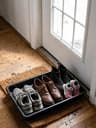
Park Wet Shoes on a Boot Tray and Stop the Mud

Half the mess by the door is not shoes at all — it is what shoes bring in. A boot tray with a raised lip catches rain, snow and mud before they reach your floor, and it gives wet pairs a defined place to dry instead of a spreading puddle. Size it for your household's wet-weather pairs, not for every shoe you own, and wipe it out once a week or it starts smelling like a swamp. This is a five-minute, few-dollar fix, and it is the one guests notice first, because a dry entryway feels cared for in a way no rack can fake.
Hang a Fabric Shoe Shelf From the Closet Rod

A hanging fabric shelf is the cheapest way to turn wasted vertical closet space into shoe storage. It clips over the rod in seconds, gives you six to ten cubbies, and folds flat when you move — a genuine plus for renters. Shoes sit one pair per cubby, which stops the sliding pile problem cold. It works best for soft shoes: trainers, flats and sandals. Heavy boots will bow the shelves, so keep those on the floor. Hang it at the end of the rod rather than the middle, where it blocks the least hanging space, and keep the cubbies you use daily at waist height so you are not crouching every morning.
Claim the Under-Stair Space With Pull-Out Drawers

The triangle under the stairs is awkward for almost everything except shoes, which are small, flat-ish and happy in shallow drawers. Pull-out drawers built into that space turn dead square footage into storage for fifteen to twenty pairs, and because the drawers close, the hallway still looks clean. This suits owners more than renters, since it takes fitting. If you rent, a low rolling cart tucked under the lowest stair step gives you a smaller version of the same idea with zero fitting. Either way, measure the height at the back of the triangle, because that is where tall boots will not fit.
Double Your Shelf Space With Shoe Stacker Slots

A shoe stacker is a small plastic slot that lets one shoe sit above its partner, so each pair takes up the footprint of a single shoe. On a normal closet shelf that doubles your capacity overnight, with no new furniture and no drilling. They work best for flat shoes — trainers, loafers, flats — and less well for ankle boots, which are too tall to stack neatly. Buy one pack and test them on your bulkiest pair before committing to a whole shelf, because some chunky trainers are too wide for standard slots. For about the price of a coffee per pack, this is the highest return per dollar in shoe organization small space fixes.
Renting? Start here
No-drill winners from this list: the over-the-door organizer, the under-bed bin, the baskets, the boot tray and the hanging closet shelf. All five leave zero marks when you move out. If you want more renter-safe ideas for the rest of the flat, our renter-friendly storage ideas cover the rooms beyond the entryway.
Stash Slippers and Casual Pairs Inside a Storage Ottoman

A storage ottoman is furniture that secretly holds shoes. In a small living room it works as a footrest, an extra seat and a home for the slippers and casual pairs that otherwise migrate to the sofa cushions. Keep it to the soft, light pairs — slippers, house shoes, a pair of canvas trainers — because heavy boots will wear the hinges and make the lid awkward to lift. One ottoman by the sofa handles the pairs you kick off while watching television, which is a surprisingly large share of the daily drift. Empty it during the audit in idea one, or it quietly becomes the new junk drawer with laces.
Build a Crate Shelf in an Afternoon for Almost Nothing

This is the shoe organization small space diy answer for anyone who would rather build than buy: stack wooden crates on their sides, screw them together if you want them stable, and you have a shoe shelf sized exactly to your wall. Paint them or leave them raw — mismatched paint looks charming here in a way it never does on a bought unit. Two crates wide and three high holds about twelve pairs, and you can add another row later without replacing anything. Sand the edges first, because rough crate wood snags socks and tights. Total cost is usually less than one bought rack, and the whole thing comes apart flat when you move.
Set Up a Low Kids Station They Can Actually Use

Kids do not use shoe storage built for adults, so build theirs at their height. Low open bins, no lids, on the floor by the door: shoes go in, shoes come out, and nobody has to ask for help. One bin per child beats one big shared bin, because a shared bin becomes a lucky dip and mornings get longer. A small picture on each bin helps children who cannot read yet — a drawing of a trainer, a boot, a sandal. Keep the station to the pairs they wear this week; the rest lives in the closet rotation from idea nineteen. If the kids' pile is only part of a bigger hallway problem, a full bedroom declutter checklist helps clear the rooms the shoes spill into.
Turn One Entryway Wall Into Hooks Plus a Shoe Shelf

In a shoe organization small entryway, one wall has to do everything: coats, bags, keys and shoes. A row of peg hooks up top with a single narrow shelf below covers all four in about twelve inches of depth. Bags and coats hang, keys go in a small bowl on the shelf, and three or four pairs line up underneath. The discipline here is the hook count — five hooks means five things hanging, and the sixth thing is the one that ends up on the floor. This is the best fix for entryways too narrow for a bench, because it uses wall space your feet never needed.
Fit a Wire Rack Inside the Closet Door

If the bedroom door is already taken, the inside of the closet door is the next free surface. A slim wire rack screwed or hooked onto it holds six to ten pairs of flats and trainers without touching a single shelf. Check the clearance before you fit it: the rack needs about two inches of depth so the door still closes over the clothes hanging inside, and the shoes must not snag sleeves every time you reach in. Keep the heaviest pairs at the bottom of the rack so the door swings normally. This pairs beautifully with idea eleven — the hanging shelf holds the bulk, the door rack holds the daily pairs at eye level.
Run a Seasonal Rotation So Only This Season Lives Out

The system that keeps everything else working is the simplest: only the current season's shoes live in the entryway and closet, and everything else lives in labelled bins on the top shelf or under the bed. Twice a year — when the weather genuinely turns, not on a calendar date — you swap them. Out-of-season pairs get cleaned before they go away, because mud stored for six months becomes a stain. This is what stops a good system sliding back into a pile: the entryway only ever holds what this weather needs, so it can never hold more than it was designed for.
A calm entryway is not really about the perfect rack. It is about coming home, putting your shoes where they belong without thinking, and finding them in the same place tomorrow morning.
Do the audit, give every surviving pair one home, and let the rotation do the remembering. Start with the pile by the door tonight.
Shoe Organization FAQs
Expert answers & styling advice
How many pairs of shoes should I keep in a small space? ▼
Most people in a small home are comfortable with eight to twelve pairs in active rotation: two everyday pairs, one smart pair, one for sport or bad weather, seasonal boots or sandals, and a couple of favourites. Everything beyond that should live in off-season bins or leave the house.
What is the best shoe storage for a rental with no drilling? ▼
Over-the-door organizers, under-bed bins, baskets, boot trays and hanging closet shelves all need zero holes and leave zero marks. A slim tilt-out cabinet also works if you have the floor space, since it stands on its own.
How do I stop shoes smelling in closed storage? ▼
Never box a pair that is still damp — let shoes air for a few hours after wearing, especially trainers. A sprinkle of baking soda left overnight and shaken out in the morning handles most odour, and cedar blocks or charcoal bags in closed boxes help between wears.
Should I store boots upright or lying down? ▼
Upright is better for the boot, because lying flat creases the shaft over time. Tall boots do well standing in a boot tray or a deep bin with rolled magazines or pool noodles inside to hold their shape. Short ankle boots are fine on a rack or in a clear box.
How often should I redo the shoe audit? ▼
Twice a year, at the seasonal swap in idea nineteen, is enough for most homes. Count pairs on the way back in, donate anything that did not get worn last season, and check that every pair still has a home.