15 Under-Bed Storage Ideas for Small Bedrooms


Fifteen ways to turn the dusty space under your bed into real storage — rolling bins, vacuum bags, a shoe tray and a guest blanket kit — sized for small bedrooms.
Table of Contents (15 Ideas)
- 1.Measure the Clearance and Empty It Out First
- 2.Roll In Low Rolling Bins
- 3.Stack Clear Drawers You Can See Into
- 4.Flatten Off-Season Clothes in Vacuum Bags
- 5.Slide Shoes Out on a Rolling Tray
- 6.Tuck Extra Linens in Flat Fabric Cases
- 7.Divide Small Things So They Stop Wandering
- 8.Label the End of Every Bin
- 9.Keep a Guest Blanket Bin Ready to Pull Out
- 10.Store Gift Wrap in a Slim Long Organizer
- 11.Gain Real Height With Bed Risers
- 12.Keep Books in a Low Basket, Not a Pile
- 13.Give Kids a Rolling Crate They Can Reach
- 14.Protect Keepsakes in Lidded Boxes
- 15.Do a Seasonal Swap and a Five-Minute Reset
The space under your bed is probably the biggest storage spot in your bedroom — and for most of us, the messiest. Shoes that lost their partner. A sweater from two winters ago. Dust you do not want to think about.
In a small bedroom, that space is too valuable to waste. A twin bed hides roughly 10 square feet under it, a queen closer to 18. That is a closet floor's worth of storage, already in your room, already paid for. The catch is the height: most beds give you only 5 to 12 inches to work with, so normal bins and boxes simply do not fit.
These 15 under-bed storage ideas are built for that low, dark, dusty reality. They start with measuring, they favor things that roll or slide, and they work whether you have a closet the size of a phone booth or no closet at all — if that is you, start with our bedroom ideas with no closet next.
 Save Pin
What you'll need
Most of these ideas run on a few workhorses: low rolling bins, vacuum storage bags, a rolling shoe tray and flat fabric linen cases. Measure your clearance first — height, width between the legs, depth — then buy once. Everything else on this list is a variation on those four.
Measure the Clearance and Empty It Out First

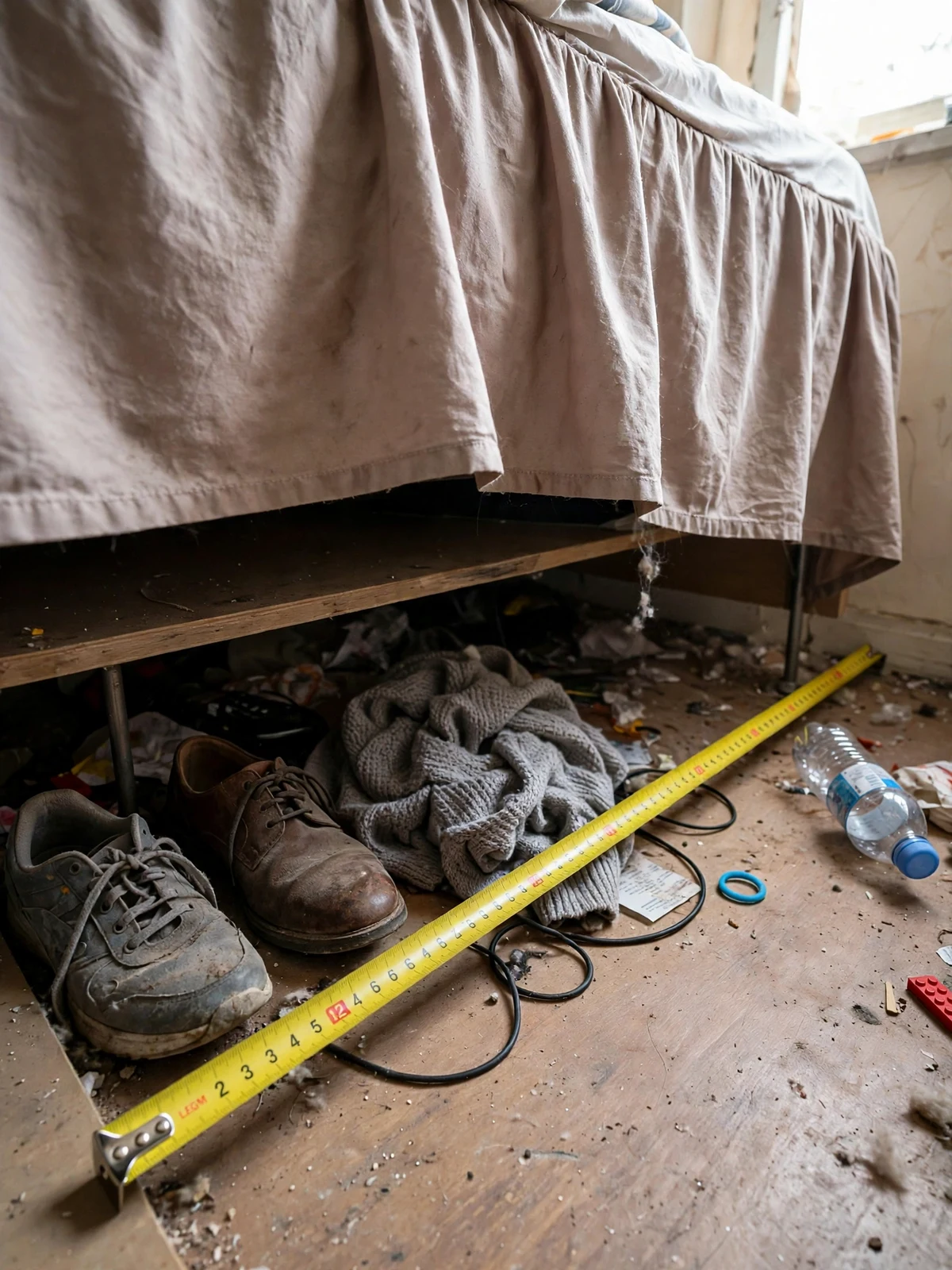
Start here, before you buy a single bin. Pull everything out from under the bed — yes, even the stuff shoved at the far back you cannot reach without lying on the floor. Then measure the clearance: floor to the bottom of the frame or slats. Most standard frames give you 5 to 7 inches, low platform beds give you as little as 3, and some frames give you a full 12. Write down the height, the width between the legs, and the depth. I have wasted money twice on bins that were half an inch too tall. Half an inch. They scraped, stuck, and ended up in a closet instead. Four minutes with a tape measure saves you all of that.
Roll In Low Rolling Bins

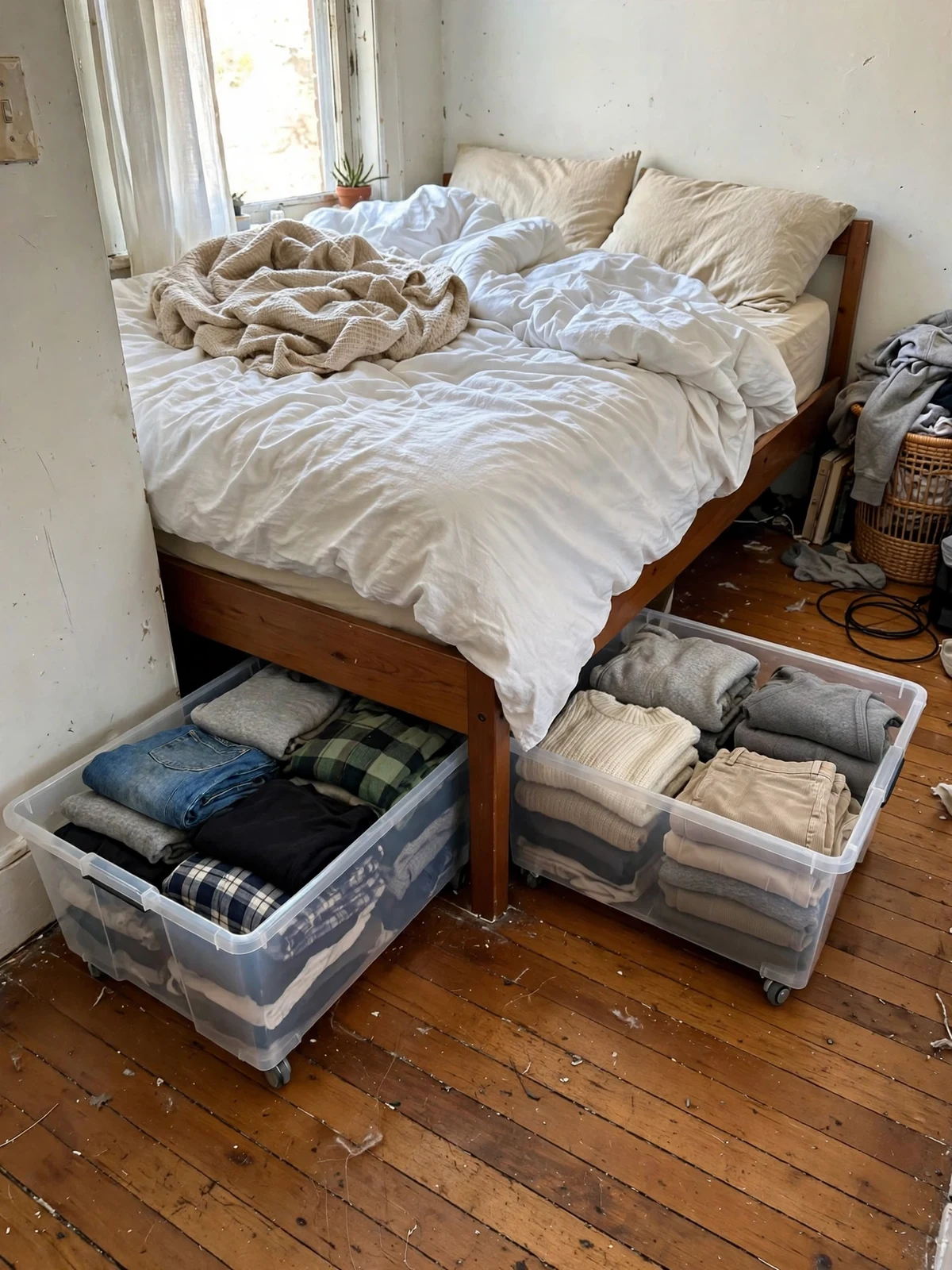
If you only add one thing, make it low rolling bins. The wheels change everything. Instead of dragging a heavy box across the floor and scratching it up, you give it a nudge and it glides out. Look for bins under 6 inches tall if your clearance is tight, with a lid if dust is a problem — and under a bed, dust is always a problem. The rolling under-bed bin style with four small casters and a clear lid runs about $18 to $28 for a two-pack. Use one side of the bed for clothes, the other for whatever your closet will not take. Label the end that faces out, not the top.
Stack Clear Drawers You Can See Into

Opaque boxes under a bed become mystery boxes. You forget them, then you buy a second version of something you already own. Stackable clear drawers fix that because you can see the contents without opening a thing. The low, wide drawer shape fits a folded stack of t-shirts perfectly, and two short stacks side by side beat one tall stack you have to dig through. Keep everyday items in the front drawer and rarely used things behind it. If you share the room, give each person one drawer — it ends the morning argument about whose side is whose, at least under the bed.
Flatten Off-Season Clothes in Vacuum Bags

Bulky sweaters and winter coats eat closet space for eight months a year. Vacuum storage bags shrink them to a flat slab about 2 to 3 inches thick, which is exactly the shape under-bed space wants. Pack a bag, seal it, vacuum the air out, and slide it to the far back — this is long-term storage, not weekly storage. One honest warning: do not vacuum-compress delicate knits or anything with structure for a full season, they can come out creased and tired. For sturdy sweaters, hoodies and kids clothes they have outgrown but you are saving, the bags are hard to beat at roughly $15 for a pack of four.
Slide Shoes Out on a Rolling Tray

Loose shoes under a bed turn into a dusty pile where you can only ever find one of each pair. A rolling shoe tray — basically a low board or frame on wheels — keeps pairs together and brings all of them out at once. It works best for the shoes you wear weekly but do not want in the doorway: gym shoes, work flats, the boots that do not fit the closet rack. If your clearance is under 5 inches, skip heels on the tray; they will catch. A simple tray costs $20 to $35, and a piece of plywood on small casters does the same job for less if you are handy.
Tuck Extra Linens in Flat Fabric Cases

Spare sheets and pillowcases are the perfect under-bed tenants: flat, light, and only needed once a week. Flat fabric linen cases with zippers keep a full set together, so you are not hunting for a pillowcase at 10 p.m. Store one complete set per case — sheet, duvet cover, pillowcases — and changing the bed becomes a one-trip job. Fabric beats hard plastic here because it gives a little when you slide it in, and it does not scrape the floor. Tuck a dryer sheet in each case if you like that fresh smell, and skip this spot for damp or not-quite-dry linens. They need air, not a zipper.
Start here if you buy one thing
If you buy one thing, make it low rolling bins. Wheels turn a space you avoid into a drawer you use daily. Pair them with vacuum storage bags at the far back for off-season clothes and you have covered most of what under-bed storage needs to do.
Divide Small Things So They Stop Wandering

Belts, scarves, gloves, chargers, spare buttons — small things slide around a big bin until they form one tangled layer at the bottom. A shallow box with adjustable dividers gives each category a lane. Move the dividers to fit what you actually own instead of forcing your stuff into fixed compartments. This is also the right home for the odd things small bedrooms never have a drawer for. If your drawers are already bursting, our dresser drawer organization ideas will help you decide what moves under the bed and what stays up top.
Label the End of Every Bin

Here is a boring idea that saves you every single week: label the end of each bin, the short side that faces the room. Not the top — you cannot read the top without pulling the bin out, which defeats the whole point. A strip of masking tape and a marker is enough. Winter boots. Guest sheets. Kids clothes size 6. When my labels fell off one winter, I opened four bins looking for gloves. Four. It took longer than the walk the gloves were for. Big, plain labels also help anyone else in the house put things back in the right bin without asking you, which is the quiet secret of any system that lasts.
Keep a Guest Blanket Bin Ready to Pull Out

Small bedrooms rarely have a linen closet, and guests rarely give you much notice. Dedicate one low bin to the guest kit: a washed blanket, a spare pillow if it fits, and a clean set of sheets. When someone stays over, you pull out one bin instead of tearing the room apart. Wash everything after they leave, fold it straight back into the bin, and you are done. A soft fabric guest blanket bin works well because blankets compress a little, and the bin stays light enough to slide one-handed. It is a small kindness to future you, who will be tired when that text — can I crash tonight? — comes in.
Store Gift Wrap in a Slim Long Organizer

Rolls of wrapping paper are an awkward shape for every closet ever built. They are, however, the exact length of the space under a bed. A slim gift wrap organizer, usually around 40 inches long and only 4 to 5 inches tall, holds six to eight rolls plus bags, ribbon and tape in its side pockets. No more crushed rolls standing in a closet corner, no more buying a new roll because the old one is buried. Keep it on the side of the bed you can reach without moving furniture. If you wrap a lot at holidays, you will wonder why this lived anywhere else.
Gain Real Height With Bed Risers

Sometimes the problem is not the organizer, it is the 4 inches of clearance. Bed risers lift the whole frame by 3, 5 or even 8 inches, and that extra height turns a useless gap into a full second tier of storage. Sturdy wooden or heavy-duty plastic risers run about $15 to $30 for a set of four — check the weight rating, especially for a shared bed, and make sure the legs sit fully in the cups. The trade-off is real: the bed sits higher, which some people love and some people hate getting into at night. If you rent, risers are perfect because nothing is built in and nothing leaves a mark.
Keep Books in a Low Basket, Not a Pile

If your nightstand is really just a stack of books with a lamp balanced on top, move the backlist under the bed. A low woven basket or shallow crate keeps six to ten books upright and easy to flip through, and it slides out like a drawer. Paperbacks and magazines fit best; heavy hardcovers make the basket drag. Keep only the current rotation here — this is a reading shelf, not a library. When a book is finished, swap it out the same day, or the basket quietly becomes the pile it replaced. Small rooms survive on habits like that, not on furniture.
Low clearance? Read this first
Under 5 inches of clearance? Stick to vacuum storage bags and flat fabric linen cases — they flex where hard bins cannot. Want hard bins anyway? Bed risers add 3 to 8 inches and change what fits. Measure twice, buy once.
Give Kids a Rolling Crate They Can Reach

Kids will use storage they can reach and ignore storage they cannot. Shallow rolling crates under a low bed put toys at kid height: roll it out, play, roll it back. That last step is the whole system, and even a four-year-old can do it in about ten seconds. One crate for blocks, one for cars or dolls — two categories max, or cleanup turns into sorting and nobody finishes. Pick crates with smooth wheels if you have wood floors. This pairs well with a wider reset like our small apartment storage ideas if the whole place is feeling tight.
Protect Keepsakes in Lidded Boxes

Photos, letters, kids artwork, the good keepsakes — they deserve better than a grocery bag in a closet corner. Lidded archival boxes keep them flat, dark and dust-free, and under the bed is honestly a good spot: out of daily traffic, away from steamy bathrooms. Two rules matter more than the box you buy. First, keep keepsakes off the floor if your home has any flood or leak history — a low shelf in a closet is safer there. Second, label by person or year, not by vague words like memories, or you will open every box to find one photo. One box per person is a kind limit that also helps.
Do a Seasonal Swap and a Five-Minute Reset

Under-bed storage fails quietly. A bin gets shoved in wrong, a bag loses its seal, and by next season it is a dusty cave again. Twice a year, when you swap seasons, pull every bin out, vacuum the space (you will be horrified, everyone is), wipe the bins, and put back only what still earns the space. Five extra minutes, twice a year. That swap day is also when you find the missing shoe, the lost charger and the sweater you thought was gone. If you want a bigger reset to go with it, the 30-day declutter challenge is a gentle way to work through the rest of the room without burning out.
You do not need all 15 ideas. Pick the three that match what is actually under your bed right now — most people start with rolling bins, vacuum bags for the off-season pile, and labels on everything. That alone turns a dusty cave into storage you use every week.
The goal is not a photo-perfect space nobody sees. It is knowing, without lying on the floor with your phone flashlight on, exactly where the guest blanket is. Small bedrooms ask more of every inch, and the inches under your bed are the easiest ones to win back. When you are ready to tackle the closet itself, our small closet organization ideas pick up right where this list leaves off.
Under-Bed Storage FAQs
Expert answers & styling advice
How much clearance do I need for under-bed storage? ▼
Most under-bed bins need 6 to 7 inches, but plenty of options work lower: vacuum storage bags compress to 2 to 3 inches and flat fabric linen cases flex to fit around 4 to 5 inches. Measure floor to frame before buying, and if you have under 5 inches, consider bed risers to gain 3 to 8 inches.
How do I keep under-bed storage from getting dusty? ▼
Use lidded bins or zippered fabric cases for anything that stays longer than a few weeks, vacuum under the bed during your twice-yearly seasonal swap, and keep loose shoes on a rolling shoe tray instead of directly on the floor. Dust still happens — lids just keep it off your things instead of on them.
What should not be stored under a bed? ▼
Skip anything damp, anything you need daily at arm's reach from the bed itself, and important papers or photos if your home has any flood or leak history. Heavy hardcover books and very heavy bins are also a poor fit — they drag instead of sliding. Keepsakes do well in lidded archival boxes only in dry homes.
Are under-bed storage ideas renter-friendly? ▼
Yes, almost all of them. Rolling bins, vacuum bags, trays, fabric cases and bed risers need no drilling, no adhesive and no permanent change to the room. Everything slides in and moves out with you, which is more than can be said for the dust that was living there.