15 Decluttering Aesthetic Ideas for a Calm, Beautiful Home

Fifteen practical ideas that make a decluttered home look as calm as it feels — edited surfaces, matching storage, soft colours and deliberate empty space.
Table of Contents (15 Ideas)
- 1.Clear One Surface Completely
- 2.Switch to Uniform Storage
- 3.Edit Each Room to a Calm Colour Palette
- 4.Leave Deliberate Empty Space on Shelves
- 5.Colour-Order Your Closet with Matching Hangers
- 6.Decant the Pantry into Uniform Glass Jars
- 7.Reset the Bathroom Counter to a Single Tray
- 8.Build a One-Tray Entryway Landing Zone
- 9.Edit the Nightstand to Three Things
- 10.Style the Coffee Table with the Three-Object Rule
- 11.Make the Desk Cable-Free and Closed-Storage
- 12.Fold Linens and Towels into Matching Stacks
- 13.Give Every Category One Beautiful Basket
- 14.Create a Calm Pause Corner
- 15.Keep It Beautiful with a 10-Minute Weekly Reset
The difference between a decluttered room and a beautiful decluttered room is rarely money. It is editing. A shelf with three things on it looks intentional; the same shelf with twelve things on it looks like storage, even if every item is useful. The ideas below all work the same way: remove a little more than feels necessary, then give what is left a proper place and a little breathing room. Start with the surface that bothers you most. One clear shelf is often enough to make the whole room feel different.
The one rule behind all fifteen ideas
Before you style anything, finish the decluttering first. No amount of matching baskets will save a shelf that is still holding things you do not use. Work in this order every time: remove, then arrange, then admire. If you are starting from a genuinely cluttered room, our guide on how to declutter your home room by room walks through the removal half step by step — come back here once the bags are out the door.
Clear One Surface Completely

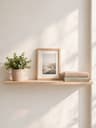
Pick the surface you look at most — the living room shelf, the top of the dresser, the kitchen counter — and take absolutely everything off it. Clean it, then stand back and look at the empty surface for a minute before you put anything back. That pause matters, because it shows you how good empty can look.
Put back three things, maximum: a small plant, one framed photo, one book you are actually reading. That is the whole display.
Keep the rest off: the things you removed either have a home inside a cupboard or they leave the house. A surface with a job — holding the kettle, holding your keys — is fine; a surface holding things because there was nowhere else to put them is not.
Switch to Uniform Storage

Mismatched storage is the fastest way to make a tidy room look messy. A shelf holding a cardboard box, a plastic tub, a carrier bag and a shoebox reads as clutter even when everything inside is perfectly organised. Uniform storage fixes it in one move.
One material per zone: pick natural seagrass baskets for the living room, plain white bins for the linen cupboard, or clear boxes for the pantry — and stick to it. Same size, same colour, same material.
Buy after you declutter: count what actually needs a home first, then buy that many. Three matching baskets beat eight almost-matching ones. Uniform storage is one of the simplest minimalist decluttering ideas there is, and it works in every room of the house.
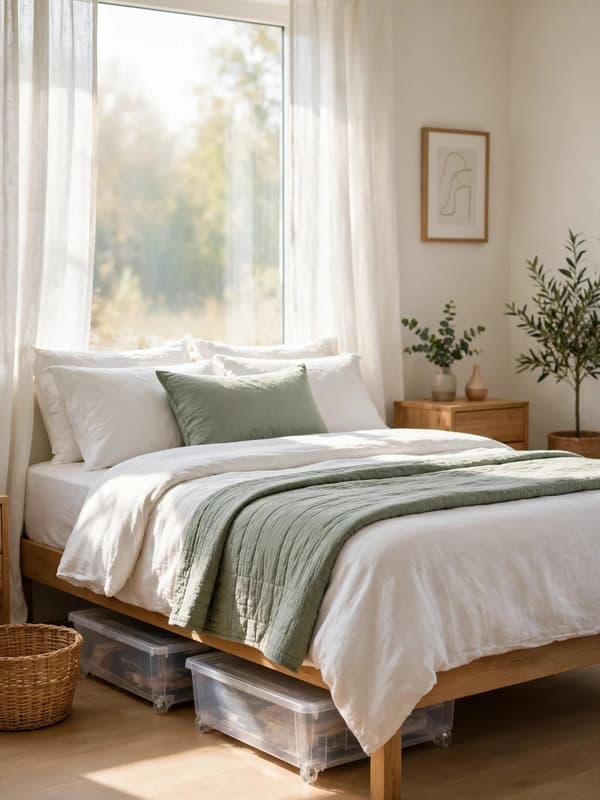
Edit Each Room to a Calm Colour Palette

A room with fourteen colours in it feels busy no matter how tidy it is. A room with two or three feels calm even when real life is happening in it. You do not need to repaint anything — just edit what is already there.
Pick two or three colours per room: a neutral base like warm white or soft grey, one calm accent like sage green or dusty blue, and natural wood or woven texture as the third note.
Move the odd ones out: the bright red throw, the neon toy, the patterned cushion that clashes with everything — these are not bad things, they just belong in a different room, or in a closed cupboard where they are useful without being visible. This is the heart of calm home decluttering: fewer colours, more calm, and nothing in the room competing for your attention.
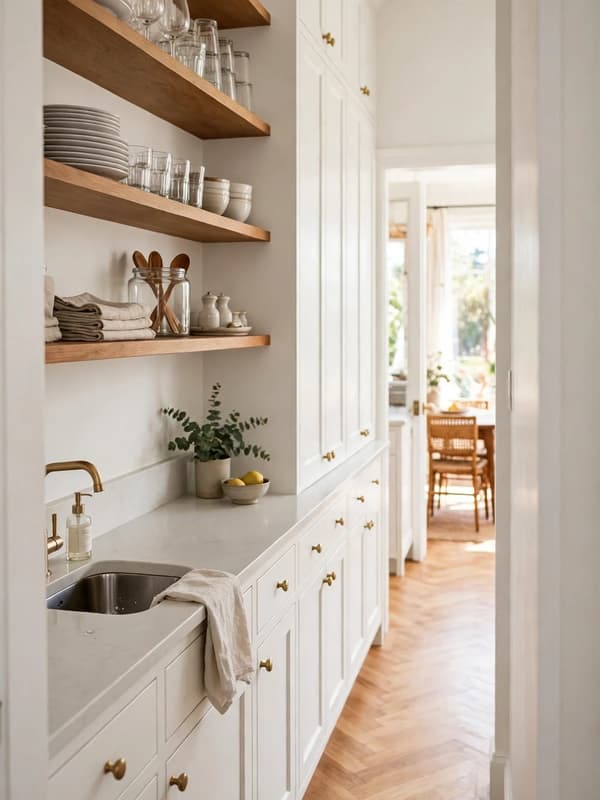
Leave Deliberate Empty Space on Shelves

A shelf filled edge to edge looks like a shop display. A shelf with gaps looks like a home someone cares about. Empty space is not wasted space — it is what lets the eye rest, and it is the single most visible sign of the decluttering aesthetic.
The two-thirds rule: fill roughly two-thirds of any shelf and leave the rest empty. Books in one group, a vase in another, and a clear gap between them.
Group, then gap: cluster similar things together — books with books, ceramics with ceramics — instead of spreading them evenly across the whole shelf. Groups with space between them look styled; evenly spaced clutter just looks spread out.
Colour-Order Your Closet with Matching Hangers

Open a closet and the first thing you see is the hangers, not the clothes. A rail of wire, plastic and wooden hangers in five colours looks chaotic before you have even looked at a single shirt. Matching hangers are a small change with a strangely large payoff.
One hanger type, end to end: slim velvet or plain wooden hangers, all the same, all facing the same way. Clothes hang evenly, nothing slides off, and the rail suddenly looks like a boutique.
Colour-order the clothes: light to dark, or by type — shirts together, then trousers, then dresses. You will find things faster, and the gradient itself is part of the look. If your closet is small, our closet storage ideas show how to fit the same calm system into a tight space without losing the breathing room.
Decanting is styling, not just storage
Half-empty packets and branded boxes are visual noise. Moving dry goods into matching glass jars turns the pantry into a display you are happy to open — and because you can see what is inside, you stop buying duplicates. Decant only what you use often, keep the original labels for anything with allergens or cooking instructions, and never decant something you will forget the name of.
Decant the Pantry into Uniform Glass Jars

Open most pantries and you see a wall of competing labels, half-torn packets and three open bags of the same rice. Uniform glass jars change the whole picture in an afternoon, and they make cooking easier too.
One jar style: same glass, same lid, same size where possible. Rice, pasta, oats, flour and sugar in a neat row with the labels facing out.
Decant in small batches: start with the five things you reach for most, not the whole pantry at once. Finish those, live with them for a week, then do the next five. For more pantry systems that keep this look working day to day, our pantry storage ideas go deeper on grouping and labelling without the clutter creeping back.
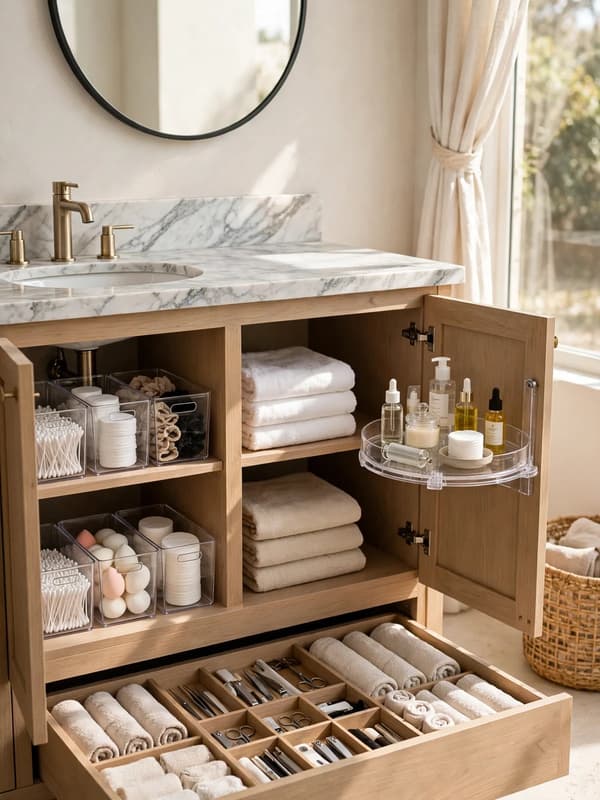
Reset the Bathroom Counter to a Single Tray

Bathroom counters attract clutter like nowhere else: a dozen bottles, a hairbrush, yesterday's cotton pads, three half-used products you tried once. The tray rule ends it, because a tray has edges — and edges are limits.
One tray, one rule: everything you use daily must fit on one small tray. Soap dispenser, toothbrush holder, one moisturiser, one small plant or candle. If it does not fit, it lives in the cabinet.
Decant the ugly bottles: move shampoo and lotion into plain matching pump bottles. The product is the same; the counter just stopped advertising to you. Our bathroom storage ideas have more small-space tricks if your bathroom barely has a counter at all.

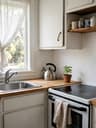
Build a One-Tray Entryway Landing Zone

The entryway is the first thing you see coming home and the last thing you see leaving, so it sets the tone for the whole house. Most entryways fail because they have no limits — shoes pile up, mail spreads, keys migrate to wherever they were dropped.
One tray for the small stuff: keys, wallet, sunglasses and the post you actually need to keep. Everything else gets recycled or filed the moment it comes through the door.
One hook per person: a coat and a bag each, nothing more. Off-season coats move to a closet, and the hook stays empty enough to use.
Shoes stay at two pairs: the pair you are wearing and one spare. The rest live in the closet or by the door in a single tidy row.
Edit the Nightstand to Three Things

The nightstand is the last thing you see before sleep and the first thing you see when you wake up, so it deserves the same editing as any other surface — arguably more. A crowded nightstand makes the whole bedroom feel restless.
Three things only: a lamp, the book you are reading, and a glass of water. That is the complete list for most of us.
Move the rest: chargers go behind the bed or inside the drawer, medicines go in the bathroom cabinet, and the pile of unread books goes back on the shelf where it belongs. Our bedroom storage ideas show how to hide the rest of the bedroom clutter so the calm surfaces stay calm.
Style the Coffee Table with the Three-Object Rule

Coffee tables are magnets. Remote controls, mugs, mail, a phone charger, a toy, a magazine from three months ago — they all land there because the table is in the middle of everything. The three-object rule gives it a limit that is easy to remember.
Three objects, three heights: a low stack of two books, a medium vase with a few stems, and a small candle. Different heights, one calm group, and the rest of the table stays clear.
Remotes get a home: one small basket or a tray on the side table, not scattered across the coffee table. When the remotes have a place, they stop multiplying.
Matching does not mean expensive
Uniform storage looks pricey, but the cheapest version is free: reuse jars you already own, cover mismatched boxes in the same plain paper, or buy one set of baskets second-hand. The look comes from consistency, not the price tag. Start with the shelf you see most and match that one first — nobody notices the inside of a cupboard until the visible shelves are done.
Make the Desk Cable-Free and Closed-Storage

A desk covered in cables looks messy even when the work on it is organised. Cables are the visual clutter of the home office, and they are also the easiest to fix, because most of them can simply be hidden.
Bare wood first: clear the desk completely, then put back only the laptop, a lamp, one notebook and one pen pot. Everything else earns its place or lives in a drawer.
Hide the cables: one cable tray under the desk, one short charging cable, and a small box for the power strip. If a cable is visible from the chair, it has not been hidden yet. This is one of the most practical minimalist decluttering ideas for anyone working from home — a clear desk genuinely makes starting work feel easier.
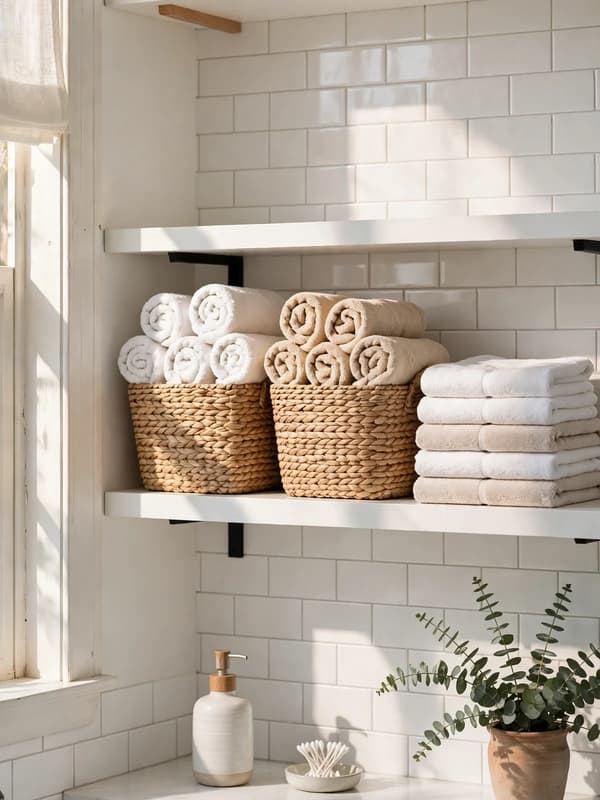
Fold Linens and Towels into Matching Stacks

Open a linen cupboard and you can tell in two seconds whether the household is calm or chaotic. Towels in six colours, sheets in a tangled ball, a fitted sheet that has never been folded in its life — it all adds up to a small daily stress every time the door opens.
One colour family: white, cream or soft grey towels, all the same. Mismatched towels go to the cleaning cupboard as rags, where they are genuinely useful.
Fold them the same way: same size, same fold, stacked with the folded edge facing out. A stack of identical white towels looks like a spa; a pile of mixed towels looks like a laundry basket that gave up.
Give Every Category One Beautiful Basket

Loose categories are what make a tidy home look untidy. The dog leads, the board games, the charging cables, the winter hats — each one is small on its own, but together they spread across every surface in the house. One basket per category ends the spread.
Name the basket, not the pile: one basket for cables, one for pet things, one for games, one for scarves and gloves. When a category has a basket, everything in it has a destination.
Make the basket worth looking at: this is the one place where pretty matters as much as practical. A good woven basket on a shelf looks like decor; a plastic bag looks like a problem you have not dealt with yet.
Create a Calm Pause Corner

Every home needs one spot that is not trying to do anything. Not a workstation, not a storage zone, not a dumping ground — just a chair, a little light and a plant. A pause corner is the decluttering aesthetic in its purest form, because its whole point is the empty space around it.
One chair, one plant, one light: a comfortable chair by a window, a small side table with nothing on it, and a plant that is alive and watered. That is the complete furniture list.
Keep it empty on purpose: no bags on the chair, no books stacked on the side table, no laundry draped over the arm. The moment it collects things, it stops being a pause corner and becomes another surface.
Keep It Beautiful with a 10-Minute Weekly Reset

A beautiful decluttered home is not a one-time project — it is a ten-minute habit. Without a reset, the surfaces refill slowly, one item at a time, and you only notice when the calm is already gone. With a reset, the look maintains itself.
Same time every week: pick a slot that already exists — Sunday evening, or the ten minutes after the weekly shop is put away. Set a timer and do not go over.
Walk the same route: entryway first, then living room surfaces, kitchen counter, bathroom tray, nightstand. Return anything that has drifted, wipe the trays, and take one bag of anything that no longer earns its place. The decluttering aesthetic is not about perfection — it is about a home that returns to calm quickly, week after week, with ten minutes of attention.
None of these fifteen ideas needs a renovation, a big budget or a free weekend. A clear shelf, a row of matching baskets, a tray on the bathroom counter, ten minutes on a Sunday — each one is small on its own, and together they add up to a home that looks as calm as it feels. Start with the room you see first in the morning and the surface that bothers you most, and let the rest follow. The prettiest thing about a decluttered home is how little effort it takes to live in once the editing is done.
Decluttering Aesthetic FAQs
Expert answers & styling advice
What is the decluttering aesthetic? ▼
The decluttering aesthetic is the look of a home that has been decluttered with beauty in mind, not just tidiness. Surfaces are mostly clear, storage is uniform, colours are calm, and there is deliberate empty space. It is not minimalism for its own sake — a home can still be warm and personal. The difference is that everything left out has been chosen on purpose, and everything else has a closed home of its own.
How do I make my home look aesthetic after decluttering? ▼
Start with one surface: clear it completely, then put back at most three things. Next, make your storage uniform — one material and one colour per shelf — and edit each room down to two or three calm colours. Leave a third of every shelf empty. Those four moves cover most of the look, and they cost very little. Add the weekly ten-minute reset from idea fifteen and the look maintains itself.
What colours work best for a calm decluttered home? ▼
Warm whites, soft greys and natural wood tones work as a base in almost any home, with one calm accent — sage green, dusty blue or warm terracotta — per room. Avoid having more than three colours visible in any one room, and let texture do the work instead: linen, wool, ceramic and woven baskets add interest without adding colour. If a room feels flat, add a plant rather than another colour.
Do I need to buy matching storage to get the look? ▼
No. The look comes from consistency, not price. Reuse jars and boxes you already own, cover mismatched boxes in the same plain paper, or buy one set of baskets second-hand. What matters is that the storage on one shelf matches — same material, same colour, same size. Start with the shelf you see most, and only buy after you have decluttered, so you know exactly how many baskets or jars you actually need.
How do I keep the aesthetic look from slipping back? ▼
Give every surface a limit — a tray, a basket or a three-object rule — so there is a visible line for when it is full. Run the ten-minute weekly reset from idea fifteen: same route, same time each week, one bag out. And use the one-in-one-out rule for anything new: it earns its place by replacing something, not by squeezing into the empty space you worked so hard to create.