15 Small Entry Way Ideas That Make a Tiny Hallway Work Harder

Fifteen ways to turn a cramped doorway into an entryway that actually works — a slim shoe cabinet, a fold-down bench, a corner nook, a pegboard, a storage ottoman, and a reset that keeps it clear.
Table of Contents (15 Ideas)
- 1.Mount a Slim Tilt-Out Shoe Cabinet That Sits Almost Flat on the Wall
- 2.Fold Down a Wall Bench When You Need a Seat, Fold It Away When You Don't
- 3.Claim the Dead Corner With a Triangular Shelf and Two Hooks
- 4.Hang a Round Mirror Over a Slim Ledge to Brighten a Dark Hall
- 5.Give Every Person a Hanging Basket, Not a Shared Pile
- 6.Squeeze in a Slim Console Table, 10 Inches Deep or Less
- 7.Draw the Entryway on the Floor With Layered Rugs and a Boot Tray
- 8.Hide the Keys in a Wall Cabinet With a Chalkboard Door
- 9.Use the Back of the Door When the Wall Is Already Full
- 10.Put Up a Pegboard Panel You Can Rearrange as Your Routine Changes
- 11.Stack Three Open Cubbies for Shoes You Can Actually See
- 12.Choose a Storage Bench With a Cushion and Baskets Underneath
- 13.Build a Wall Charging Station With a Mail Sorter and Key Rail
- 14.Do a Seasonal Swap and a 5-Minute Reset So the Zone Stays Clear
- 15.Hide Shoes in a Storage Ottoman and Mark the Zone With a Runner Rug
Some homes have a proper entryway. Yours might have a door, a wall, and about three feet of floor before the living room starts. That is still enough — it just means every inch has to earn its place.
These 15 small entry way ideas — the kind of tiny entryway organization that actually fits a narrow hall — are built for that exact situation: narrow hallways, doors that open straight into the living room, and rentals where you cannot drill into anything. Most of them use the wall instead of the floor, and take an afternoon at most. The goal is not a showroom hallway. It is a doorway where coats, keys, shoes, and mail each have one obvious home, so the pile by the door stops forming in the first place.
Start by standing in your doorway and watching what you actually carry in. That short list — not a photo you liked online — is what your entryway needs to hold.
Measure first, buy second
Before you buy anything, measure three things: the width of the wall you plan to use, the depth from that wall to where people walk, and the height of your longest coat. A cabinet deeper than 10 inches turns a narrow hall into a squeeze, and hooks hung too low drag jackets across the shoe tray.
Mount a Slim Tilt-Out Shoe Cabinet That Sits Almost Flat on the Wall

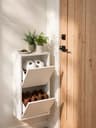
A tilt-out shoe cabinet is the single best piece of furniture for a hallway that is too narrow for a shoe rack. At about 8 inches deep it sits almost flat against the wall, yet each tilted compartment holds two or three pairs upright, so shoes stop living in a drift by the door. Mount it beside the front door so the compartments open without blocking the walkway. The flat top is a bonus: a small dish for keys, a plant, and suddenly the cabinet looks like furniture instead of storage. Keep only the pairs you wear this week inside — two or three per person — and the rest goes in a closet. For more ways to get shoes off the floor, see our shoe storage ideas.
Fold Down a Wall Bench When You Need a Seat, Fold It Away When You Don't

Sitting down to put your shoes on feels like a small luxury until you try it, and then it feels like common sense. The problem in a tiny hallway is that a bench eats the walkway. A fold-down wall bench solves that: it flips down when you need a seat and folds flat against the wall when you do not, sticking out barely two inches. Mount it at about 18 inches high, fix it into studs or proper wall anchors, and test it with your full weight before trusting it. Pair it with a row of hooks above and a basket beside it for scarves, and you have a seat, a coat rail, and a landing spot in one strip of wall.
Claim the Dead Corner With a Triangular Shelf and Two Hooks

Every home has a dead corner by the front door — the spot where nothing quite fits and the vacuum cleaner lives. Turn it into the entryway instead. A small triangular corner shelf takes up no walkway at all and still holds a dish for keys, sunglasses, and a plant. Add one hook on each adjoining wall: a jacket on one side, a tote bag on the other, and a pair of shoes on a small mat below. The whole setup costs less than most coat racks and uses space that was doing nothing. It works best in square hallways and in flats where the door opens into a corner rather than a straight wall.
Hang a Round Mirror Over a Slim Ledge to Brighten a Dark Hall

Dark hallways make small entryways feel half their size, and a mirror is the cheapest way to fight that. A large round mirror bounces light from the door or a window across the hall, and it gives you a last check before you leave. Hang it over a slim wooden ledge — not a table — so keys and a small vase have a home without taking any floor space. A wall sconce beside the mirror adds warm light on dark winter mornings, and because everything is mounted, the floor stays completely clear. Keep the ledge nearly empty: keys, one thing you like looking at, nothing else, or the ledge becomes another clutter shelf.
Give Every Person a Hanging Basket, Not a Shared Pile

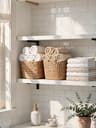
Shared entryway storage always ends up belonging to one person and annoying everyone else. Hanging baskets fix that by giving each person a visible, limited home for their small stuff: gloves, a beanie, a dog leash, sunglasses. Hang three or four woven baskets at staggered heights on wooden pegs so they read as a group but stay separate, and keep each basket small enough that it cannot turn into a junk drawer. The rule that makes this work is simple: when a basket overflows, something in it has to move out. It is one of the easiest small entryway storage ideas to install, because it needs only a few screws and no furniture at all.
Squeeze in a Slim Console Table, 10 Inches Deep or Less

A console table sounds too big for a small entryway until you look at the slim ones. At 10 inches deep or less it hugs the wall and still gives you a landing surface, two small drawers for the bits that look messy — spare keys, a tape measure, dog treats — and space underneath for baskets of scarves and gloves. The rule that keeps it working is the same one that keeps every landing surface working: the top is for what you need today, not for everything you own. One small dish for keys, a stack of mail, a plant, and the rest stays clear. If the top starts collecting random objects, the table is too big for the habit, not too small for the hallway.

Three helpers worth the money
If you buy only three things, make them these: a boot tray with a raised edge so mud stays put, a small valet tray or dish for keys and coins, and a washable rug you can actually clean. Measure the wall and the floor space first, and skip everything else until you have lived with the setup for a month.
Draw the Entryway on the Floor With Layered Rugs and a Boot Tray

Some entryways have no walls to work with at all — just a door and a walkway. That is when the floor has to do the organizing. Layer a flatweave rug over the hall floor to mark where the entryway starts, then put a smaller jute doormat on top of it right inside the door, and a boot tray with a raised edge at the end of the mat. The layers catch dirt before it reaches the rest of the house, tell everyone exactly where shoes belong, and make a doorway that opens straight into a living room feel like a real entryway. Pick a washable rug if you can, because the entryway rug is the one rug in the house that actually gets dirty. For more shoe-spot ideas, see our front-door shoe organization ideas.
Hide the Keys in a Wall Cabinet With a Chalkboard Door

Keys are the smallest thing in the entryway and the one you lose most often, because they have no obvious home. A wall-mounted key cabinet fixes that in about a foot of wall: three or four brass hooks inside hold every set, and the chalkboard door gives you a place to scribble a reminder — bin day, a parcel to collect, milk — where you will actually see it on the way out. Mount a slim shelf underneath for sunglasses and a wallet, so the whole pocket dump lands in one spot. It is a good pick for narrow halls because the cabinet sticks out barely three inches, and closing the door hides the clutter completely.
Use the Back of the Door When the Wall Is Already Full

When there is no free wall and no floor space, the back of the door is the last surface left — and it is usually empty. A clear over-the-door pocket organizer hangs from two hooks over the door, needs no screws, and holds sunglasses, a small umbrella, the dog leash, and the mail in see-through pockets, so you can find things without digging. Put a boot tray underneath for the shoes, and you have a full drop zone — one of the simplest entryway drop zone ideas for renters — that comes down in seconds when you move out. One caution: keep the pockets light. A door organizer stuffed with heavy things swings, bangs, and eventually pulls the hooks off. For more no-drill tricks, see our over-the-door storage ideas.
Put Up a Pegboard Panel You Can Rearrange as Your Routine Changes

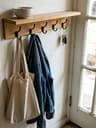
A pegboard panel is the most flexible piece of entryway storage you can buy, because you can move everything on it in seconds. Mount a light wood panel beside the front door, add hooks for a cap and a tote bag, a peg for sunglasses, and a small wooden tray underneath for the mail. When your routine changes — a new dog, a new gym bag, a season of scarves — you move the pegs instead of buying new furniture. Keep it to one panel, about two feet wide, and resist the urge to fill every hole. A pegboard with breathing room looks calm and works better than one packed solid, because you can actually see what is hanging on it.
Stack Three Open Cubbies for Shoes You Can Actually See

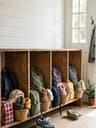
Open cubbies are the simplest shoe storage there is, and stacking them is what makes them work in a small entryway. Three white cube boxes stacked against the wall hold three pairs heel-out, so you can see every pair at a glance instead of digging through a pile. Put the most-worn pair at the bottom, where it is easiest to reach, and a basket of scarves on top so the stack earns its height. The trick is the same as with every shoe system: cap the pairs. Three cubbies hold three pairs, and when a fourth pair arrives, an old one has to move to a closet. A stack that grows taller than three cubes starts to wobble and look like a tower, so stop at three.
Small bench, big difference
A bench that is 30 inches wide still seats one person at a time, which is how most of us get out the door anyway. Measure the wall first, then buy the bench to fit the wall — never the other way round.
Choose a Storage Bench With a Cushion and Baskets Underneath

A storage bench does three jobs that a plain bench cannot: it gives you a seat, it hides shoes and gloves in baskets underneath, and its cushion makes the hallway feel like a room instead of a corridor. Pick one about 18 inches high with a washable cushion — entryway cushions get sat on with wet coats and muddy hands — and slide two woven baskets below, one for shoes and one for gloves and hats. Hang a row of hooks above it for coats and the bag you grab tomorrow, and the whole wall becomes one tidy station. Our closet storage ideas help with the overflow.
Build a Wall Charging Station With a Mail Sorter and Key Rail

The phone is the newest member of the entryway pile, and it needs a home just like the keys do. Mount a slim floating shelf at chest height and put a small wooden charging stand on it, with the cable tucked behind the shelf so it does not dangle. Below it, a wall-mounted mail sorter with two or three slots takes the envelopes, and a brass key rail beside it holds the keys. Everything you grab on the way out — phone, keys, mail that needs answering — now lives in one vertical strip of wall about two feet wide.
Do a Seasonal Swap and a 5-Minute Reset So the Zone Stays Clear

A drop zone only works if it holds this season, not every season. Twice a year, swap the coats on the hooks: current season up front, off-season in labelled woven bins on a low shelf below. The swap frees more hook space than any organizer you can buy, and the bins keep the out-of-season scarves and gloves visible enough that you remember where they are. When the bins fill up, that is the limit working as intended — the overflow goes to a closet or a storage room, not onto a longer rail. Then keep it clear with a five-minute reset once a week: shoes back on the tray, mail sorted, keys in the dish, and anything that migrated to the entryway returned to its real room.
Hide Shoes in a Storage Ottoman and Mark the Zone With a Runner Rug

A storage ottoman is the quietest piece of entryway furniture: it looks like a seat, it hides a surprising amount of shoes, and it takes up no wall at all. Pick one in a washable fabric, about 30 inches long, and park it at the end of a runner rug. The rug does the real organizing work here — a long flatweave runner in soft neutral stripes marks the entryway zone across the floor, so the hallway reads as its own space even in an open-plan flat. Lift the lid, drop the shoes in, close it, and the doorway looks calm again. It is the best option when the walls are already full or you rent and cannot mount anything.
A calm entryway is not really about furniture. It is about walking in, putting everything down in a spot you do not have to think about, and walking into the rest of your home with empty hands.
Pick the wall idea first, add one shoe home and one pocket tray, and let the rest wait until you know what you actually miss. Then keep the weekly reset short and honest, and the doorway that used to greet you with a pile will start greeting you with a bit of calm instead.
Small Entry Way Ideas FAQs
Expert answers & styling advice
What is the best way to organize a very small entryway? ▼
Start with the wall, because it is the space you are probably wasting. One slim piece — a tilt-out shoe cabinet, a row of hooks, or a pegboard panel — plus a boot tray for shoes and a small dish for keys covers most homes. These small entry way ideas work because they give coats, keys, shoes, and mail one obvious home each, so nothing has to pile up on the floor.
How do I make an entryway when there is no entryway at all? ▼
Draw it on the floor. A runner rug or a layered doormat marks where the entryway starts and ends, even in an open-plan flat. Add a slim console or a storage ottoman at the edge of the rug, a row of hooks on the nearest wall, and a boot tray for shoes, and the zone reads as a real entryway without a single wall being built.
What is the slimmest shoe storage for a narrow hallway? ▼
A tilt-out shoe cabinet is the slimmest option at about 8 inches deep, and it hides the shoes completely. If you want to see your shoes, stackable open cubbies or low floating shelves work, but cap them at two or three pairs per person. Anything deeper than 10 inches starts to block the walkway in a narrow hall.
How can I add entryway storage without drilling holes? ▼
Use the door and the floor. An over-the-door pocket organizer holds sunglasses, mail, and the dog leash with no screws, a storage ottoman hides shoes without touching a wall, and adhesive hooks rated for a few pounds each can hold a tote and a light jacket. Wipe the wall with rubbing alcohol first, press firmly, and wait a full day before hanging anything heavy.
How do I stop shoes piling up by the front door? ▼
Cap the pairs and give them a boundary. Two or three pairs per person, on a boot tray or in cubbies, and everything else lives in a closet. When the tray is full, that is the limit working as intended. Adding a bigger tray just moves the pile, so cap the pairs instead of expanding the storage, and do a five-minute reset once a week.