15 Small Desk Organization Ideas That Keep You Focused

Fifteen ways to make a small desk feel calm and focused — a one-tray rule, a raised monitor, tidy cables, and a two-minute reset that actually sticks for good.
Table of Contents (15 Ideas)
- 1.The One-Tray Rule for Everything on the Desktop
- 2.Raise the Monitor and Free the Space Under It
- 3.A Divider Tray That Fixes the Junk Drawer
- 4.A Vertical File Holder Instead of Paper Piles
- 5.A Cable Tray Along the Back Edge of the Desk
- 6.Pen Cup Discipline: Only What You Use Daily
- 7.A Clamp Lamp That Doesn't Eat Desk Space
- 8.A Headphone Hook on the Desk Edge
- 9.One Parking Spot for Sticky Notes
- 10.A Hanging Organizer Under the Desk
- 11.The Two-Box System: Now and Later
- 12.One Personal Thing, Nothing More
- 13.A Laptop Stand and Keyboard for Breathing Room
- 14.A Dock for Your Notebook and Planner
- 15.The Two-Minute Shutdown Reset
A small desk does not stay messy because you are lazy. It stays messy because it is small — every object has to earn its patch of surface, and most desks never get rules for what earns what.
Here is the honest math: a typical small desk is about 40 by 20 inches. That is roughly five and a half square feet for your laptop, your notebook, your coffee and your thoughts. A lamp base, a pile of papers and a nest of cables can eat half of it before you have done a minute of work. And your brain notices — a crowded surface is a quiet, constant list of unfinished business.
These 15 small desk organization ideas are built for focus, not for photos. One home for everything, clear space where your eyes rest, and a two-minute reset that keeps it that way. If your desk sits in a corner of a bedroom or living room, our small apartment storage ideas will help the rest of the room pull its weight too.
 Save Pin
What you'll need
Most of these ideas run on a few calm workhorses: a bamboo desktop tray, a monitor stand riser, a cable management tray and a vertical file holder. Buy the tray first — it sets the border everything else respects. The rest can arrive one payday at a time.
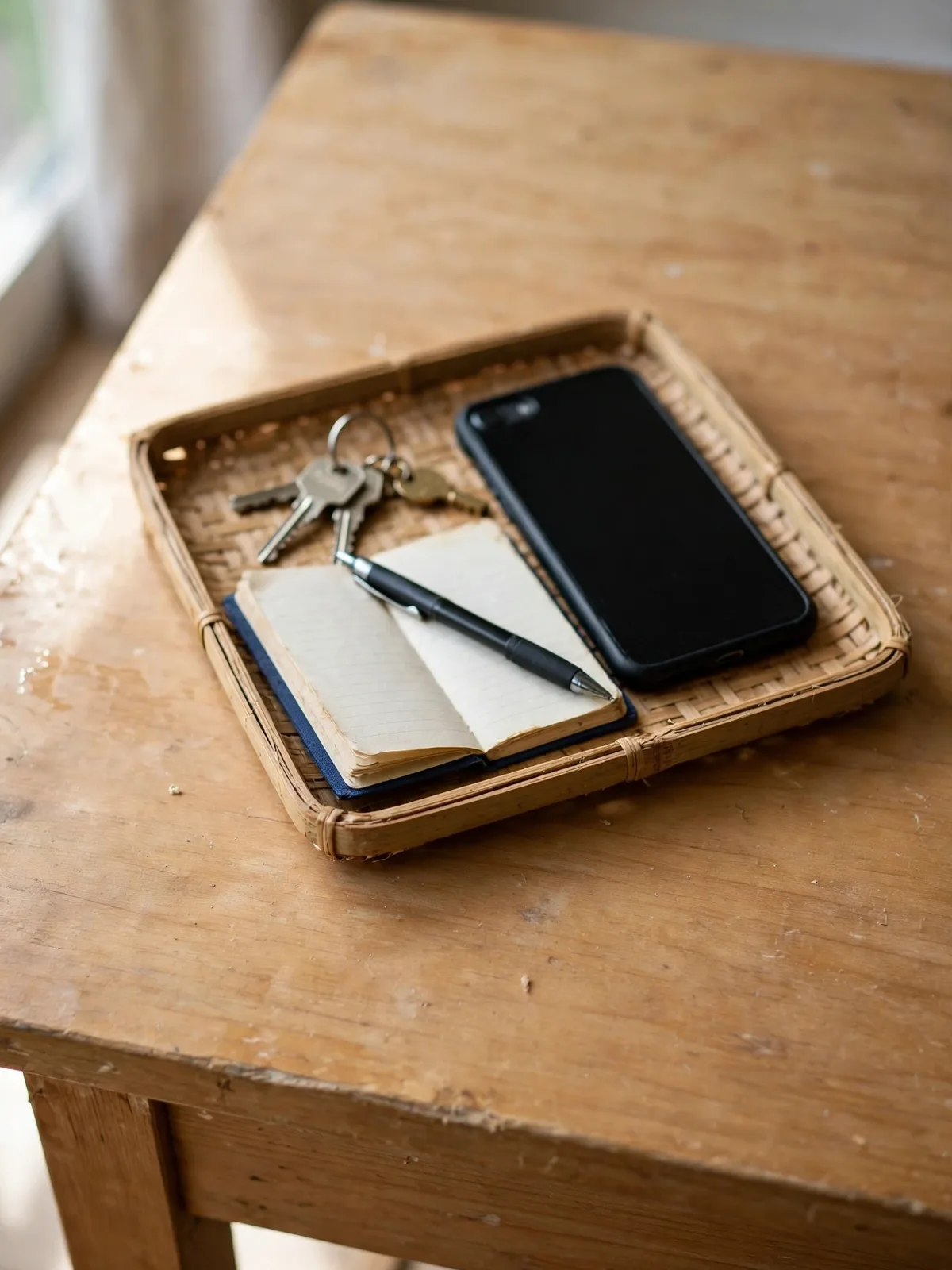
The One-Tray Rule for Everything on the Desktop

Here is the rule that changed my desk more than any organizer I ever bought: everything that lives on the desktop has to fit in one tray. Phone, keys, wallet, notebook, the pen you are actually using — if it does not fit in the tray, it does not live on the desk. A bamboo desktop tray, roughly 12 by 8 inches, costs about $12 to $18 and becomes the border. Loose things inside a border read as one object to your brain. The same six things scattered across the surface read as six distractions. When the tray overflows, that is your signal — something gets a drawer, not more desk.
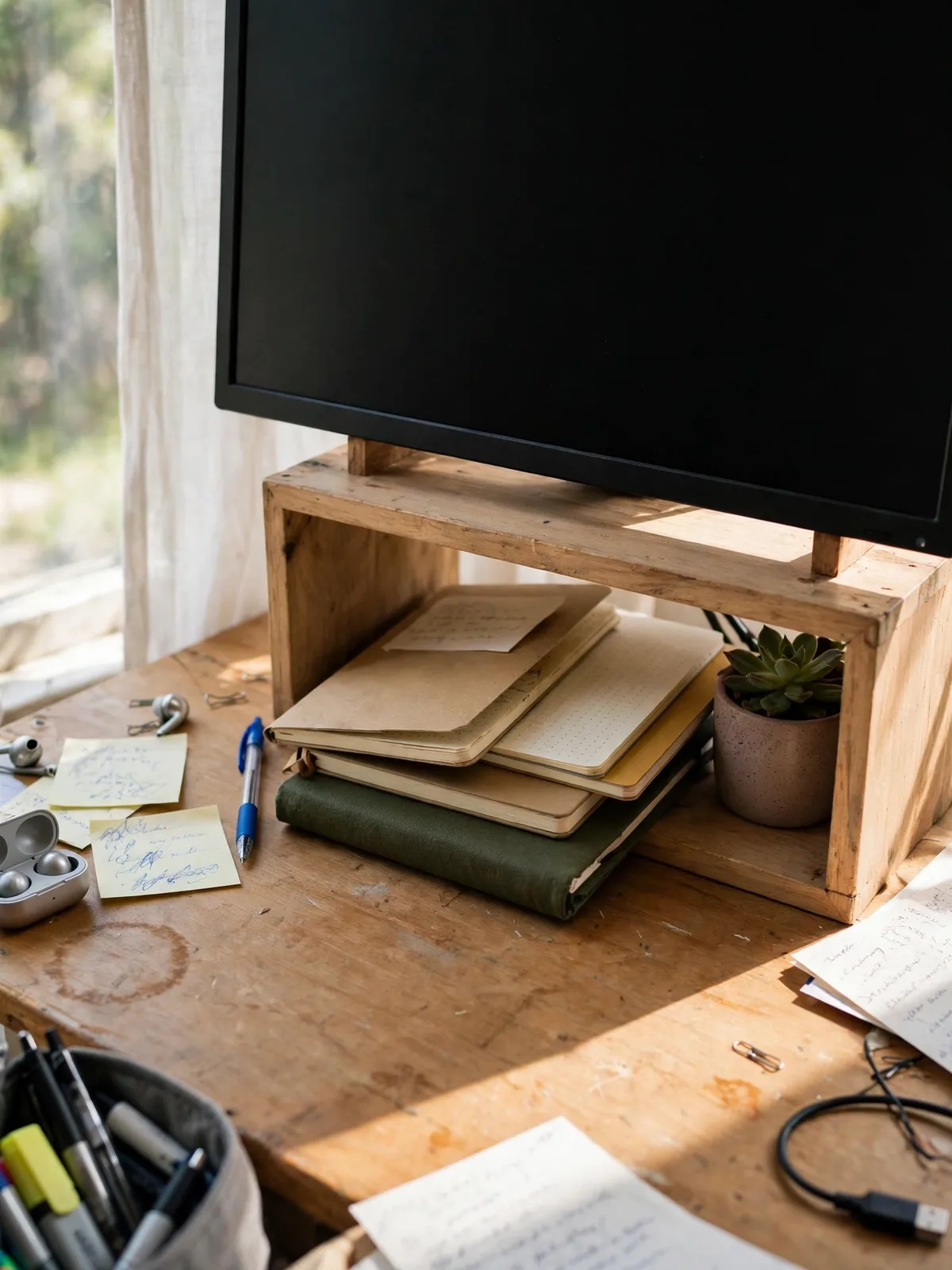
Raise the Monitor and Free the Space Under It

A monitor sitting flat on a small desk wastes two things: your posture and about a square foot of hidden storage. Raise it on a monitor stand riser — a simple wood or bamboo shelf, usually 16 to 20 inches wide — and the screen lands at eye level while the space underneath becomes a garage. Slide your notebook, planner or even your keyboard under there when you need a clear surface for paper work. Stands run $20 to $35, and the sturdy bamboo ones hold a laptop dock too. Measure the height you need first: the top of the screen should sit roughly at or just below eye level when you sit up straight.
A Divider Tray That Fixes the Junk Drawer

Every desk has that drawer. The one you open with a little shame. The fix is not cleaning it more often — it is giving the chaos lanes. A bamboo drawer divider tray with adjustable compartments turns one dumping ground into six small homes: chargers here, paper clips there, washi tape and sticky notes in their own slots. Adjustable sets run $14 to $22 and expand to fit most desk drawers, which are usually 12 to 15 inches wide. The rule that keeps it working is one category per compartment, no exceptions. The day a random battery lands in the pen slot, the drawer starts sliding back to junk.
A Vertical File Holder Instead of Paper Piles

Paper piles grow sideways, and sideways is exactly the direction a small desk cannot afford. A vertical file holder — the upright metal or wood kind with three to five slots, about $13 to $20 — stores the same papers standing up, in a footprint smaller than one sheet of paper. Give each slot a job: to act on, to file, waiting on someone. When a slot gets fat, that is your ten-minute filing cue. I resisted this one for months because it felt like office-supply-store overkill. It is not. Piles hide deadlines. Slots show them to you, one honest row at a time.
A Cable Tray Along the Back Edge of the Desk

Look at your desk from the doorway. If you can see a nest of cables, your brain is seeing it all day too. A cable management tray mounted under the back edge — a wire basket around 16 inches long, $15 to $25 — swallows the power strip, the charger bricks and the slack. Route every cable down, along the tray, and up only where it has to reach. Add two or three velcro cable ties inside so nothing sags out. The desktop goes visually quiet, vacuuming under the desk stops being a negotiation, and the floor stays clear enough to stretch your legs.
Pen Cup Discipline: Only What You Use Daily

Count the pens in your cup right now. Most people find nine to fourteen, and use two. A stuffed pen cup is a tiny decision you make every time you reach for a pen — and tiny decisions all day are exactly what focus cannot afford. Keep a small ceramic pen cup with only the daily drivers: your two good pens, a pencil, a highlighter, scissors if you use them daily. Everything else moves to the drawer tray from idea three, or honestly, to the trash — half of them are dead anyway. Test each one on a scrap of paper. It takes four minutes and the cup feels different for months.
Start here if you buy one thing
If you buy one thing, make it the bamboo desktop tray. It costs the least, needs no setup, and instantly shows you how much of your desk clutter was just homeless objects. Add the cable management tray second — together they calm the surface and the view under it.
A Clamp Lamp That Doesn't Eat Desk Space

A traditional desk lamp has a big round base, and on a small desk that base is prime real estate — easily 30 square inches gone. A clamp lamp grips the back or side edge instead, so the footprint drops to zero and the arm swings light exactly where you need it. Look for a metal clamp that opens to 2 inches, an arm with real tension (cheap ones droop by week two), and a warm-to-daylight adjustable bulb. Decent ones run $22 to $38. Bonus: with nothing sitting on the surface, the whole desk wipes clean in one pass, which makes the nightly reset from idea fifteen much easier to keep.
A Headphone Hook on the Desk Edge

Headphones are the worst shape to store flat — big, round, and always landing on your notebook. A headphone hook that clamps or sticks to the desk edge, usually $10 to $16, gives them a parking spot in the air instead. Under-desk hooks keep them hidden and dust-light; edge hooks keep them grabbable. Either beats the desktop. This is a small idea with an outsized effect, because headphones are often the single biggest object on a small desk. The same trick works for a cap or a bag strap, but give the hook one job. One hook, one thing, no negotiations at 9 a.m.
One Parking Spot for Sticky Notes

Sticky notes are useful. Sticky notes everywhere — on the monitor, the wall, the lamp, your water bottle — are just paper anxiety. Give them one parking spot: a small acrylic sticky note holder, about $8, parked in one corner of the desk, holding one pad only. The rule is that a note lives there, on the pad or stuck to the holder's edge, and nowhere else. When a task is done, the note goes straight in the trash — that little crumple is genuinely satisfying. If notes keep escaping, it usually means the pad is doing a planner's job, which is what idea fourteen is for.
A Hanging Organizer Under the Desk

The space under a small desk is usually just legroom and dust, but the front edge can work. A hanging under-desk organizer — fabric pockets or a clamp-on basket, $14 to $24 — hangs below the surface and holds the second tier: your glasses case, a charger, lip balm, the notebook you are not using today. It keeps near-you things near you without touching the desktop. One warning: measure your legroom before you buy, and mount it off to the side you do not favor, or your knees will file a complaint within the hour. Shallow pockets beat deep ones here — deep pockets become tiny junk drawers.
The Two-Box System: Now and Later

Most desk clutter is not mess. It is decisions you have not made yet, sitting in paper form. The two-box system sorts them in about ten seconds: one small inbox box labeled Now for anything you will touch this week, one labeled Later for everything else. Two simple boxes or letter trays, $10 to $18 for the pair, stacked or side by side. Papers may only land in a box, never on the bare desk — that is the whole system. On Friday, the Later box gets five honest minutes. Half of it usually goes straight to recycling, because later has a way of quietly becoming never.
One Personal Thing, Nothing More

A desk with zero personality feels like a waiting room, and you will avoid it. A desk with nine personal things feels like a souvenir shelf, and you will not focus at it. The sweet spot is one. One small potted plant, one framed photo, one little object that makes you smile — pick your single thing and let it be genuinely yours. Mine is a small plant I have somehow kept alive for two years, which feels like a personal record. When a second cute thing tries to move in, it has to evict the first one. That one-in, one-out rule keeps the desk warm without letting it get loud.
The focus rule behind all 15
Your eyes should be able to rest somewhere. Keep at least half the desktop visibly empty during work — no vertical file holder, tray or dock is allowed to creep past the halfway line. Clear space is not wasted space. On a small desk, clear space is the whole point.
A Laptop Stand and Keyboard for Breathing Room

If you work on a laptop, the laptop itself is the clutter — it pins you to one hunched spot and sprawls across the middle of the desk. Raise it on an aluminum laptop stand, $25 to $40, add a slim wireless keyboard and mouse, and two things happen. Your screen sits at eye level, and when you want paper space, you just move the light keyboard aside — the laptop stays parked on its stand like a little desktop tower. The desk suddenly has zones instead of one crowded middle. It also pairs neatly with the broader setup in our small home office organization ideas if your whole corner needs the treatment.
A Dock for Your Notebook and Planner

Notebooks and planners stored flat become landing pads — everything you set down lands on them, and then they are buried by lunch. A wooden notebook dock, basically a slotted stand around $15 to $22, parks them upright at the desk's edge like books on a shelf. You see the spines, you grab the right one in a second, and the covers stay clean. It also creates a hard limit: when the dock is full, a new notebook means an old one is finished or retired. If your paper system needs a bigger reset first, our 30-day declutter challenge is a kind way to clear the backlog before it reaches the desk.
The Two-Minute Shutdown Reset

None of the other fourteen ideas survive without this one. At the end of the workday, set a timer for two minutes — actually set it — and return the desk to its photograph: tray stocked, notebook in its dock, papers in the Now box, headphones on their hook, cables where they belong. Two minutes is short enough that you will actually do it on a tired Thursday. The payoff arrives the next morning, when you sit down to a clear surface and a clear first thought instead of yesterday's leftovers. Skip a day and it costs four minutes. Skip a week and it costs a Saturday. Protect the two minutes.
You do not need all 15 ideas, and you definitely do not need them this weekend. Start with the tray, the pen cup edit and the two-minute reset — three changes, under $20 total if you only buy the tray, and the desk already feels like a different place to sit down.
The goal was never a desk that looks good in a photo. It is a desk your brain trusts: sit down, see one thing to work on, and start. Small desks ask more discipline per inch than big ones, but they also reward it faster — a few honest rules and the whole surface turns calm. When you are ready to give the rest of the room the same treatment, our small home office organization ideas pick up right where this list leaves off.
Small Desk Organization FAQs
Expert answers & styling advice
How do I keep a small desk organized when I work and study at it? ▼
Give each activity a zone and a container rather than its own half of the desk. Work tools live in the bamboo desktop tray and drawer, study papers live in the vertical file holder, and switching activities means swapping containers — about thirty seconds — instead of reshuffling piles. The two-minute shutdown reset at the end of each session keeps the zones honest.
What is the best way to hide cables on a small desk? ▼
Mount a cable management tray under the back edge, put the power strip inside it, and route every cable down into the tray and up only where it must reach the device. Shorten the slack with velcro cable ties instead of zip ties so changes stay easy. From sitting height, the goal is simple: no cable visible against the wall or floor.
How much clear space should a small desk have? ▼
Aim for at least half the surface visibly empty while you work — enough room for an open notebook next to your laptop, roughly speaking. If organizers and trays cover more than half, something has to move into a drawer, under the desk, or off the desk entirely. Clear space is what lets one task hold your attention.
Are these small desk organization ideas renter-friendly? ▼
Yes. Trays, stands, docks and holders simply sit on the desk, clamp lamps and hooks grip the edge without screws, and a cable management tray can mount with removable adhesive strips instead of drilling. Everything lifts off and moves out with you, and nothing leaves a mark on the desk or the wall.