17 Closet Storage Ideas That Actually Work in Real Closets

17 practical closet storage ideas — double rods, slim hangers, clear bins, baskets, hooks and honest labels — that work in bedroom, hall, linen and coat closets.
Table of Contents (17 Ideas)
- 1.Empty It Out Before You Buy a Single Bin
- 2.Add a Second Rod and Double Your Hanging Space
- 3.Switch to Matching Slim Velvet Hangers
- 4.Stop Stacks From Toppling With Shelf Dividers
- 5.Put Clear Bins on Every Shelf
- 6.Keep Woven Baskets on the Top Shelf
- 7.Hang an Over-the-Door Organizer for Shoes and Accessories
- 8.Use a Hanging Shelf Organizer for Sweaters and Jeans
- 9.Slide Stackable Drawers Under the Hanging Clothes
- 10.Claim the Top of the Closet for Backstock and Off-Season Gear
- 11.Give Shoes a Real Home on the Floor
- 12.Screw in Hooks for Bags, Hats, and Belts
- 13.Treat the Linen Closet Like a Shop Shelf
- 14.Set Up the Coat Closet by the Door
- 15.Rotate Seasons Instead of Cramming Them All In
- 16.Give Small Accessories Their Own Spot
- 17.Label Everything, Then Do a Ten-Minute Reset
Most closets fail in the same quiet way. They start out fine, then one busy week piles a jacket on the shelf, a bag lands on the floor, and the folded jeans lean a little further every day until opening the door feels like a small negotiation. It is not a willpower problem. A closet with one rod, one shelf, and no plan for the floor will beat almost anyone, because there is nowhere for anything to actually go.
These 17 ideas fix that without a remodel or a big spend. They work in bedroom closets, hall closets, linen closets, and coat closets — anywhere clothes, towels, or shoes need a home. The trick is to give every category its own spot and to use the space you already have: the second half of the rod, the top shelf, the back of the door, and the floor. If your closet is genuinely tiny, start with our small closet organization ideas after this one. For now, pull out a laundry basket and a donation bag. We are starting with the empty-out.
 Save Pin
What to buy first
Most of this list runs on five things: matching slim velvet hangers, clear bins with lids, acrylic shelf dividers, an over-the-door organizer, and a label maker or chalk labels. Buy them in that order if you are spreading out the cost — the hangers and bins change the most. Everything else here is just rearranging what you already own.
Empty It Out Before You Buy a Single Bin

Yes, all of it. Every shirt, shoe, and mystery scarf comes out onto the bed. You cannot organize a closet you are still standing inside of, and this one honest hour saves you from shuffling clutter around for months. Sort as you go into three piles: keep, donate, and toss. Anything you have not worn in a year, anything that does not fit, and anything you keep meaning to repair goes in the donate or toss pile — no auditions, no maybes. Wipe the shelves and vacuum the floor while the closet is bare, because dust loves the corners. What goes back in should be clothes you actually wear.
Add a Second Rod and Double Your Hanging Space

A single rod wastes the bottom half of almost every closet. Shirts and folded pants only need about 40 inches of hanging height, so a second rod fitted below the first one doubles the clothes you can hang in the same closet. Put shirts, blouses, and jackets on the top rod, and pants, skirts, and folded trousers on the lower one. A tension rod works in a rental, but a proper rod on brackets holds far more weight and will not slip at 2 a.m. Measure first: leave about 42 inches from the top rod to the lower one, and keep the lower rod at least 30 inches above the floor so longer pieces clear the shoe rack.
Switch to Matching Slim Velvet Hangers

A closet full of mixed hangers — thick plastic ones, wire ones from the dry cleaner, a few wooden ones — wastes inches and looks restless even when it is tidy. Slim velvet hangers are about a quarter of an inch thick, so swapping a full rod of chunky hangers can free up six to eight inches of rod space, which is room for four or five more shirts. The velvet grip stops silk blouses and camisoles sliding onto the floor, and matching hangers make the whole closet look calmer the moment you open the door. Buy one box of fifty and do the full swap in one go — mixing half and half just keeps the mess.
Stop Stacks From Toppling With Shelf Dividers

Folded clothes on an open shelf have one habit: leaning. One pulled-out sweater and the whole stack slides sideways like a slow landslide. Clear acrylic shelf dividers clip onto the shelf and hold each stack upright, so jeans stay in the jeans column and t-shirts stay in the t-shirt column. They work best on shelves at least 12 inches deep, and they cost less than a takeaway coffee each. Keep stacks short — five or six items high, not ten — because a stack you have to dig through is a stack that ends up on the floor. Dividers also make it obvious when a category is growing out of its space.
Put Clear Bins on Every Shelf

Clear bins are the simplest closet organizers you can buy, and they earn their keep on the shelves where folded clothes do not belong: socks, underwear, swimwear, gym gear, and the small stuff that never stacks neatly. Because the bin is clear, you can see what is inside without pulling it out, and because it has a lid, the contents stay dust-free on a high shelf. Fill each bin about three-quarters full so you can reach in and grab something. Label the front edge, not the top, so the label is readable while the bin is still on the shelf.
Keep Woven Baskets on the Top Shelf

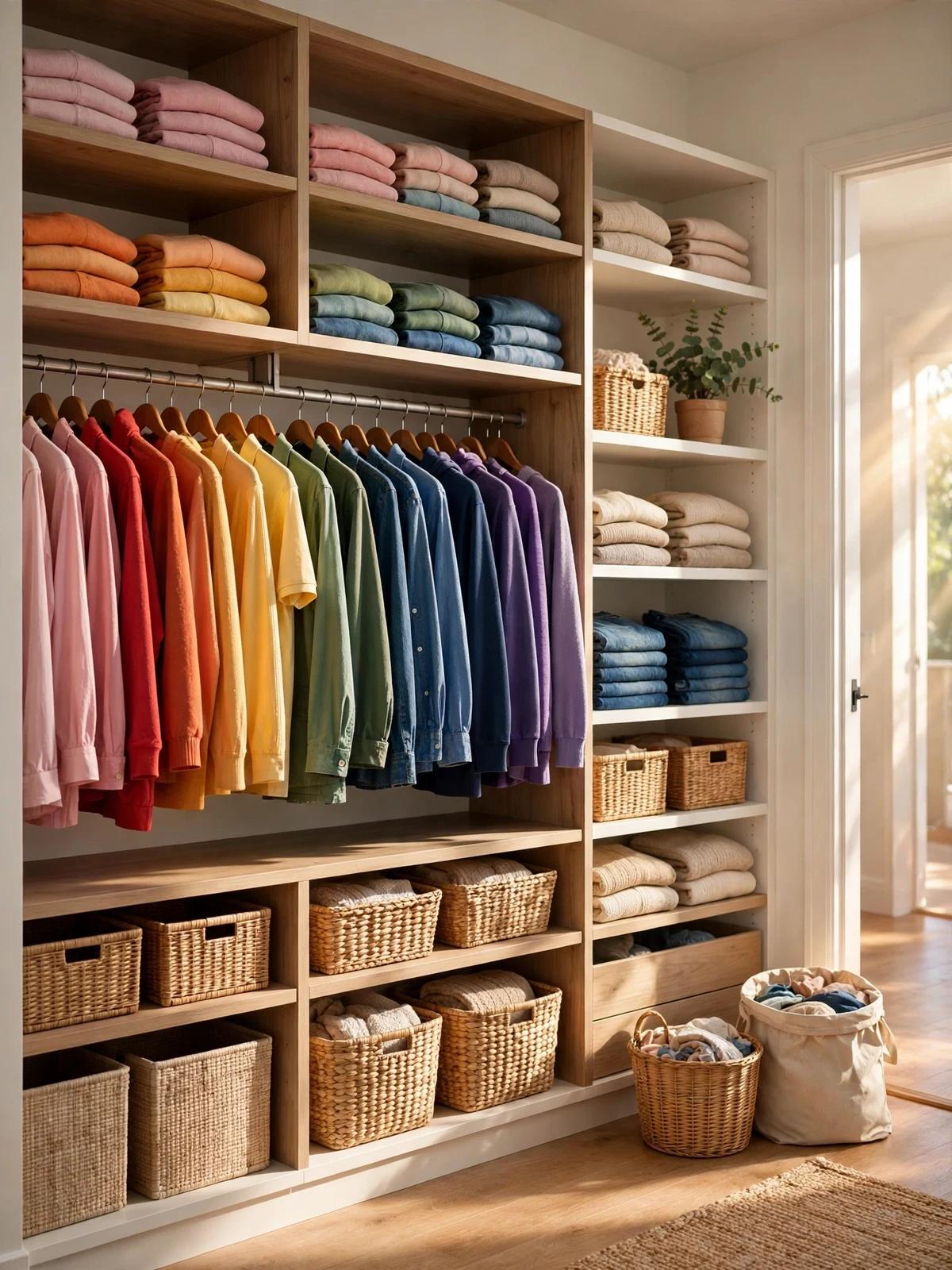
The top shelf is the wrong place for anything you grab daily, and the perfect place for soft, light things you reach for once a week: scarves, hats, gloves, spare tote bags, and out-of-season accessories. Woven baskets with handles make that height workable, because you can pull the whole basket down, take what you need, and slide it back in one motion instead of stretching for loose items. Pick baskets that fit the shelf depth with an inch to spare, and keep them light — heavy denim up there is a headache waiting to fall. One basket per category, handles facing out.
Hang an Over-the-Door Organizer for Shoes and Accessories

The back of the closet door is free storage that most closets never use. An over-the-door organizer with clear pockets holds a surprising amount: two or three pairs of flat shoes, sunglasses, belts, ties, jewelry rolls, and the small accessories that otherwise drift to the bottom of drawers. It hangs on hooks, so there is nothing to screw in and nothing to patch when you move out. Check that the door still closes cleanly once it is loaded, and keep the heaviest items in the lowest pockets so the door swings properly. For more ways to use door space, see our over-the-door storage ideas.



The one measurement that matters
Before buying any closet organizers, measure the inside of your closet: width, depth, and the height from the rod to the floor. Most reach-in closets are 24 inches deep, and most bins and shelf units are sold in 12, 16, or 18-inch depths. A bin that is two inches too deep means a door that will not close — and a return trip you did not need.
Use a Hanging Shelf Organizer for Sweaters and Jeans

Sweaters should not live on hangers — they stretch at the shoulders and slide off in a sad heap. A fabric hanging shelf organizer clips onto the rod and gives you six cubby compartments that hold folded knits, jeans, and t-shirts in neat, visible stacks. It takes up about 12 inches of rod space, which is roughly the width of six hanging shirts, and in return you get a whole column of folded storage that never needs a shelf. Roll chunky knits if the cubbies are shallow; rolled sweaters stay put and you can see each one.
Slide Stackable Drawers Under the Hanging Clothes

The space under short hanging clothes — shirts on the top rod, pants on the lower one — is usually dead air with a few shoes lost in it. A small stack of drawers, two or three high, turns that gap into real storage for socks, underwear, pajamas, and workout clothes. Plastic units are light and cheap, fabric cube drawers look softer, and either beats a pile on the floor. Leave a few inches of clearance above the top drawer so you can open it without catching a hem, and put the most-used drawer at the top. If the drawers wobble, a strip of grip liner underneath fixes it.
Claim the Top of the Closet for Backstock and Off-Season Gear

The best top of closet storage ideas start with one rule: the top shelf is for things you touch once a month, not once a day. Spare bedding, the extra blanket, out-of-season coats in a lidded bin, the suitcase you use twice a year — all of it earns the high shelf, while daily clothes stay between knee and eye level where they belong. Use matching lidded bins so the top shelf reads as one calm row, and label each bin on the front edge where you can read it from the floor. Keep a small folding step stool in the closet or nearby, because a top shelf you cannot reach safely is just a shelf you ignore.
Give Shoes a Real Home on the Floor

Shoes loose on the closet floor become a pile within a week, and the pair you want is always at the bottom of it. A two-tier shoe rack sized to your closet floor keeps everyday pairs lined up and visible, and a boot tray underneath catches mud and rain before it reaches the carpet. Put the shoes you wear most at the front, and cap the collection at what the rack holds — when it is full, a pair has to go before a new one comes in. If your shoes spill into the bedroom, our shoe organization for small closets has more floor-level fixes that work in tight spaces.
Screw in Hooks for Bags, Hats, and Belts

Bags are the hardest thing to store in a closet: they flop, they crush, and they eat a whole shelf for two handbags. A row of sturdy wall hooks on the closet's side wall or on the back of the door solves it — one bag per hook, hanging by its strap, visible and easy to grab. The same hooks take hats, caps, belts looped over the hook, and the tote bag you reach for every morning. Use proper wall anchors on drywall, because a full handbag is heavier than it looks. Keep the hooks at shoulder height so bags do not drag on the shoes below.
Treat the Linen Closet Like a Shop Shelf

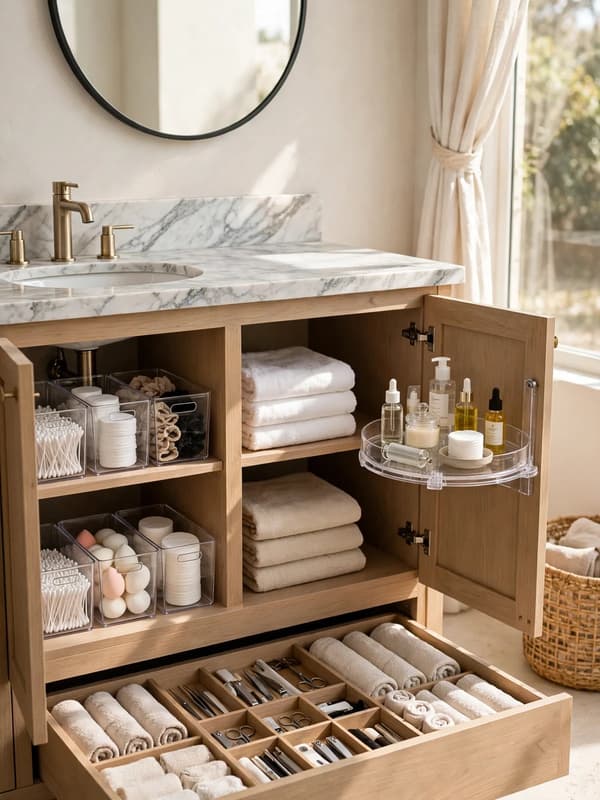
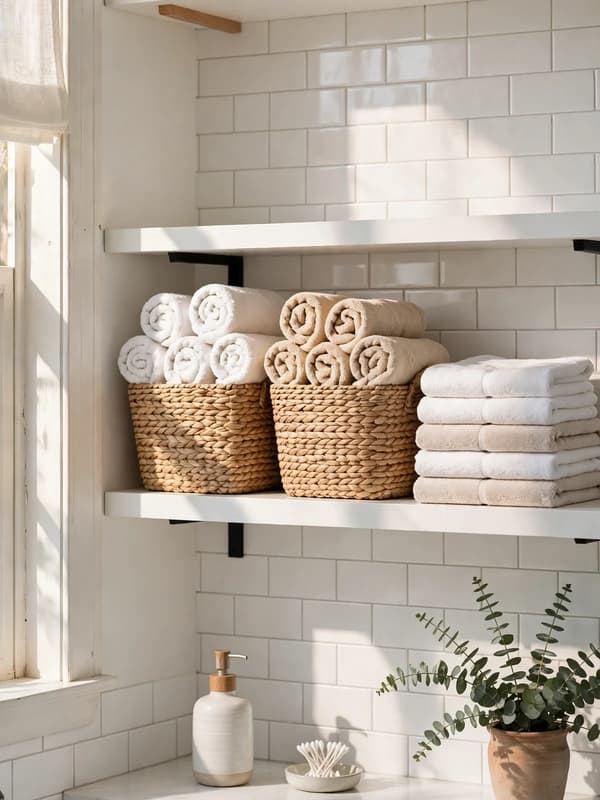
Linen closets go wrong because towels and sheets are folded to different sizes and stuffed wherever they fit. Fold everything to the same width — bath towels in thirds, hand towels in half — and stack them with the folded edge facing out, the way shops do it. Keep each bed's sheets together as a set, folded inside one of its own pillowcases, so grabbing fresh bedding is one pull instead of a hunt through three shelves. A small basket on the bottom shelf holds washcloths and hand towels, and a jar of lavender sachets keeps the whole closet smelling clean. Leave a hand's width of air at the front of each stack so nothing topples.
If your closet has no shelves at all
Some closets are just a rod and four bare walls. A freestanding shelf unit that stands on the floor, or a hanging shelf organizer clipped to the rod, gives you shelves without a single screw. Start with one unit on the side wall, live with it for two weeks, and only then decide what else the closet actually needs.
Set Up the Coat Closet by the Door

The hall or entry closet works hardest in the worst weather, so it needs a different setup from the bedroom: sturdy hooks at two heights, one row for adults and a lower row the kids can actually reach. Coats hang on the hooks or a short rod, and a woven basket on the floor holds gloves, scarves, and hats so they stop migrating to every flat surface in the house. A boot tray by the door catches wet shoes, and a small shelf up high holds the spare umbrella and the dog lead. In summer, swap the heavy coats out and the same closet holds rain jackets and the picnic blanket.
Rotate Seasons Instead of Cramming Them All In

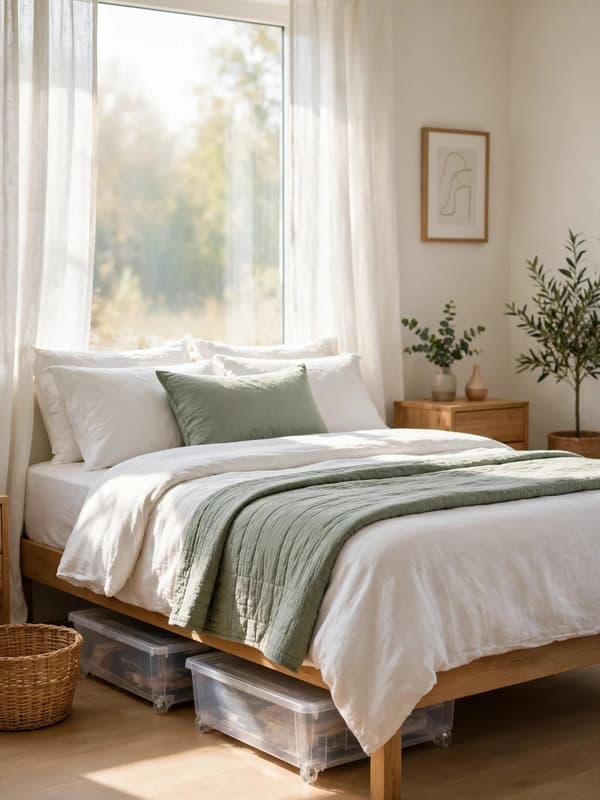
A closet holding summer and winter at the same time is a closet holding twice what it should. Twice a year, swap the seasons: pack the off-season clothes into lidded bins or vacuum bags, label them, and store them on the top shelf or under the bed. This is one of the best closet storage ideas for small spaces, because it instantly frees a third of your hanging space without buying anything. While the closet is half empty, check each piece before it goes back — anything stained or unworn for a year goes in the donation bag. The swap takes an afternoon, and the closet feels new for six months.
Give Small Accessories Their Own Spot

Belts, scarves, and jewelry are small enough to vanish and expensive enough to miss. A belt rack mounted on the inside wall keeps leather belts hanging straight instead of coiled in a drawer, scarf rings on a single hanger hold a dozen scarves in the space of one shirt, and a velvet-lined tray on a shelf keeps necklaces from tangling into one knot. Put the tray where you get dressed, not buried under folded clothes, because accessories you cannot see are accessories you never wear. One tray and one rack is enough for most people — if the collection outgrows them, edit it, do not buy a bigger tray.
Label Everything, Then Do a Ten-Minute Reset

Labels feel fussy right up until someone else puts the laundry away and everything still ends up in the right place. Label the front of every bin and basket, and label the shelf edge too, so the zones survive whoever is unloading the bags. Then keep it alive with a ten-minute reset once a week, ideally before laundry day: hang the strays, refold the leaning stack, and pull out one thing to donate. That is the whole maintenance plan. Skip the reset and the mess wins back a little ground each week; keep it, and the closet you organized in idea one is still the closet you have six months from now.
A closet will never hold everything a bigger one can — and that is fine. What it can do is hold exactly what you wear, in a way that lets you find it in ten seconds on a dark morning. Start with the empty-out, add the second rod, switch the hangers, and keep the labels honest. You do not need all 17 at once. Pick the five that solve your biggest headache, live with them for a week, then add more. And if the empty-out turned up more clothes than your closet can hold, our wardrobe reset walks through the full declutter, piece by piece.
Closet Storage FAQs
Expert answers & styling advice
How do I organize a closet with no built-in shelves? ▼
Start with a hanging shelf organizer clipped to the rod — it gives you six cubbies with no tools at all. Then add a small freestanding shelf unit on the side wall, or a stack of drawers under the hanging clothes. Clear bins on the floor handle the rest. You can build a fully working closet this way in an afternoon, with no screws in the wall.
What are the best closet organizers for a rented home? ▼
Stick to things that leave no holes: matching slim hangers, a tension rod for double-hanging, an over-the-door organizer, a hanging shelf organizer, and freestanding drawers or shelf units. Adhesive hooks work for light items like belts and scarves, but test one first — cheap adhesive fails on textured walls and takes paint with it. Everything on this list comes with you when you move.
How do I store clothes at the top of the closet without forgetting them? ▼
The best top of closet storage ideas only work if you can see what is up there, so use matching lidded bins with a label on the front edge, not the top. Keep a short written list taped inside the closet door of what lives on the top shelf, and check it during your seasonal swap. If something has sat untouched for a full year, it probably does not need the prime top-shelf spot.
How can I organize a closet in a small bedroom? ▼
These closet storage ideas for small spaces start with the same three moves: a second rod to double hanging space, slim hangers to win back inches, and a seasonal rotation so only this season's clothes are in the closet at all. Then use the door and the floor — an over-the-door organizer and a low shoe rack — before buying anything bulky. If clothes still overflow, the overflow usually belongs under the bed or in the donation bag, not in a second closet.
How often should I declutter my closet? ▼
A full declutter should only happen once — after that, it is maintenance. Do the seasonal swap twice a year and use it as your declutter moment: anything unworn for a full year, stained, or stretched goes out before the next season goes in. Between swaps, the ten-minute weekly reset keeps the system honest. If you find yourself reorganizing from scratch every month, a zone is in the wrong place — usually the everyday clothes are stored too high.