17 Walk In Closet Organization Ideas That Finally Make Mornings Easy

17 practical ideas — zones, double hanging, a shoe wall, drawers, labels and a weekly reset — that make a walk in closet easy to use every single morning.
Table of Contents (17 Ideas)
- 1.Empty It Out Before You Buy a Single Thing
- 2.Sketch the Layout in Three Zones
- 3.Hang by Category First, Then by Color
- 4.Double Hang the Long Wall
- 5.Put a Center Island to Work
- 6.Give Shoes a Whole Wall
- 7.Switch to Matching Slim Hangers
- 8.Add Drawers for the Folded Stuff
- 9.Use Shelf Dividers and Clear Bins
- 10.Send Out-of-Season Clothes Up High
- 11.Add a Full-Length Mirror and Real Lighting
- 12.Use the Door and Wall Hooks for Accessories
- 13.Set Up a Tomorrow-Outfit Hook
- 14.Corral Belts, Scarves, and Jewelry in Baskets
- 15.Label the Bins and the Shelf Edges
- 16.Keep a Laundry Hamper and a Donate Basket Inside
- 17.Do a Ten-Minute Weekly Reset
A walk in closet should be the easiest room in the house to use, but most of them are not. They start as a luxury — all that space, all those rails — and slowly turn into a place where clothes pile up, shoes migrate to the floor, and getting dressed takes longer than it should. The problem is rarely the size of the closet. It is that nobody ever gave it a system.
These 17 walk in closet organization ideas are the ones that actually hold up in real life, in closets people use every single day. No full renovation, no custom carpenter, no budget that needs a spreadsheet. Just practical changes — zones, rails, drawers, bins, and a few honest habits — that make the room work the way it looks in photos.
Start with the first two ideas and the rest gets much easier. And if your closet is on the smaller side, our small closet organization ideas cover the same principles in a tighter space.
What to buy first
If you buy only four things, make them matching slim velvet hangers, shelf dividers, clear bins, and a slim laundry hamper. Together they fix the three real problems of a walk in closet — clothes sliding off, stacks toppling, and dirty laundry piling up — for less than one new outfit. Everything else on this list is refinement.
Empty It Out Before You Buy a Single Thing

Every good closet starts with a mess on the bed. Take everything out — every hanger, every folded stack, every shoe — and pile it where you can see it. You will find things you forgot you owned, things that never fit right, and at least one item you have bought twice. Sort into three piles as you go: keep, donate, and fix or toss. Be honest about the keep pile. If you have not worn it in a year and it does not fit the life you actually live, it goes. Only when the closet is truly empty do you start putting things back, and that is when a wardrobe reset pays off — the stuff that returns is only the stuff you wear.
Sketch the Layout in Three Zones

A walk in closet works best when it has a plan, not just shelves. Before you hang anything, sketch the space in three zones: hanging on the longest wall, folded clothes and drawers on the back wall, and shoes along the floor or the shortest wall. Daily clothes go between shoulder and knee height, where your hand lands without thinking. Occasional things — formal dresses, heavy coats — go to the far end. This is the heart of a good walk in closet organization ideas layout: you stop hunting and start reaching. Measure the walls while you are at it. A rail needs about 24 inches of depth, and a walkway needs at least 30 inches, or you will be sidestepping your own clothes every morning.
Hang by Category First, Then by Color

Grouping clothes by category is the single change that makes a closet feel calm. All the work shirts together, all the jeans together, all the dresses together. Within each group, arrange light to dark. It sounds fussy, but it solves a real problem: when everything is mixed up, you scan the whole rail every morning. When it is grouped, your eyes go straight to the section you need. Keep the pieces you reach for most at the front of each group and the rarely worn ones at the back. A rail that reads left to right — short sleeves, long sleeves, trousers, dresses — turns getting dressed into a two-minute job instead of a daily dig.
Double Hang the Long Wall

One rail wastes half the wall. Most shirts, blouses, and folded trousers only need about 40 inches of height, so a second rail underneath doubles what the wall holds. Mount the top rail around 80 inches high and the lower one around 40 inches, and keep dresses and long coats on a separate single-hang section at the end. This is the cheapest big win in walk in closet storage ideas — two rails, a handful of brackets, and suddenly the floor is clear and the rail is not jammed. Leave a few inches of breathing room at the end of each rail. A packed rail wrinkles clothes and hides the ones in the middle, which defeats the whole point.
Put a Center Island to Work

If your closet is at least 10 feet wide, a center island changes how the room feels. It is not just a pretty extra — it is drawers for underwear, socks, and folded tees, a top surface for laying out tomorrow's outfit, and a place for a jewelry tray and a small vase. Keep at least 36 inches of walkway on each side so drawers open fully without blocking the rails. No room for a built-in island? A narrow dresser or a low storage bench does the same job in a smaller footprint. The island also gives the closet a middle, which stops the room from feeling like a corridor with clothes on both sides.
Give Shoes a Whole Wall

Shoes scattered on the floor are how a walk in closet falls apart. Give them one dedicated wall of open shelving, low and shallow, with each pair facing out. Heels together, sneakers together, boots on the bottom shelf where their height fits. Slanted shelves look smart and make pairs easier to grab, but flat shelves hold more. Keep the shoes you wear weekly at eye and knee level and the occasion pairs up high. If the collection is big, a second row of shelving on the opposite wall beats a pile by the door every time. For more shoe-specific tricks, see our shoe organization for small closets — the same pairing and grouping rules apply here, just with more room.




The layout rule that saves the most space
Double hanging plus a top shelf is the biggest space win in any walk in closet organization ideas layout. Two rails hold twice the clothes, and the top shelf takes everything out of season. If you do nothing else from this list, do those two — the closet will feel twice as big by dinner.
Switch to Matching Slim Hangers

Mixed hangers are a quiet space thief. Thick plastic, wire, and chunky wood hangers all take different amounts of room, so the rail looks uneven and clothes slide off. Switch to one type of slim velvet hanger in a single color and you will fit roughly a third more on the same rail. Velvet grips stop silk and camisoles from sliding to the floor. Keep a few sturdy wooden hangers for heavy coats and structured jackets — velvet hangers bend under real weight. Buy one big pack, not three small ones, and retire the odd hangers to the laundry room. The rail will look calmer the same afternoon, and nothing will have cost much.
Add Drawers for the Folded Stuff

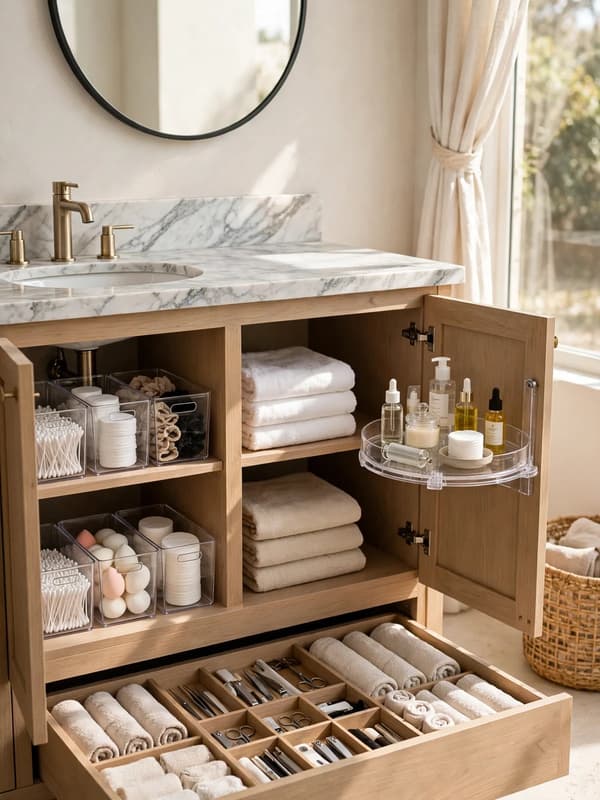
Not everything belongs on a hanger. Knitwear stretches on hangers, t-shirts stack better folded, and underwear and socks need a drawer, full stop. A bank of drawers under the hanging rail or in the island handles all of it. File-fold t-shirts upright in rows like files in a drawer — you can see every shirt at once instead of digging through a stack. Put socks and underwear in small drawer dividers so they stop migrating into one tangled pile. Keep the top drawer for the things you grab daily and the bottom drawer for the things you grab weekly. Drawers also hide the visual noise, which is half the battle in an open closet.
Use Shelf Dividers and Clear Bins

Open shelves are great until the stacks lean. Shelf dividers — simple upright panels that clip or stand on the shelf — keep folded sweaters and jeans in tidy columns that do not topple when you pull one out. Pair them with clear bins for the small stuff: scarves, swimwear, gym gear, and the odds and ends that never stack well. Clear bins matter because you can see what is inside without opening anything. Label the front of each bin with what lives in it. Two or three dividers per shelf and a bin or two per category is usually enough; more than that and the shelves start looking like a warehouse.
Send Out-of-Season Clothes Up High

The top shelf is for things you do not need this month. Heavy winter coats in July, linen dresses in January — pack them in matching lidded boxes or vacuum bags and put them up high, out of the daily eyeline. Label each box with the season and a rough list of what is inside, so you are not opening all four boxes in October looking for one sweater. Keep a small step stool in the closet if the top shelf is out of reach; if getting there is a chore, the swap will never happen. Twice a year, when the season turns, the boxes come down, the current season goes up, and the closet resets itself.
Add a Full-Length Mirror and Real Lighting

A walk in closet without a mirror is a dressing room you cannot use. Mount a full-length mirror on the back of the door or lean a tall one against the end wall, where the light hits it. Then fix the lighting, because a dim closet hides stains, mismatched socks, and the navy-versus-black problem. Warm LED strips under the shelves light the clothes instead of your head, and a small ceiling fixture in the middle of the room beats a single bulb by the door. If there is a window, keep the shelves low on that wall so the daylight gets in. Good light is the difference between a closet and a cave.
Use the Door and Wall Hooks for Accessories

Handbags, belts, and scarves need a home that is not the floor or a tangled pile. A row of sturdy hooks on the back of the door or on a spare stretch of wall holds them all where you can see them. Hang bags by their handles, one per hook, so they keep their shape. Loop belts over a hook or a ring, and drape scarves over a multi-hook rail so they do not crease. Keep sunglasses and small jewelry on a little tray or stand nearby. Over-the-door storage ideas work here too — a slim rack on the door holds accessories without taking a single inch of shelf space.
A quick word about the island
An island only works if the closet is wide enough. Keep at least 36 inches of walkway on each side, or drawers will hit the rails and you will be shuffling sideways every morning. In a narrow closet, skip the island and spend the money on better drawers under the rails instead.
Set Up a Tomorrow-Outfit Hook

Mornings go wrong when you are choosing clothes half asleep. Pick one hook or a small valet rail near the mirror and lay out tomorrow's outfit the night before — top, bottoms, shoes underneath, bag on the hook. It takes three minutes at night and saves ten frantic ones in the morning. This is also the spot for clothes that are worn once and still clean: the jeans you wore for two hours, the blazer that does not need washing yet. They hang here instead of landing on the chair or the floor, and the closet stays tidy because the in-between clothes finally have a place to go.
Corral Belts, Scarves, and Jewelry in Baskets

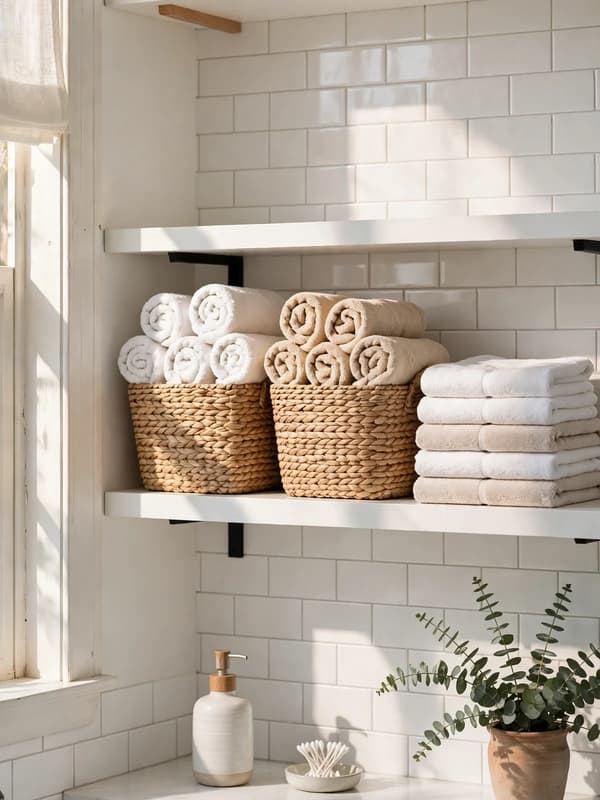
Small accessories are the first things to vanish in a big closet. Give them shallow baskets on a shelf at eye level: one for belts rolled up, one for scarves, one for the jewelry you wear most. Rolling scarves instead of folding them saves space and stops creases, and a small tray inside the basket keeps necklaces from tangling into a knot. Keep the everyday pieces here and the special-occasion ones in a lidded box on a higher shelf. When everything small lives in a basket, you stop buying a third black belt because you could not find the first two.
Label the Bins and the Shelf Edges

Labels feel like overkill until someone else puts the laundry away and everything ends up in the wrong bin. Label the front of every bin and the edge of every shelf with what belongs there — not in fancy script, just clear words you can read from the doorway. Use tags you can change, because the contents will shift with the seasons. The labels also do a quiet job for you: they make it obvious when something is out of place, so the fix takes seconds instead of a full reorganization. A labeled closet is a closet that stays organized after the first week, which is the part most systems skip.
Keep a Laundry Hamper and a Donate Basket Inside

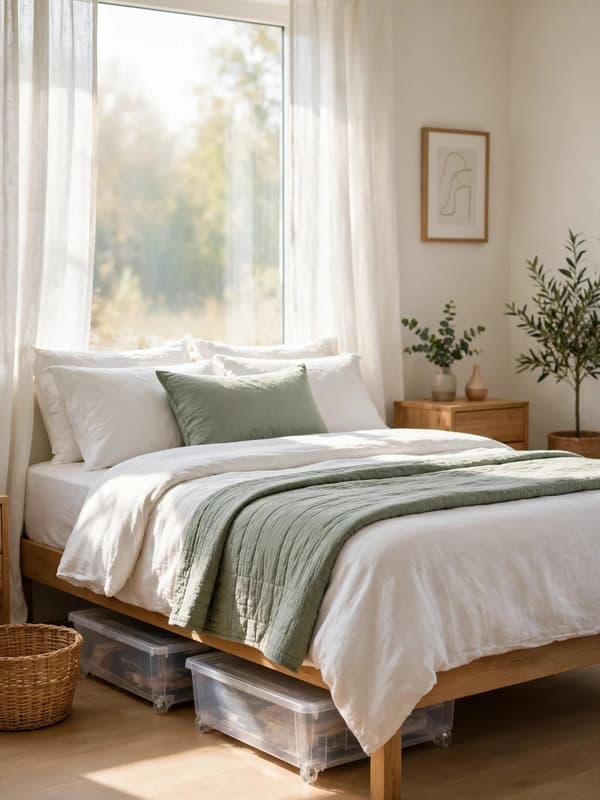
Two baskets by the door keep the closet honest. A slim laundry hamper means dirty clothes go straight in instead of piling on the floor or the chair. A small donate basket means the shirt that does not fit anymore goes in the moment you notice it, not six months later when you finally admit it. When the donate basket is full, tie it off and drop it at the charity shop on your next errand. This is the simplest of all walk in closet storage ideas, and it works because it removes the decision — the basket is right there, so the habit forms on its own. For bulky bedding that does not belong in the closet at all, our under-bed storage ideas keep it out of the way.
Do a Ten-Minute Weekly Reset

No closet stays organized on its own. Once a week — Sunday evening works for most people — spend ten minutes putting it right: hang the strays, refold the one leaning stack, return the shoes to their wall, and empty the laundry hamper. Check the tomorrow-outfit hook and the donate basket while you are there. That is the whole job. Skip the reset and the mess creeps back a little each week until the closet needs another full day. Keep it, and the closet you organized once stays organized for months. Master walk in closet organization ideas are not about a perfect day of organizing; they are about a small habit that protects the system you already built.
A walk in closet does not need to be big to work well — it needs a plan, a place for everything, and ten minutes a week to keep it honest. Start with the empty-out, sketch your three zones, and hang by category. Add the rails, the drawers, and the shoe wall as you go, and let the labels and the weekly reset do the quiet work of keeping it that way. Pick the five ideas that solve your biggest headache, live with them for a week, and then add more. A calm closet makes for a calmer morning, and that is a decent trade for a weekend of sorting. That is what master walk in closet organization ideas come down to in the end.
Walk In Closet Organization FAQs
Expert answers & styling advice
How much does it cost to organize a walk in closet? ▼
Most closets can be organized well for $100 to $300: matching hangers, shelf dividers, clear bins, hooks, and a hamper. Built-in drawers or a center island cost more, from $500 upward, but they are optional. Start with the cheap fixes first — hangers and dividers change the most for the least money — and add bigger pieces only when you know the layout works.
How do I organize a walk in closet with no built-ins? ▼
Use freestanding pieces instead. A garment rail, a stack of drawers, and a freestanding shoe rack do the same job as built-ins and can move with you. Add shelf dividers and bins to keep stacks tidy, and use the door for hooks and racks. The system matters more than the furniture — zones, categories, and labels work in any closet.
What is the best layout for a walk in closet? ▼
Hang clothes on the longest wall, put drawers and folded clothes on the back wall, and give shoes the shortest wall or the floor level. Keep daily clothes between shoulder and knee height and out-of-season items up high. Leave at least 30 inches of walkway in the middle so you can move without turning sideways.
How do I keep a walk in closet organized when two people share it? ▼
Split it down the middle — one side each, with a clear line between them. Each person gets their own rail, drawers, and shoe section, and shared things like the mirror and the island stay in the middle. Label the bins with names, not just contents. The split stops the slow drift where one person's clothes quietly take over the whole room.
How often should I declutter a walk in closet? ▼
Do a quick pass every season when you swap the out-of-season boxes — that is four honest chances a year to let things go. Keep the donate basket in the closet so pieces leave the moment you notice they do not fit or you do not wear them. A full empty-out once a year is enough if the weekly reset and the seasonal pass are actually happening.