17 Hidden Storage Ideas for Small Homes

Seventeen storage spots hiding in plain sight — inside ottomans, under stairs, behind mirrors and in the gap beside your fridge — for small homes.
Table of Contents (17 Ideas)
- 1.A Storage Ottoman That Swallows the Living-Room Clutter
- 2.A Storage Bench at the Foot of the Bed
- 3.Fake Book Boxes Hiding in the Bookshelf
- 4.Low Trays That Slide Under the Sofa
- 5.A Headboard With a Hidden Shelf Behind It
- 6.Bed-Base Drawers That Read as Part of the Frame
- 7.A Lift-Top Coffee Table With a Hollow Middle
- 8.Shelves Hidden Behind a Curtain
- 9.A Mirror That Opens Into a Cabinet
- 10.Toe-Kick Drawers Under the Kitchen Cabinets
- 11.The Dead Space Above the Doorway
- 12.Storage Inside the Stairs (or Under-Stair Pull-Outs)
- 13.A Lift-Up Entry Bench by the Front Door
- 14.A Dining Banquette With Storage Inside
- 15.A Shallow Cabinet Hidden Behind a Picture Frame
- 16.A Slim Rolling Cart in the Fridge-to-Wall Gap
- 17.Vintage Suitcases That Store the Off-Season Stuff
Small homes do not usually have a storage problem. They have a visibility problem. The blankets, batteries, board games and backup towels all have to live somewhere, and in 600 square feet, somewhere usually means in plain sight, on every surface.
Hidden storage is the fix. It uses the space your home already has — inside the furniture you sit on, under the stairs you climb, in the gap beside the fridge you open ten times a day — and it keeps the clutter behind a lid, a curtain, or a mirror until you actually need it.
These 17 hidden storage ideas range from a $15 set of fake book boxes to one carpenter-worthy stair project. Start with the cheap ones, measure everything twice, and let your home start lying to your guests in the best possible way.
 Save Pin
Start with furniture that works twice
The fastest wins on this list are pieces you would buy anyway: a storage ottoman, a storage bench, a lift-top coffee table. If a piece of furniture takes up floor space in a small home, it should be holding something. Check the inside before you check the price tag.
A Storage Ottoman That Swallows the Living-Room Clutter

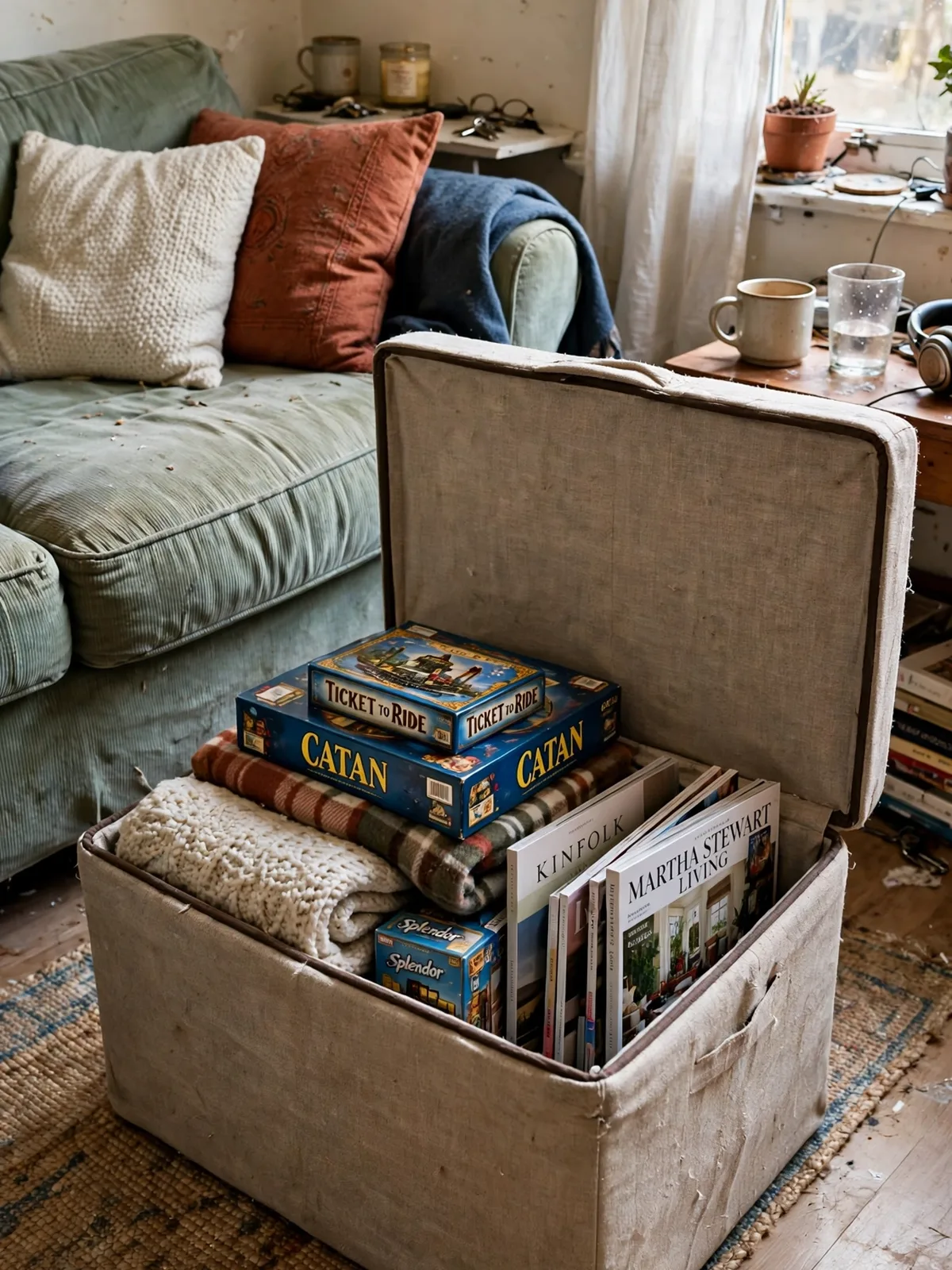
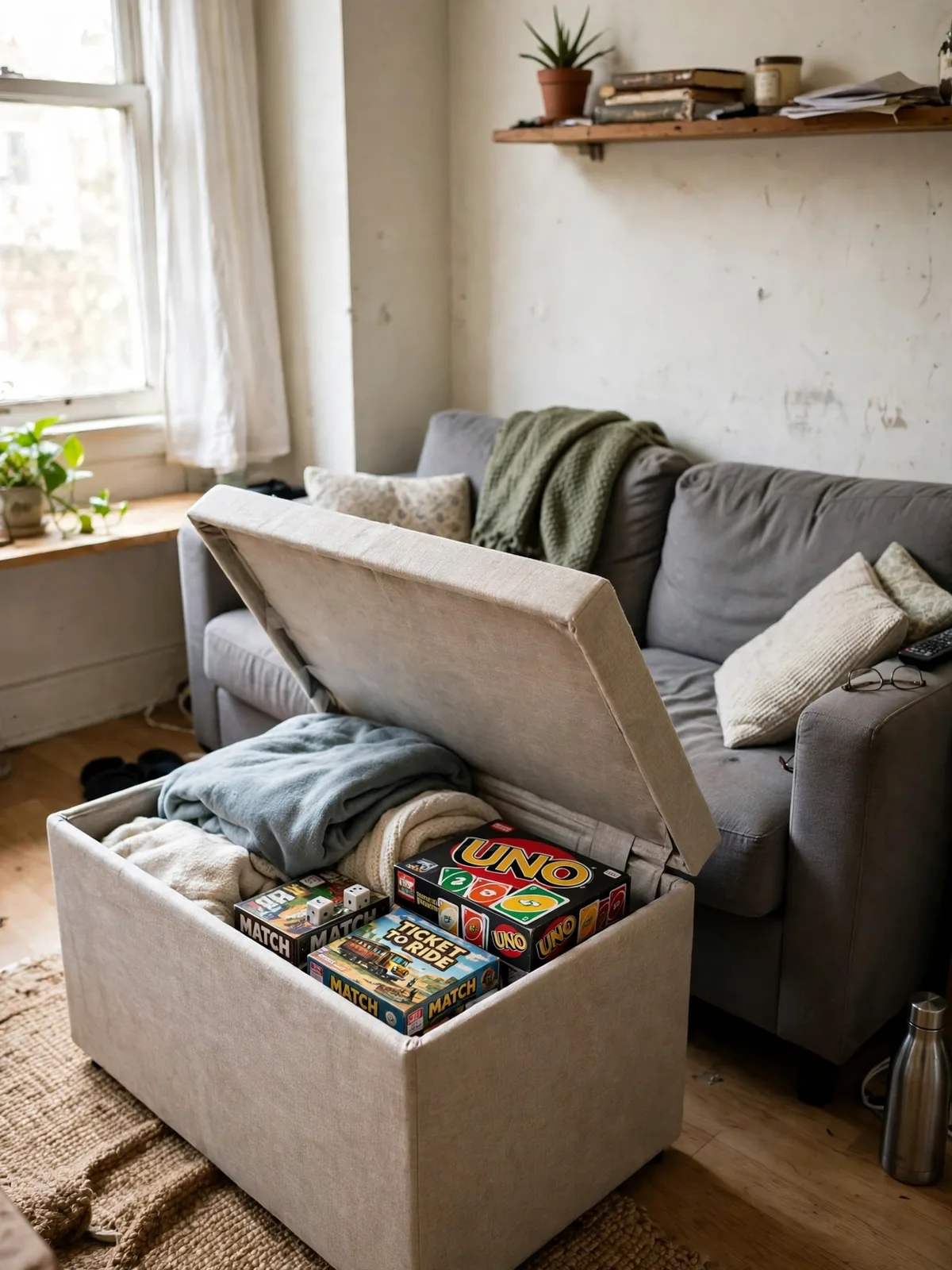
A big storage ottoman is the hardest-working liar in a small living room. It looks like a footrest, works as extra seating when friends come over, and inside it swallows the stuff that normally lives on your couch — two throw blankets, the board games, remotes, charging cables, even the dog toys. A standard 36-inch fabric ottoman runs about $60 to $120 and holds roughly what a medium moving box holds. Pick one with a hinged lid instead of a loose top; hinges stay open while you dig. Faux leather wipes clean if kids or pets rule the room. Park it where clutter already gathers.
A Storage Bench at the Foot of the Bed

The foot of your bed is dead floor in most bedrooms. A storage bench turns it into a linen closet you sit on. The typical bench is about 48 inches wide and 18 inches deep, with a hinged lid over one long compartment — enough for the spare duvet, two pillows, and the heavy winter blanket that bullies everything else in your closet. Upholstered versions run $90 to $180; flat-pack wooden ones cost less. Get safety hinges if kids will open it, because that lid is heavy. It also gives you a place to sit while tying shoes, which sounds small until you have done it on a mattress edge for years.
Fake Book Boxes Hiding in the Bookshelf

Some clutter is small, valuable, and ugly to leave out — passports, a spare key, the good jewelry, gift cards. Fake book boxes hide it in plain sight on the shelf it already lives near. They come in sets of two or three for about $15 to $25, sized like real hardcovers, with hollow insides and covers that blend into an actual book row. Slide them between real books of similar height so the spines do not line up too perfectly — real shelves are a little messy. One rule: tell one other person in the house which books are fake. A hiding spot nobody can find again is just losing things with extra steps.
Low Trays That Slide Under the Sofa

Measure the gap under your sofa before you judge it. Most sofas sit 4 to 6 inches off the floor, and that shallow space is perfect for low storage trays — flat, lipped trays that slide like drawers without any hardware. One tray holds the shoes that pile up by the couch, another takes magazines, the laptop, and the puzzle in progress. Bamboo or powder-coated metal trays run $15 to $30 each. Add felt pads underneath if your floors scratch easily. The trick is one category per tray. The moment a tray becomes miscellaneous, it becomes the junk drawer you have to lie on the floor to reach.
A Headboard With a Hidden Shelf Behind It

A headboard is a wall you already own. Headboards with a hidden rear shelf — or sliding front panels — hide a shallow ledge, usually 4 to 6 inches deep, running the width of the bed. That is exactly enough for the bedside pile: the book you are reading, your phone and charger, a water bottle, glasses, the TV remote that migrates. Beds look calmer because the nightstand surface stays nearly empty. Storage headboards start around $150 for a queen. If replacing the headboard is not an option, a slim floating shelf mounted directly behind your current one creates almost the same hidden ledge for under $30.
Bed-Base Drawers That Read as Part of the Frame

If your bed frame is due for replacement anyway, skip the empty under-bed void and buy the drawers built in. Bed-base drawers are part of the frame itself — usually two to four deep drawers, each big enough for a folded stack of sweaters or a full set of linens. Because they are framed and on real runners, they glide instead of scraping like loose bins do, and the bed reads as solid furniture, not storage. Expect to pay $100 to $250 more than a plain frame. It pairs naturally with our under-bed storage ideas if your current frame still has a few good years left.
Hunt the dead spaces
Walk your home slowly and look for the gaps everyone ignores: the 4 inches under the kitchen cabinets, the wall above the doorway, the slot beside the fridge. Toe-kick drawers and a slim rolling cart exist because those gaps are real storage — they just never had a door before.
A Lift-Top Coffee Table With a Hollow Middle

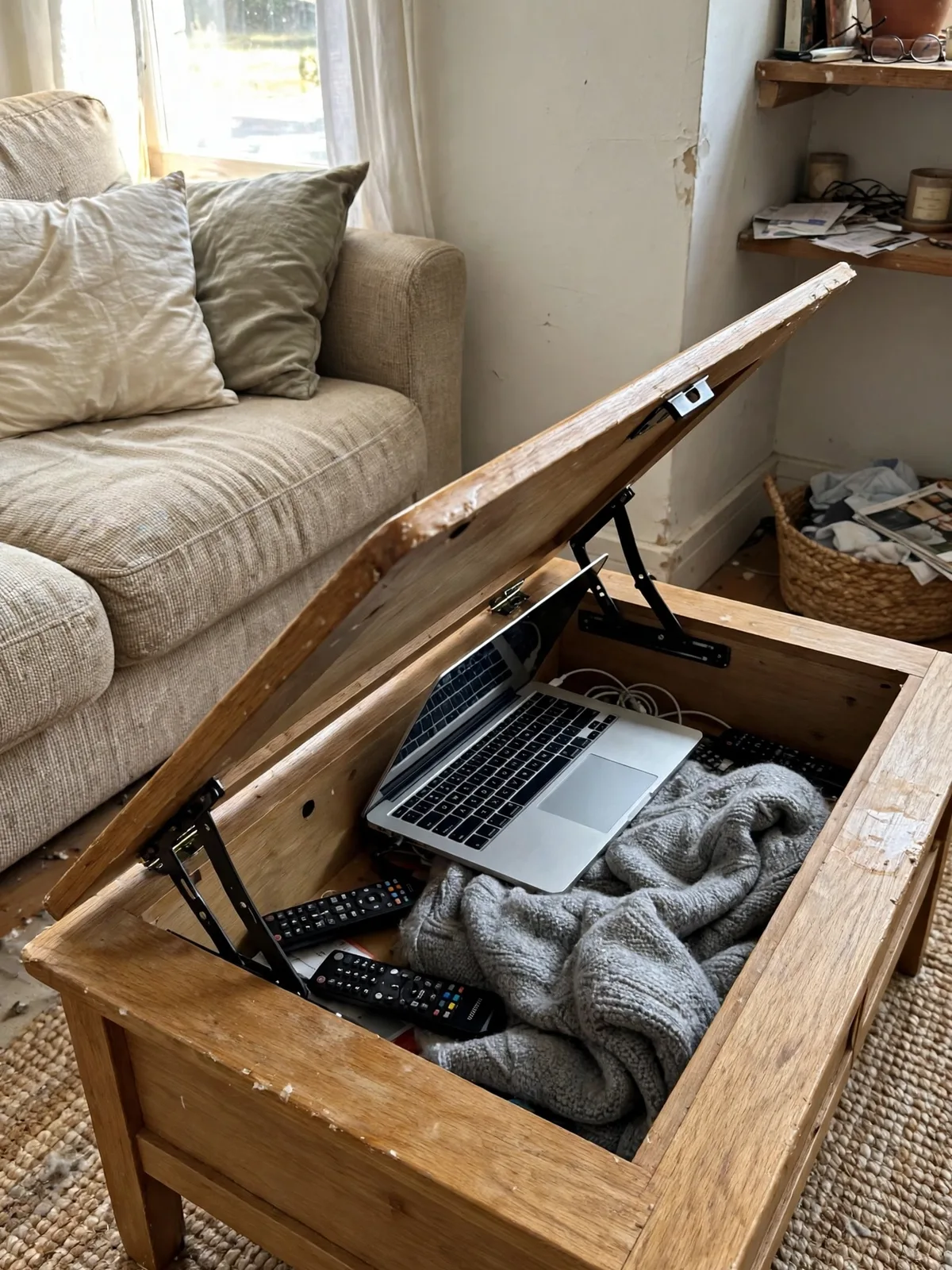
A lift-top coffee table hides two tricks. The top rises on a hinge to about 24 or 25 inches — comfortable height for eating or working from the couch — and underneath sits a hollow compartment, typically 3 to 5 inches deep, that swallows remotes, coasters, the laptop, chargers, and the throw blanket. In a studio apartment, this one piece replaces a desk, a side table, and a storage bin. Prices run $120 to $250 for solid, wobble-free hinges; go cheaper and the lift mechanism wobbles within a year. Test the hinge in the store if you can, and keep the compartment to flat things so the top still closes flush.
Shelves Hidden Behind a Curtain

Not every hiding spot needs a door. A set of shallow shelves hidden behind a curtain works anywhere a cabinet will not fit: a rental hallway, the wall beside the pantry, a laundry corner. Mount two or three shelves 8 to 10 inches deep, hang a simple linen curtain on a tension rod or ceiling track in front, and the whole thing reads as a soft wall instead of storage. It is ideal for the unglamorous overflow — cleaning supplies, extra toilet paper, the toolbox. Fabric hides the visual noise, costs under $20, and in a rental the whole setup comes down with a few screw holes to fill. Choose a curtain wider than the shelves so it drapes instead of clinging.
A Mirror That Opens Into a Cabinet

A full-length mirror that swings open into a cabinet is the bathroom cabinet's bigger, smarter sibling. Most are about 4 to 5 inches deep — enough for jewelry hooks, makeup, perfumes, and the hair tools that otherwise colonize the sink. Wall-mounted versions run $80 to $200; over-door ones cost less and suit renters. Hang it in the bedroom or hallway where you actually get ready, not necessarily the bathroom. The mirror face means nobody walking past sees storage at all, just a mirror. Soft-close hinges matter here more than anywhere; a slamming mirror full of glass bottles will cure you of cheap hardware fast.
Toe-Kick Drawers Under the Kitchen Cabinets

That recessed strip at the bottom of your kitchen cabinets — the toe kick — is about 4 inches tall and usually completely hollow. Toe-kick drawers turn it into the flattest drawer in the house, and flat is exactly what baking sheets, cooling racks, and the big cutting board need. Retrofit kits run $40 to $80 per drawer and install under most standard cabinets in an afternoon. It is also a genius spot for a folding step stool or the rarely used platter that only comes out once a year. Be honest about one thing: you will forget this drawer exists for the first month. Put only flat, rarely urgent things in it until the habit sticks.
The Dead Space Above the Doorway

Look up. The wall space above a doorway — inside a closet, a bathroom, or a bedroom — is usually blank, and a single shelf there holds a surprising amount. In a bathroom it takes the stock-up overflow: extra towels, toilet paper, the big shampoo bottles. Above a closet door it holds the out-of-season bin you need twice a year. A simple board on two brackets costs under $25 and installs in twenty minutes. Keep it for light, bulky things you do not grab daily, because everything up there involves a step stool. In a small home, that trade is worth it: the prime shelves stay free for daily life.
Storage Inside the Stairs (or Under-Stair Pull-Outs)

Stairs look solid, but a staircase is mostly hollow — and in a small home that is cubic feet of storage going to waste. The classic build puts drawers inside the stair treads themselves, one per step, perfect for shoes, gloves, and tools. If a remodel is not in the cards, under-stair pull-outs on the side wall do the same job: tall rolling panels that slide out from under the slope, holding coats, the vacuum, or board games. This is the one project on the list that usually needs a carpenter, and prices vary wildly, from a few hundred for simple pull-outs to far more for fitted tread drawers. It is also the one guests will talk about.
Measure the hiding spot first
Every failed hidden-storage project I have seen came down to half an inch. Measure the gap, the depth, and the swing of the lid or door before you buy. Write it on a sticky note, take the note to the store, and let a snug fit be the whole point — hidden storage only works when it truly disappears.
A Lift-Up Entry Bench by the Front Door

Small homes rarely have a mudroom, but most have two feet of wall beside the front door. A lift-up entry bench claims it: shoes and bags disappear inside the seat, and the top gives you somewhere to sit while you put them on. Look for one about 36 inches wide with a slow-close hinge and, ideally, a washable cushion — entry benches collect weather. Prices run $70 to $160. Inside, keep only what belongs to this week: current shoes, the dog leash, reusable bags. The bench is a landing strip, not a closet. If off-season boots move in, the daily shoes end up on the floor again, and the whole system quietly dies.
A Dining Banquette With Storage Inside

A dining banquette with storage inside earns its keep twice: it seats more people in less floor space than chairs, and each bench seat lifts or slides open to hold the big, awkward dining stuff — table linens, serving platters, the fondue set, extra candles. Built-in versions are a carpenter job, but freestanding storage benches pushed against a wall fake the look for $150 to $300. This is the move that makes tiny dining corners work, and it pairs well with the broader approach in our small apartment storage ideas. One tip: store things here by occasion, all together, so setting a holiday table means opening one bench, not four closets.
A Shallow Cabinet Hidden Behind a Picture Frame

It looks like framed art on the wall. Behind it is a cabinet about 3 to 4 inches deep. Picture-frame storage cabinets are made for the shallow, scattered things that never get a home: keys and sunglasses by the door, medicines and first aid in the hallway, spice packets in the kitchen. Most hold their frame front with a magnetic latch and open with a gentle pull. They run $50 to $120 depending on size. Because they are shallow, nothing gets buried — everything inside stands in a single row, visible at a glance. Of all the hiding spots on this list, this is the one visitors never, ever guess.
A Slim Rolling Cart in the Fridge-to-Wall Gap

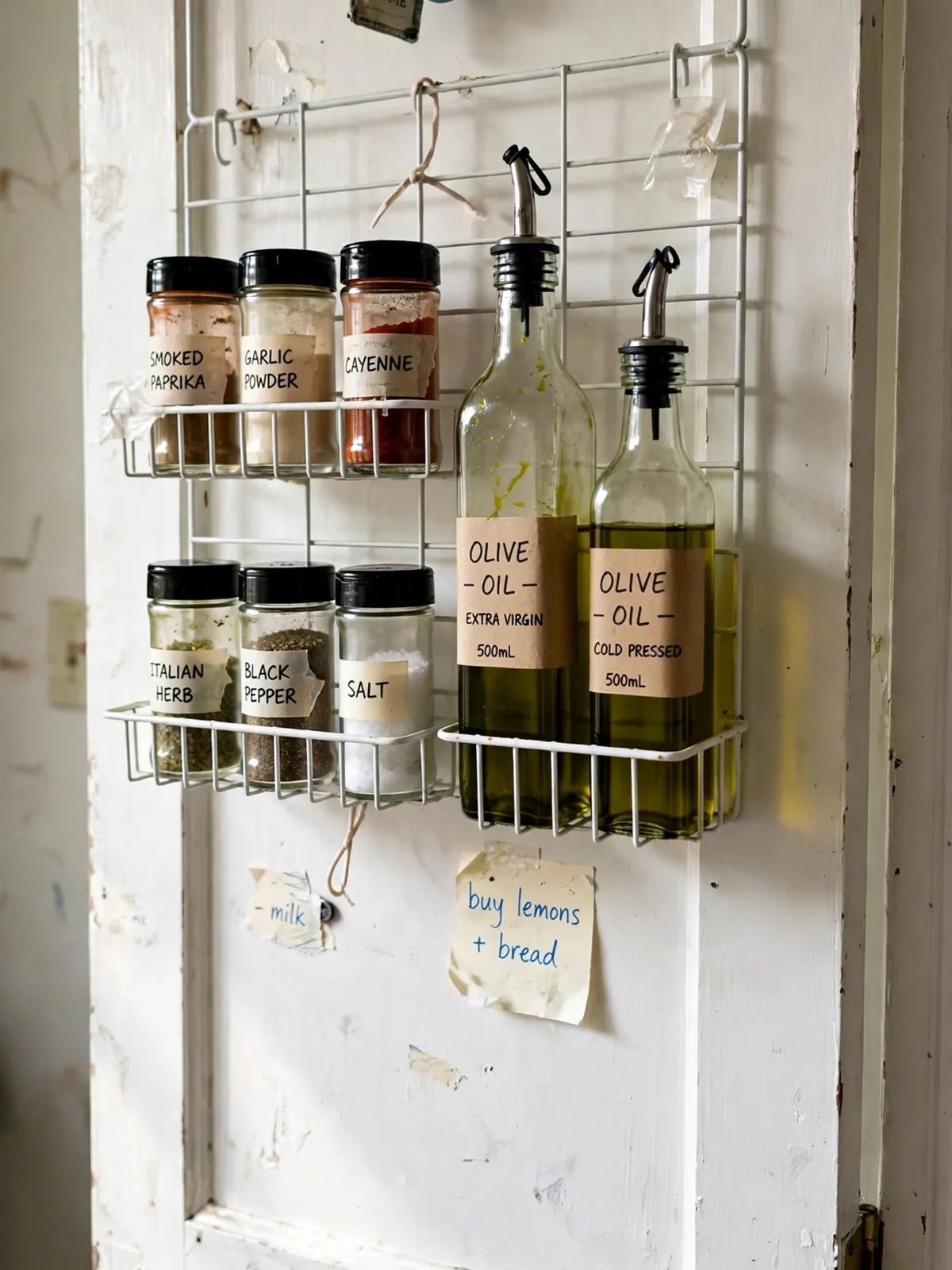
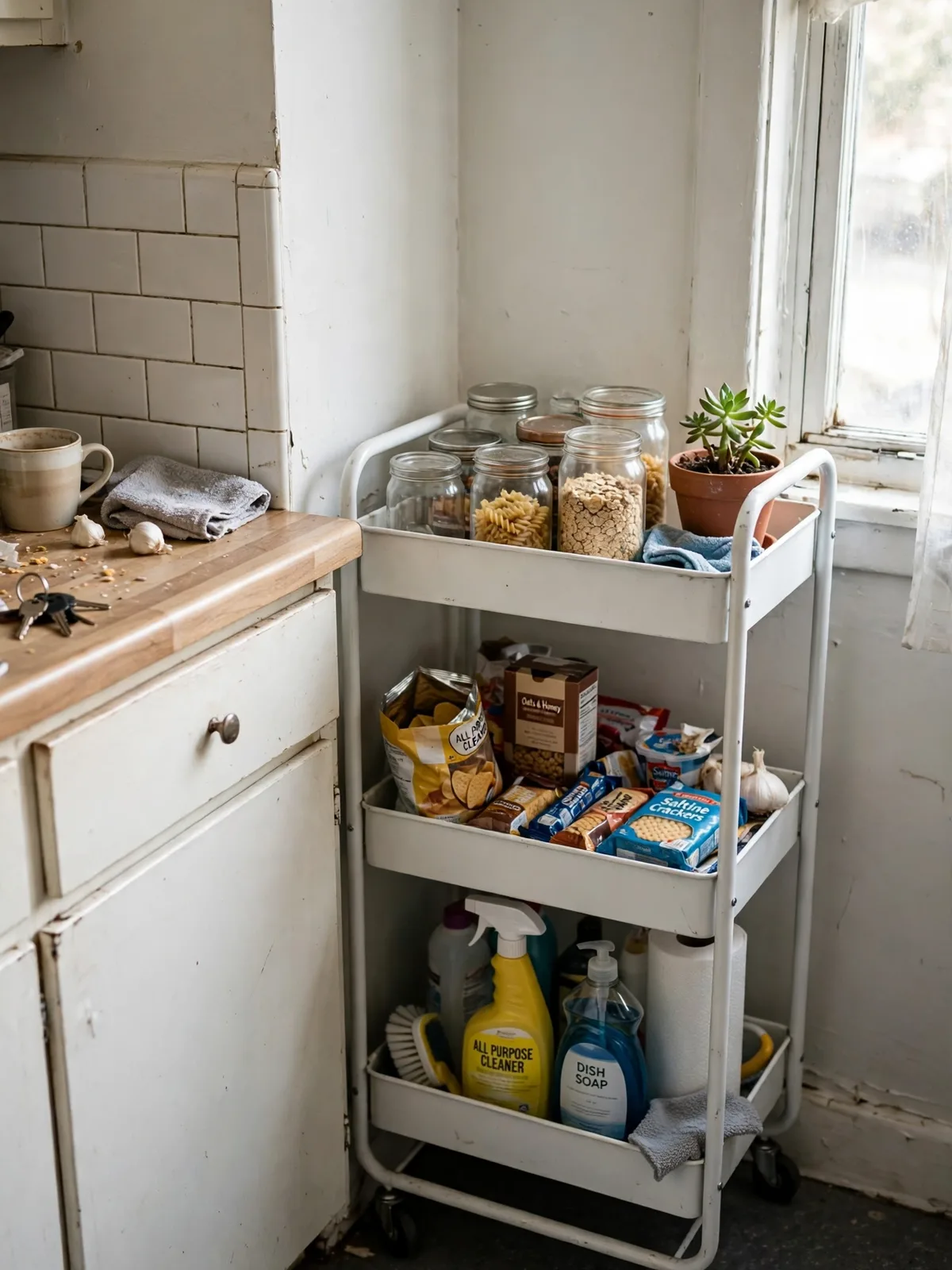
Run your hand along the side of your fridge. In most kitchens there is a gap of 5 to 7 inches between the fridge and the wall or counter — pure dead space with dust in it. A slim rolling cart built for exactly that gap, usually about 5 inches wide on casters, slides in and turns the slot into a vertical pantry: spices, oils, wraps and foils, tall cleaning bottles. They cost $25 to $45 and assemble in minutes. Pull it out by the handle, take what you need, roll it back. Measure your gap first — carts come in a few widths, and half an inch too wide is just a cart standing in your kitchen.
Vintage Suitcases That Store the Off-Season Stuff

A stack of vintage suitcases reads as decor. Open them and they are storage with better PR. Hard-shell vintage cases are sturdy, stack two or three high as a side table, and each one swallows a season: winter scarves and gloves in one, beach towels and swim gear in another, keepsakes in the third. Thrift stores sell them for $10 to $30 each. Line them with a clean fabric bag if the interior smells like attic, and slip a label inside the lid listing what is in there. They work especially well for renters — no installation, they move with you, and the furniture is doing a second job the whole time.
You do not need all 17. Pick the three hiding spots your home already offers — most people start with a storage ottoman, the fridge-gap cart, and whatever is waiting above the nearest doorway — and let those prove the idea before you spend on furniture.
The goal is not a home that looks empty. It is a home where the everyday stuff has a place to disappear to, so the surfaces stay clear and the rooms feel bigger than they measure. Hide less, but hide it better: if half of what you are stashing is stuff you do not need, the 30-day declutter challenge is the honest first step, and our bedroom ideas with no closet pick up right where this list leaves off.
Hidden Storage FAQs
Expert answers & styling advice
What counts as hidden storage? ▼
Storage counts as hidden when the container disappears into something else — a bench, a mirror, a stair, a wall. If guests cannot point to where your blankets live, it is hidden. Open shelves and labeled bins are great organization, but they are visible organization; this list is about the kind you cannot see at all.
How do I find hidden storage space in my small home? ▼
Look inside, under, above and behind. Inside furniture that is hollow, under stairs and sofas, above doorways, behind mirrors and curtains. Measure each spot you find — most homes have at least three usable dead spaces, and the fridge gap and toe-kick alone can add the equivalent of a small cabinet.
Is hidden storage furniture worth the extra cost? ▼
Usually, yes — because it replaces two purchases with one. A storage ottoman at $80 replaces a $50 footrest plus a storage bin, and it saves the floor space the bin would have taken. The exception is cheap lift mechanisms: hinges and lift-tops are where budget versions fail first, so spend there if you spend anywhere.
How do I keep hidden storage from becoming forgotten storage? ▼
Keep a simple rule: hidden spots hold things you use weekly or seasonally, never things you use never. Label the inside of lids — a vintage suitcase with its contents listed inside the lid never becomes a mystery box — and do a quick inventory of every hiding spot when the seasons change.