17 Storage Room Ideas That Turn a Spare Room Into Real Storage

17 practical ideas — zones, heavy-duty shelving, labeled bins, under-stairs drawers and a monthly reset — that turn a spare room, garage corner or basement into storage you can actually find things in.
Table of Contents (17 Ideas)
- 1.Empty It Out and Start With a Blank Slate
- 2.Give the Room Zones Before You Buy Anything
- 3.Put In Heavy-Duty Freestanding Shelving
- 4.Switch to Clear Bins in One or Two Sizes
- 5.Use the Ceiling Height With Top Shelves
- 6.Hang a Pegboard Wall for Tools
- 7.Keep a Slim Rolling Cart in the Middle
- 8.Fit Pull-Out Drawers Under the Stairs
- 9.Shrink Seasonal Clothes With Vacuum Bags
- 10.Get Bikes and Sports Gear Up on the Wall
- 11.Keep Basement Storage Off the Floor
- 12.Label Everything and Keep an Inventory List
- 13.Use the Back of the Door
- 14.Stack Crates for Toys and Keepsakes
- 15.Rotate by Season With Four Labeled Boxes
- 16.Tame Small Parts With Jars and Drawer Dividers
- 17.Do a Ten-Minute Monthly Reset
Every house has a room like this: the spare room, the corner of the garage, the basement nook, the cupboard under the stairs. It starts as a sensible place to keep things and slowly becomes the place where things go to disappear. You know the feeling — you buy a second extension cord because the first one is in there somewhere, buried under the camping gear.
The problem is rarely the size of the room. It's that nothing in it has a fixed address. These 17 storage room ideas work in all four of those spots, because they fix the same root problem: a room with no zones, no labels and no plan for what goes where. If the rest of your home needs the same treatment, our small apartment storage ideas use the same zone-and-bin logic room by room.
 Save Pin
What you'll need for most of these ideas
Most of this list runs on five things: heavy-duty metal shelving, clear stackable bins in one or two sizes, woven storage baskets, chalk labels with a chalk pen, and a pack of vacuum storage bags. Buy them in that order if you're spreading out the cost — the shelving and the bins change the most, the fastest. Everything else here is just deciding where things live.
Empty It Out and Start With a Blank Slate

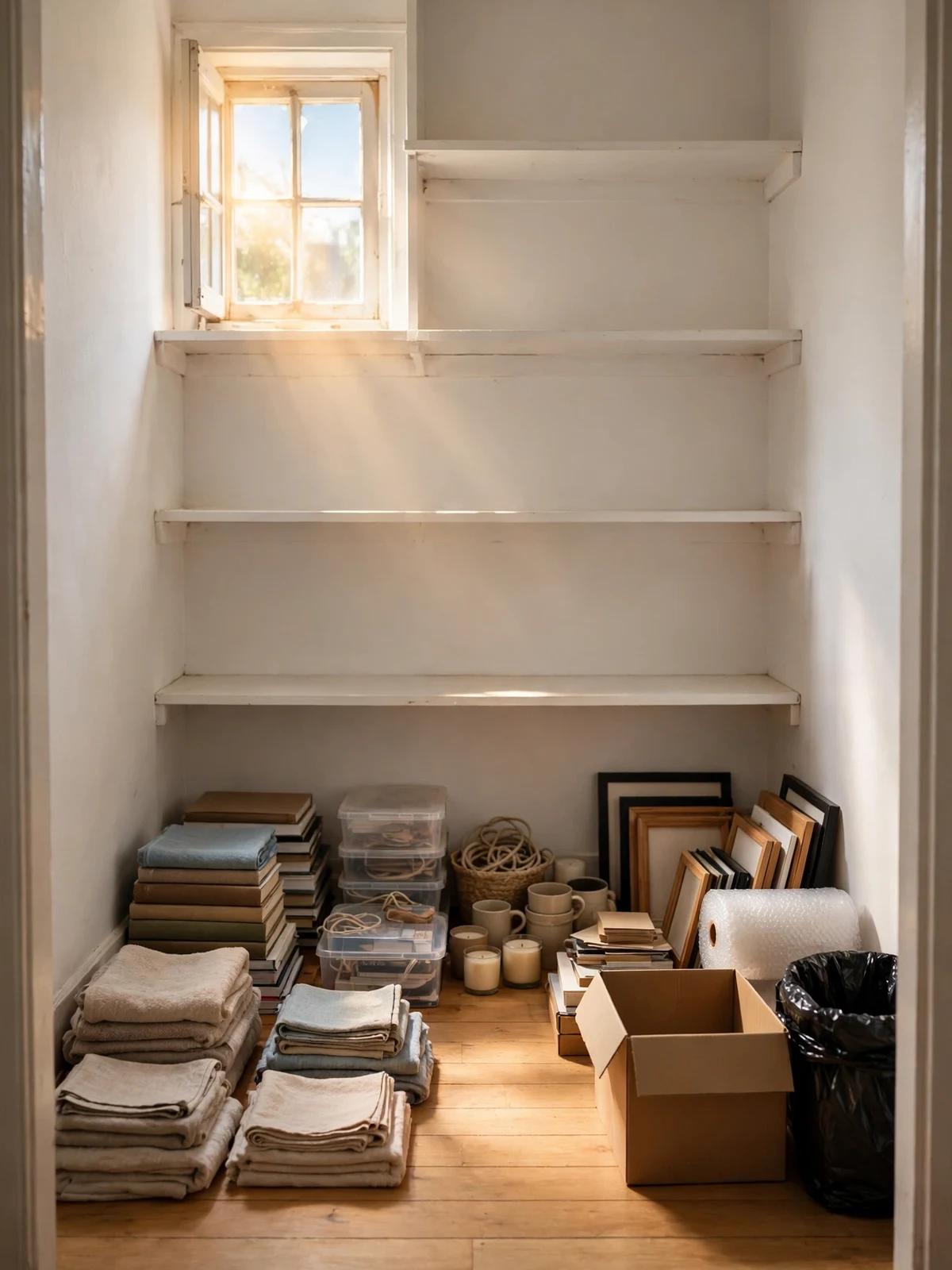
Yes, all of it. Every box, bag and loose item comes out of the room and onto the floor or the landing. You cannot organize a storage room while you're still standing inside the mess, and one honest afternoon of pulling everything out saves you months of shuffling boxes around. Sort as you go into four piles: keep, donate, bin, and relocate (things that belong in another room entirely). Sweep the floor and wipe the shelves while the room is empty, then only put back what you actually use or genuinely need to keep.
Give the Room Zones Before You Buy Anything

A storage room without zones becomes a junk drawer with a door. Before you buy a single bin, decide what each wall and each shelf is for: one wall for seasonal things, one for tools and household spares, one for keepsakes and paperwork. Within a shelf, group by category — all the holiday decorations together, all the camping gear together. It sounds obvious until you realize most storage rooms are organized by 'wherever it fit on the day I carried it in.' Zones end the daily treasure hunt, and putting things away becomes a two-minute job instead of a puzzle.
Put In Heavy-Duty Freestanding Shelving

If you buy one thing for a storage room, make it a proper shelving unit — not the flimsy wire rack that bows under a box of books. Heavy-duty metal shelving in a 36-inch or 48-inch width holds real weight: paint cans, toolboxes, boxes of files. The open sides matter as much as the strength, because you can see and reach everything without opening a door. Bolt the unit to the wall with the brackets that come in the box; a loaded shelf in a garage can tip when a kid pulls on it.
Switch to Clear Bins in One or Two Sizes

Cardboard boxes are the enemy of a tidy storage room: they sag, they tear, they hide what's inside, and mice love them. Replace them with clear stackable bins in just one or two sizes — a large 60-litre for bulky stuff and a smaller 30-litre for the rest. Clear matters, because a bin you can see into gets used and refilled, while an opaque box quietly becomes a mystery you never open. Same-size bins stack in straight columns instead of leaning towers, which quietly buys you a whole extra row of space. Label the narrow end, not the top, so you can read it when bins are stacked.
Use the Ceiling Height With Top Shelves

Most storage rooms waste the top two feet of wall. That's where the rarely used stuff belongs: suitcases, the artificial Christmas tree, the spare duvet, the box of outgrown baby clothes you're keeping for the next child. Fit one high shelf across the wall — a simple 12-inch-deep board on sturdy brackets, or a second tier on top of your shelving unit — and the floor suddenly has breathing room. This is one of the best storage room ideas for small spaces because it adds storage without taking a single inch of floor. Keep a small step stool in the room itself so reaching the top shelf is a ten-second job, not a reason to drag a chair in from the kitchen.
Hang a Pegboard Wall for Tools

Tools in a box are tools you can't find. A wooden pegboard on one wall turns the whole collection into a display you can read at a glance: hammers, screwdrivers, the drill, the spirit level, each on its own hook. Trace around each tool with a marker once it's hung, so the outline shows you exactly where it goes back — and shows you instantly when something is missing. If you're renting, a freestanding pegboard panel that leans against the wall does the same job with no holes. Our hidden storage ideas have more ways to get gear off the floor without drilling.


Keep a Slim Rolling Cart in the Middle

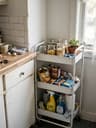
A storage room needs one thing you can move: a slim three-tier rolling cart for the stuff you use often but don't want on a shelf. Cleaning sprays and cloths, the small toolbox, light bulbs and batteries, the bag of screws — all in one cart that rolls to wherever you're working and tucks back against the wall when you're done. It also works as a temporary landing spot when you're carrying things in: load the cart, wheel it to the right shelf, put things away properly. Buy one with locking casters so it stays put on a sloped garage floor, and load the heaviest tier at the bottom so it rolls straight instead of tipping on a turn.
The two buys that do the heavy lifting
If the budget only stretches to two things, make it heavy-duty metal shelving and clear stackable bins. Together they solve the two real problems of a storage room — things piling on the floor, and things hiding in boxes — for less than a family takeaway. Everything else on this list is refinement.
Fit Pull-Out Drawers Under the Stairs

The cupboard under the stairs is the most awkward storage in the house: deep, dark, and sloped, so everything at the back is unreachable. The fix is to stop treating it as a cupboard and treat it as drawers. Shallow pull-out drawers on runners — or even sturdy low bins on wheels — let you slide the whole category toward you: shoes in one, scarves and hats in another, the vacuum and cleaning kit in the deepest one. Measure the slope before you buy anything; the drawers get shorter as the ceiling drops, and that's fine.
Shrink Seasonal Clothes With Vacuum Bags

Winter coats, spare duvets and out-of-season clothes eat a shocking amount of shelf space. Vacuum storage bags shrink a bulky duvet to about a third of its size — roll the air out or use a vacuum cleaner nozzle, seal it, and stack the flat bags like books on a shelf. They're brilliant for the 'keeping it for next year' pile that otherwise fills a whole unit. Dry everything fully first, then seal.
Get Bikes and Sports Gear Up on the Wall

A bike leaning against the wall eats a metre of floor and falls over the moment someone brushes past it. A vertical wall hook or a ceiling hoist gets it up and out of the way — hang it by the front wheel and the whole bike takes up about as much space as a coat. Do the same for the rest of the sports pile: a tall mesh basket for balls, a wall rack for rackets and bats, skis or a snowboard mounted flat on brackets. The rule is simple — anything long, round or awkward goes on the wall, and the floor keeps only things that stack. Measure the handlebar width before you fit the hook, or two bikes side by side will tangle every time.
Keep Basement Storage Off the Floor

Basements flood a little, leak a little, or just stay damp — and the floor is where the damage happens. Nothing in a basement storage room should sit directly on concrete. Raise bins on low wooden pallets, a plastic shelving unit with feet, or even a couple of bricks under each corner of a crate. Cardboard is banned down here; it wicks moisture and turns to mush in one wet season, so everything goes in sealed plastic bins with snap lids. A small dehumidifier in the corner, emptied weekly or plumbed to a drain, keeps the air dry enough that clothes and paper survive the winter.
Label Everything and Keep an Inventory List

Labels feel fussy right up until someone else puts things away and everything still ends up in the right place. Use chalk labels or erasable tags on every bin so the system survives whoever is carrying boxes in. Label the shelf edge too, not just the containers — that's what turns 'zones' from an idea into a habit. Then take it one step further: keep a simple inventory list on a clipboard inside the door, one line per bin, updated when something moves. 'Bin 4: Christmas lights, extension cords, tree skirt' means you never open six bins to find the lights. Good storage room organization is mostly this — writing down where things are, and trusting the list.
Use the Back of the Door

The back of the storage room door is free real estate. An over-door rack with a few shallow shelves holds wrapping paper, gift bags, tape and ribbon — the wrapping station that otherwise spreads across a whole shelf. A row of sturdy hooks takes the step ladder, the dustpan and brush, or the spare ironing board. This is one of those small storage room ideas that costs almost nothing and quietly frees a full shelf. Renters, this one is for you: it hangs on hooks, no screws, no damage, and it comes with you when you move. Just check the door still closes cleanly once it's loaded, and keep the heaviest items low so the door doesn't swing like a pendulum. Our over-door storage ideas cover the same trick for every other door in the house.
Stack Crates for Toys and Keepsakes

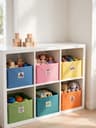
Toys and keepsakes are the two categories that creep the fastest, and they need different rules. Toys go in stackable crates the kids can actually reach and carry — one crate per type, blocks in one, dolls in another, and a firm one-in-one-out rule when a new toy arrives. Keepsakes go higher, in one lidded bin per child, with a date on the label: school drawings, the first shoes, the birthday cards worth keeping. Stacking crates instead of one giant toy box means you can pull out a single category without the whole pile avalanching onto the floor, which is how toy storage usually fails.
A quick word about damp
If your storage room is a basement or a garage corner, check it after the first heavy rain. Sealed plastic bins and a small dehumidifier cost far less than replacing a box of water-damaged photo albums. The test is simple — if the concrete feels cold and clammy under your hand, nothing paper or fabric should touch the floor.
Rotate by Season With Four Labeled Boxes

Four boxes, one per season, is the simplest rotation system there is. The spring box holds the garden seed trays and the light jackets; summer holds the picnic set and the paddling pool; autumn holds the leaf bags and the Halloween decorations; winter holds the sled and the thick blankets. When a season ends, its box goes to the top shelf and the next one comes down — a ten-minute swap, twice a year, instead of a full-day sort. Label each box with its season in big letters on the narrow end, and keep a short contents list taped inside the lid. Seasonal rotation is the heart of storage room organization: the room only ever holds what this season needs at arm's reach, and the rest waits quietly overhead.
Tame Small Parts With Jars and Drawer Dividers

Screws, nails, picture hooks, spare batteries, fuses, the mystery keys — the small stuff is what makes a storage room feel chaotic even when the big bins are tidy. Decant it all into small glass jars on one shelf, or a shallow parts organizer with adjustable dividers: one compartment for screws, one for wall plugs, one for batteries, one for the keys nobody can identify (label those with a tag and a date — unclaimed after a year, they go). A drawer divider in a single deep drawer does the same job for the flat stuff: tape measures, spare bulbs, the glue gun. The test is simple — if finding a single AA battery takes more than thirty seconds, your small-parts storage is costing you time every week.
Do a Ten-Minute Monthly Reset

No system survives contact with a real month of living unless it's maintained, and the maintenance here is genuinely small: ten minutes, once a month, ideally on the first Saturday. Put strays back in their zones, check the labels are still honest, move anything nearly finished into the donate box, and sweep the one dusty corner. That's it. While you're in there, glance at the inventory list on the door and cross off anything that left the room. Skip the reset and the mess wins back a little ground each month; keep it, and the storage room you organized in idea one is still the storage room you have a year from now.
A storage room will never hold everything a bigger house can — and that's fine. What it can do is hold exactly what you use, in a way that lets you find it in five seconds. Start with the empty-out, give the room zones, put in one good shelving unit and label everything honestly. You don't need all 17 ideas at once. Pick the five that solve your biggest headache, live with them for a month, then add more as you see what your room actually needs. Small room, calm house — that's the whole goal. And if the clutter is the real problem rather than the room, our 30-day declutter challenge clears it one small daily task at a time.
Storage Room Organization FAQs
Expert answers & styling advice
How do I organize a storage room with no shelves? ▼
Start with one freestanding shelving unit — a 36-inch heavy-duty metal unit costs less than most people expect and instantly gives you four or five levels of storage. Until it arrives, stack clear bins in columns against the wall, heaviest at the bottom, and use the back of the door for hooks and a rack. Avoid piling boxes on the floor: a pile is not storage, it's a landslide waiting for a reason.
What is the best way to store things in a damp basement? ▼
Keep everything off the floor on pallets or shelving with feet, use sealed plastic bins instead of cardboard, and run a small dehumidifier. Paper, photos and fabric should go in sealed bins on an upper shelf, never at floor level. Check the room after heavy rain for the first month so you learn where any damp comes in before it ruins anything.
How do I keep a storage room organized with kids in the house? ▼
Give kids one shelf or one set of crates that's entirely theirs — toys they can reach, in containers they can carry, at a height that doesn't need climbing. Everything above that line stays adult-organized. Add a one-in-one-out rule for new toys, and put the keepsake bin for each child on a high shelf so the daily chaos never touches it.
Should I use clear or opaque bins in a storage room? ▼
Clear bins win in almost every storage room, because you can see what's inside without opening anything — and a bin you can see into is a bin that gets used. Opaque bins only make sense when the contents look messy no matter what, like a jumble of cables, or when the room gets direct sun that would fade fabrics. Even then, label the narrow end clearly.
How often should I clean out a storage room? ▼
A full clean-out should only happen once — after that, it's maintenance. Ten minutes a month for the reset (strays back in their zones, labels checked, donate box emptied) and a proper hour once a year, ideally in spring, to catch anything you've stopped needing. If you find yourself emptying the whole room every few months, the system — not you — needs adjusting. Usually a zone is simply in the wrong place.