15 Corner Cabinet Organization Ideas That End the Dead Space

Corner cabinets do not have to be dead space. 15 fixes for blind, deep, upper and lower corners, from a $25 lazy susan to pull-out magic corners and diagonal drawers.
Table of Contents (15 Ideas)
- 1.Put a Full-Round Lazy Susan in a Lower Blind Corner Cabinet
- 2.Install Kidney Swing-Out Shelves in a Lower Corner Cabinet
- 3.Add a Pull-Out Magic Corner Unit to a Lower Blind Corner
- 4.Use Half-Moon Pull-Out Shelves in a Deep Lower Corner Cabinet
- 5.Fit Diagonal Corner Drawers That Use the Whole Wedge
- 6.Spin a Two-Tier Turntable in an Upper Corner Cabinet for Spices and Oils
- 7.Add a Diagonal Shelf Insert to an Upper Corner Cabinet for Display Storage
- 8.Stand Everyday Dishes in a Corner Plate Rack in an Upper Corner Cabinet
- 9.Stack Mugs on a Corner Shelf Riser in an Upper Corner Cabinet
- 10.Stick a Battery LED Light Strip in the Deep Corner So It Stops Being a Cave
- 11.Use Clear Bins on a Turntable for the Deep Back Corner
- 12.Follow the Rarely Used Rule: Seasonal and Party Items Only in the Corner
- 13.Hide Sponges in a Sink-Front Tilt-Out Tray by a Corner Sink
- 14.Make a Small Appliance Station in an Upper Corner Cabinet — Your Coffee Corner
- 15.Measure First: Identify Your Corner Type — Blind, Diagonal or L-Shaped — and Pick the Right Fix
Every kitchen has one: the corner cabinet where good pans go to disappear. You end up kneeling on the floor, phone torch on, arm in up to the shoulder, and the lid you need is still two inches out of reach.
The fix is rarely a bigger kitchen. Good kitchen cabinet organization corner storage comes down to matching the hardware to the corner you actually have. A blind corner wants a pull-out or a swing-out shelf that brings the back to you. A diagonal corner wants drawers. An upper corner wants a turntable or a riser, so nothing can hide behind the front row.
And if your real headache is kitchen cabinet organization deep storage, that long dark stretch at the very back, several ideas below are built for exactly that, from clear bins on a turntable to a cheap light strip that ends the cave effect. Here are 15 fixes, roughly in order of effort, starting with the easiest win of the lot.
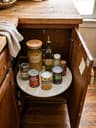
Put a Full-Round Lazy Susan in a Lower Blind Corner Cabinet

If you only do one thing on this list, do this. A full-round lazy susan is the simplest fix for a lower blind corner because it needs no tracks, no drilling and no cabinet surgery. Measure the inside of the cabinet at its narrowest point, then buy the biggest round tray that fits with a finger's width to spare. In a standard 36-inch corner base cabinet that usually means a 28-inch or 32-inch turntable, which costs roughly $25 to $45. Drop it in, load the heavy everyday things around the edge, cans, jars and the olive oil, and give it a spin. The back of the cabinet stops being a mystery because the back now rotates to the front. Keep one small gap in your loading so the tray never jams against the door frame.
Install Kidney Swing-Out Shelves in a Lower Corner Cabinet

Kidney-shaped shelves, sometimes sold as D-shaped, are cut to fit the curve of a corner cabinet with a hinged or bifold door. The clever part is the swing: pull the door and both shelves glide out and round the corner towards you, so the contents arrive in daylight instead of staying buried. Most sets fit 28-inch and 32-inch cabinet openings and hold a surprising amount, two levels of mixing bowls, the slow cooker, baking dishes and the blender base. Expect to pay $120 to $220 for a decent set, and set aside an hour with a drill and a level. It is more work than a lazy susan, but for heavy items that would topple off a spinning tray, the flat, steady shelf wins.
Add a Pull-Out Magic Corner Unit to a Lower Blind Corner

The magic corner sounds like marketing, but the mechanism earns the name. It is a frame of two wire baskets linked to the cabinet door. Open the door and the front basket pulls out with it, while the second basket slides sideways out of the blind section you could never reach. Every centimetre of a deep lower corner becomes usable, which is why this is the fix kitchen fitters suggest first for blind corners. It is also the priciest option here, usually $200 to $350 plus fitting, and it needs a minimum door opening, often around 15 to 16 inches, so check yours before ordering. Best for daily pots and pans you are tired of excavating.
The three pull-outs worth the money
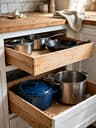
If you are spending real money on one lower corner, these three earn it: a blind corner pull-out optimizer (magic corner) for daily pots and pans, a kidney swing-out shelf set for heavy bowls and small appliances, and half-moon pull-out shelves when the door opening is too narrow for a full unit. Measure the door opening twice before ordering any of them.
Use Half-Moon Pull-Out Shelves in a Deep Lower Corner Cabinet

Half-moon shelves are the middle ground between a simple turntable and a full magic corner. Each shelf is shaped like a half circle and pivots out of the cabinet on its own, so you can swing the top shelf towards you without disturbing the one below. They suit a deep lower corner cabinet where the door opening is too narrow for a full round tray to spin happily. Most kits are two shelves in soft-close steel or solid plastic, around $80 to $150, and each shelf typically holds up to 35 pounds. They are a kind choice for heavy cast iron and casserole dishes, because the weight stays on a shelf instead of a spinning disc. This is kitchen cabinet organization deep storage at its most practical.
Fit Diagonal Corner Drawers That Use the Whole Wedge

Look at a diagonal corner cabinet from above and it is a wedge. Most shelves waste the pointy end of that wedge. Diagonal corner drawers are built at the same 45-degree angle as the cabinet front, so the drawer box fills the whole shape, right into the back point. A set of three is the classic layout: a shallow top drawer for cutlery and utensils, a medium one for wraps and towels, and a deep bottom drawer for pots. This one is a renovation or new-kitchen move rather than a weekend retrofit, and it costs more than any insert, but nothing else on this list wastes less space. If you are planning cabinets now, it pairs beautifully with the layouts in our kitchen cabinet organization ideas.
Spin a Two-Tier Turntable in an Upper Corner Cabinet for Spices and Oils

Upper corner cabinets swallow spice jars whole. A two-tier turntable, usually 10 to 12 inches across, doubles the storage in one sweep of that awkward upper shelf and keeps every label one spin away. Put the daily spices on the bottom tier at eye level and the tall bottles, oils, vinegars and the big salt tub, on the top tier. The raised edge matters more than people expect; look for a lip or a non-slip surface so jars do not skate off mid-spin. These cost about $15 to $25 and need zero installation, which makes them the best value idea in the upper half of this list. More spice-specific layouts live in our spice organization ideas.
Add a Diagonal Shelf Insert to an Upper Corner Cabinet for Display Storage

Some upper corners are too shallow or too oddly angled for a turntable to make sense. A diagonal shelf insert, a simple angled board or a small set of diagonal cubbies, turns that dead wedge into display storage instead. The angle faces the room, so the things you put there should be the good-looking, grab-often ones: the stacked ceramic bowls, the nice glasses, the cookbooks you actually open. Because everything sits on show, nothing gets pushed to a hidden back row. You can build one from a single pine board cut at 45 degrees for under $20, or buy ready-made corner cubby inserts. It is storage, yes, but it also makes the corner look deliberate rather than forgotten.


Small buys that fix upper corners
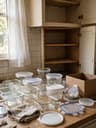
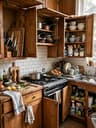
Upper corners rarely need hardware, just height and light: a two-tier turntable for spices and oils, a stackable corner shelf riser for the mug sprawl, and a corner plate rack so everyday dishes stand upright. All three together usually come in under $75, and none of them needs a drill.
Stand Everyday Dishes in a Corner Plate Rack in an Upper Corner Cabinet

Stacked plates in a corner cabinet are a daily annoyance: you lift the whole pile for the plate at the bottom, and the corner shape means the stack never sits straight. A corner plate rack, a slatted wooden or bamboo frame shaped to hug the angle, stands plates upright like files in a drawer. You slide out exactly the plate you need, and the rack keeps a small air gap between each one, so there is less chipping. These racks usually hold 8 to 10 dinner plates and cost $20 to $35. Put everyday dishes here, at the height between your hip and your shoulder, and save the low cabinets for heavier things. Your wrists will notice the difference within a week.
Stack Mugs on a Corner Shelf Riser in an Upper Corner Cabinet

Mugs are the worst shape to store flat: wide, handled and mostly air. In an upper corner cabinet they sprawl across a whole shelf while the space above them does nothing. A stackable corner shelf riser, a small tiered stand shaped for the angle, gives you two or three levels in the same footprint. Everyday mugs on the bottom level, the nice set on top, espresso cups in the little wedge at the side. Most risers are bamboo or coated metal, hold 8 to 12 mugs and cost $15 to $30. Measure your shelf height before buying; you want at least 5 inches of clearance per level for standard mugs. It is a ten-minute fix with an outsized payoff.
Stick a Battery LED Light Strip in the Deep Corner So It Stops Being a Cave

Sometimes the corner is not badly organized, it is just dark. Everything past the first six inches might as well be in another house. A battery LED light strip fixes that for about $10 to $15: peel, stick it under the shelf or along the top inside edge of the cabinet, and pick one with a motion sensor so it wakes up when the door opens. Warm white light reads truer for food labels than cold blue. No wiring, no electrician, and renters can peel it off later. It sounds too small to matter, but once the back of a deep corner is lit, you stop buying duplicate jars of things you already own, which is where the real saving hides.
Use Clear Bins on a Turntable for the Deep Back Corner

For a deep back corner that no hardware quite fits, this low-tech pairing works far better than it should. Put two or three clear bins with handles on the biggest turntable your cabinet takes, often an 18-inch tray in a base cabinet. One bin for baking supplies, one for packets and pouches, one for snacks or lunchbox bits. Because the bins are clear, you can see when the flour is running low without opening anything, and because they sit on a turntable, the whole group spins forward and lifts out in one go. This is the heart of kitchen cabinet organization deep storage: group, see, spin, lift. It also suits food containers well, as our food container organization ideas show in more detail.
For the deep back corner
Deep corners respond to a simple kit: clear bins with handles so groups lift out in one go, a large 18-inch turntable under them so the whole group spins forward, and a battery LED light strip with a motion sensor along the top edge so you can actually see what is back there.
Follow the Rarely Used Rule: Seasonal and Party Items Only in the Corner

Here is the rule that keeps every other idea on this list working: the hardest corner in your kitchen should hold only the things you reach for the least. The fondue set. The big party platter. The cake stand, the holiday mugs, the punch bowl that comes out twice a year. If an item is used weekly, it has no business in the deepest spot, no matter how neatly it fits. Do a quick honesty pass with a box beside you: anything in the corner that you use every week moves to an easier cabinet, and anything rarely used takes its place. This costs nothing and takes twenty minutes. Most corner chaos is not a storage problem at all, it is a placement problem.
Hide Sponges in a Sink-Front Tilt-Out Tray by a Corner Sink

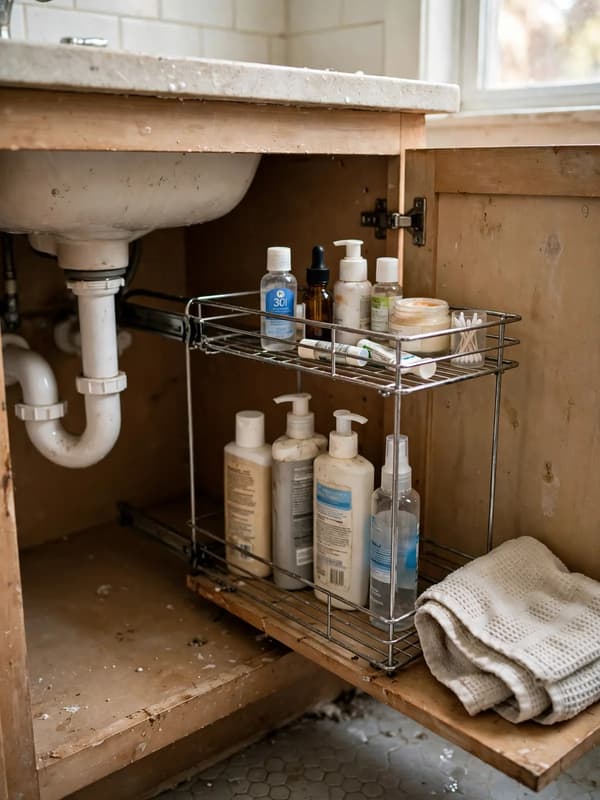
Corner sinks create their own dead space: the false drawer front right under the sink, which looks like a drawer and opens like a lie. A tilt-out tray kit replaces that fixed panel with a hinged one and a slim tray behind it, exactly the right size for the things that otherwise colonize your countertop: sponges, the scrub brush, sink plugs, a bottle brush. Kits cost $20 to $40 and fit most standard false fronts; the tray itself is usually stainless steel or plastic and lifts out for a wash. It will not change your life, but a clear sink edge makes the whole corner feel calmer, and it frees a surprising amount of counter. For the cabinet under that sink, see our under-sink organization ideas.
Make a Small Appliance Station in an Upper Corner Cabinet — Your Coffee Corner

The countertop stretch under an upper corner cabinet is often too shadowy for chopping but perfect for a small appliance station. Claim it as a coffee corner: the machine lives on the counter, and the upper corner cabinet above it holds everything that goes with it, mugs on a small riser, beans or pods in a clear jar, filters and the French press on the shelf above. Keeping the whole ritual in one corner means one cabinet to open with sleepy eyes, and it pulls a daily clutter magnet off your main worktop. If tea is more your thing, the same layout works with a kettle and a small tea caddy. Heavy pots, meanwhile, belong lower down; our pots and pans organization ideas cover that end of the kitchen.
Measure First: Identify Your Corner Type — Blind, Diagonal or L-Shaped — and Pick the Right Fix

Before you buy anything on this list, spend five minutes identifying what you actually have, because the wrong hardware in the right cabinet still fails. Open the corner and look. A blind corner has one door and a wall of hidden space beside it; it wants pull-outs, swing-outs or a lazy susan. A diagonal corner has an angled front, often with a bifold door; it loves turntables and corner drawers. An L-shaped corner has doors on both sides and shelves you can mostly reach; simple risers and bins may be all it needs. Measure the door opening, the inside width and the depth, and write the three numbers in your phone. Every product listing assumes you know them. Guessing is how organizers end up in the returns pile.
Corner cabinets are not broken storage, they are just storage that was never given a system. Give a blind corner a way to pull its contents forward, give an upper corner some height and light, give the deep back a spin and a clear bin, and the dead space quietly becomes some of the hardest-working space in the kitchen.
Start with the corner that annoys you most, measure it honestly, and pick the one fix from this list that matches its shape. One corner done properly has a way of making the whole kitchen feel calmer, and it usually takes less than an afternoon.
Corner Cabinet FAQs
Expert answers & styling advice
What is the best organizer for a blind corner cabinet? ▼
For most kitchens, a pull-out magic corner unit is the most complete fix, because it brings the hidden half of the cabinet out into the open. If the budget or the door opening rules that out, a large lazy susan is the best simple option: cheap, no installation, and it still puts the back of the cabinet within reach.
How do I organize a deep corner cabinet? ▼
Treat kitchen cabinet organization deep storage as three jobs: group, light and spin. Group similar items in clear handled bins, add a battery LED strip so the back is visible, and set the bins on the largest turntable the cabinet takes. Keep only rarely used items at the very back, and everyday things in the front half that you can reach without kneeling.
What size lazy susan do I need for a corner cabinet? ▼
Measure the inside of the cabinet at its narrowest point, including any door hinges, then choose a tray at least 2 inches smaller than that measurement. A 36-inch corner base cabinet usually takes a 28-inch or 32-inch lazy susan. For upper cabinets, 18-inch and 24-inch trays are the common sizes. When in doubt, go one size down; a tray that jams helps nobody.
Are diagonal corner drawers worth the cost? ▼
If you are renovating or ordering new cabinets, yes. Corner drawers use the full wedge shape, including the back point that shelves waste, and a deep bottom drawer swallows pots that fit nowhere else. As a retrofit they rarely make sense, because the cabinet carcass has to change. Existing kitchens get better value from pull-outs and turntables.
Can I organize a corner cabinet without installing anything? ▼
Yes. The no-drill kit is a turntable, two or three clear bins, a shelf riser and a stick-on LED strip. Add the rarely used rule, moving weekly items out of the deepest spot, and most corners behave themselves. Renters can take the whole kit to the next kitchen, which is more than can be said for most fitted hardware.