15 Pots and Pans Organization Ideas for Deep Cabinets

Deep cabinets swallow pots whole. These 15 ideas — pull-out drawers, peg systems, lid files, vertical dividers and a proper baking zone — make every pan easy to see, grab and put back.
Table of Contents (15 Ideas)
- 1.Deep Pull-Out Drawers Inside a Base Cabinet
- 2.An Adjustable Peg System in a Deep Drawer
- 3.A Vertical Lid File So Lids Stop Living on Top of Pots
- 4.Lids Mounted on the Inside of the Cabinet Door
- 5.A Horizontal Tiered Pan Rack for Skillets
- 6.Vertical Pan Dividers — Pans Filed on Their Sides
- 7.Sheet Pans and Cutting Boards Stored Vertically
- 8.A Roll-Out Shelf Under the Cooktop Cabinet
- 9.A Corner Lazy Susan That Makes the Blind Corner Hold Pots
- 10.Stack With Felt Pan Protectors So Nonstick Survives
- 11.A Dishes Cabinet Nearby: Plate Rack and Stacked Bowls With Risers
- 12.A Hanging Rail With S-Hooks Under an Upper Cabinet or on a Wall
- 13.An Overhead Pot Rail or Rack for Bigger Kitchens
- 14.The Nesting Set Rule for Small Kitchens
- 15.The Baking Zone: Sheet Pans, Casseroles and Roasting Trays by the Oven
If your pots live in a deep base cabinet, you already know the routine. You crouch down, peer into the dark, drag out two pans to reach the one at the back, and everything clatters back in a heap. Good kitchen cabinet organization for pots is not about buying more storage. It is about making that 24-inch-deep cabinet work like a drawer, so you can see every pan, grab it with one hand, and put it back without a small avalanche.
The 15 ideas below are built for real kitchens — standard 36-inch base cabinets, awkward blind corners, lids that never stay put, and the sheet pans that end up wherever they fit. Some are $15 fixes for this weekend, a couple are bigger projects. Start with the cabinet that annoys you most.
Deep Pull-Out Drawers Inside a Base Cabinet

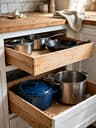
This is the single biggest fix, and it is not close. Replace the fixed shelf inside a 30- or 36-inch base cabinet with two deep pull-out drawers on full-extension slides, and the whole cabinet changes. Instead of reaching 24 inches into the dark, the contents come to you. The lower drawer, about 10 to 12 inches deep, holds your tall stockpot, Dutch oven, and largest saucepan. The upper drawer, around 5 to 6 inches deep, takes skillets and medium pots. Look for slides rated for 75 to 100 pounds — a drawer full of cast iron is heavier than it looks. A retrofit kit for one cabinet usually runs $120 to $250, and most people fit one in an hour with a drill and a level. If you only do one thing, do this. Our broader kitchen cabinet organization ideas show how the same pull-out thinking works for the rest of the kitchen.
An Adjustable Peg System in a Deep Drawer

A deep drawer on its own still lets pots slide every time you open it. An adjustable peg system fixes that. A pegboard base sits in the bottom of the drawer, and tall wooden or metal pegs push into the holes to ring each pot and hold it in place. A 12-inch skillet gets a wide ring, a small saucepan gets a tight one, and when you buy a new pan you just move the pegs — no new organizer needed. Peg sets for a standard drawer cost about $30 to $60. Measure your drawer interior before you order, because a 30-inch cabinet drawer is usually closer to 26 inches inside. Leave a finger of space around your heaviest pot so you can lift it straight up without catching the pegs on either side.
A Vertical Lid File So Lids Stop Living on Top of Pots

Lids are half the clutter problem. They slide off stacked pots, they clatter, and the glass one you need is always at the bottom. A vertical lid file — basically a rack with slots, like a toast rack for lids — stands them upright in a row inside the cabinet or drawer. A rack with 8 to 10 slots holds the lids for most home sets, from a small 6-inch saucepan lid up to a wide 12-inch skillet lid. Stainless steel and bamboo versions both run $15 to $25. Put the rack at the front of the cabinet or along one side of a deep drawer, sorted largest at the back. You should be able to flip through them with one finger and pull the right one first time.
Lids Mounted on the Inside of the Cabinet Door

If cabinet space is tight, the inside of the door is free storage you are probably not using. A door-mounted lid rack screws or hooks onto the inside of a base cabinet door and holds 4 to 6 lids flat against it. Command-strip and over-door versions cost $12 to $20 and need no tools, which makes them a good renter option. Check two things before you buy: that your lids fit the rack's hooks — deep dome lids can be too thick — and that the door still closes fully with your tallest pot on the shelf behind it. This spot suits the lids you use daily: the skillet lid, the medium saucepan lid, the one that fits the Dutch oven. The rest can live in the lid file.
Measure before you buy anything
Deep cabinets punish guesswork. Before you order a single rack, measure three things and write them on your phone: the cabinet's inside width, its depth front to back (usually 22 to 24 inches), and the clear height under any shelf. Then measure your biggest pan with its lid on. Most returns happen because a rack fit the cabinet but the 12-inch skillet with a dome lid did not fit the rack. Five minutes with a tape measure saves the whole return trip.
A Horizontal Tiered Pan Rack for Skillets

Stacking skillets directly on each other scratches nonstick and makes the bottom pan a two-handed job. A horizontal tiered rack works like a small set of shelves: each pan rests on its own level with air between it and the next. A 4- or 5-tier rack fits inside most base cabinets and holds a 12-inch skillet, a 10-inch skillet, and a couple of smaller pans without any of them touching. Expect to pay $25 to $40 for a sturdy steel one. Measure your cabinet height first — racks need about 12 to 14 inches of vertical room once pans are on them. Put the pan you cook eggs in on the top tier, at grab height, and the heavy cast iron at the bottom where it is stable.
Vertical Pan Dividers — Pans Filed on Their Sides

The other way to store pans is on their sides, filed like books. Vertical dividers slot into a cabinet or deep drawer and create narrow bays, each holding one pan upright. This uses far less height than a tiered rack, so it suits cabinets with a shelf in the way or drawers about 8 inches deep. It is a kind way to store nonstick, stainless, and sheet-thin crepe pans, because nothing rests on the cooking surface. Divider sets run $18 to $30, and adjustable ones expand to fit the width of your cabinet. One honest caution: very heavy cast iron skillets are happier lying flat. File the lighter pans, and give the cast iron its own flat spot.
Sheet Pans and Cutting Boards Stored Vertically

Flat things stored flat become a stuck-together pile. Half-sheet pans, baking trays, and cutting boards all store better standing up. A set of tension dividers or a simple vertical rack inside a tall cabinet — the narrow one beside the oven is ideal — files them upright so you slide out the one you need. This is the heart of kitchen cabinet organization sheet pans actually need: vertical, separated, and near where you bake. A divider set costs $15 to $28. Keep it to the pans you use: two half-sheets, one quarter-sheet, a muffin tin, and your two everyday boards is plenty for most homes. If a board wobbles, it is too thin for the slot — pair it with a sheet pan in the same bay.
A Roll-Out Shelf Under the Cooktop Cabinet

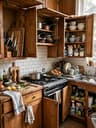
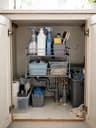
The cabinet under or beside the cooktop is prime real estate, and in most kitchens it is the messiest one. A single roll-out shelf — a shallow tray on slides that you add to the cabinet floor — turns it into storage you can actually use for everyday pans. The roll-out holds the 2 or 3 pans you cook with daily, right under the burners where you need them. Kits cost $50 to $90 per shelf and screw into the cabinet base in about 30 minutes. It holds less than a full drawer conversion, but it costs a third as much and works in cabinets with plumbing or a fixed half-shelf that drawers cannot replace. Measure around any pipes before ordering.
Three helpers worth the money
If you buy nothing else, these three earn their drawer space: felt pan protectors in mixed sizes, about $12 a pack, to sit between every stacked pan; a sturdy stainless steel lid rack with wide slots for glass lids, around $18; and a set of adjustable vertical pan dividers that expand to your cabinet width, about $24. Together they handle lids, stacking, and filing — the three jobs every deep cabinet needs — for under $60 total.
A Corner Lazy Susan That Makes the Blind Corner Hold Pots

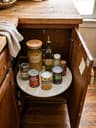
Blind corner cabinets swallow pots whole. You put the roasting pan in there in November and find it in March. A lazy susan fixes the geometry: two round or kidney-shaped trays that spin, so the back of the corner rotates to the front. A 28- or 32-inch two-tier susan holds a surprising amount — a stockpot and slow-cooker base on the bottom, saucepans on top. Expect $70 to $150 for a sturdy one, more for a pull-out corner system that slides the whole corner out. Store the pots you use weekly in there, not the once-a-year ones, because you will actually reach them now. For sizing and blind-corner alternatives, see our corner cabinet organization ideas.
Stack With Felt Pan Protectors So Nonstick Survives

Sometimes stacking is the only option — a small cabinet, a big set, no budget for racks yet. Stacking is fine. Stacking bare pan on bare pan is what kills nonstick. Felt pan protectors are soft star-shaped pads that sit between pans and cushion the cooking surface. A pack of 12 in mixed sizes costs about $10 to $14 and takes two minutes to put into service. Nest largest to smallest: the 12-inch skillet at the bottom, protector, 10-inch, protector, 8-inch on top. The same pads work between stainless pans to stop rattling, and between glass lids and pot rims. Replace them when they get thin and grubby, about once a year. It is the cheapest idea on this list and it genuinely saves pans.
A Dishes Cabinet Nearby: Plate Rack and Stacked Bowls With Risers

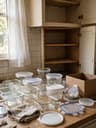
Pots get easier when the cabinet next door stops competing for space. Give dishes their own spot close to the dishwasher, and think about kitchen cabinet organization dishes need too: a vertical plate rack that files dinner plates upright, so you lift one out instead of lifting a stack of six. Beside it, a small shelf riser doubles your bowl storage — cereal bowls stacked four high on the riser, pasta bowls below it. Plate racks run $20 to $35, risers $12 to $18. Keep everyday plates and bowls between waist and shoulder height; the heavy serving platters can go higher. Once dishes have a fixed home, the pots cabinet stops being the overflow for everything. The same zoning idea helps with food container organization ideas in the drawer nearby.
A Hanging Rail With S-Hooks Under an Upper Cabinet or on a Wall

If your cabinets are full, look at the wall. A rail — a simple bar mounted under an upper cabinet or on a stretch of empty wall — with S-hooks holds your most-used pans in the open, handles out, ready to grab. A 24- to 30-inch rail with 8 hooks costs $20 to $35 and holds a skillet set, a saute pan, and a couple of saucepans, as long as they have a hole or loop in the handle. Stainless and copper pans look good up there; scratched-up nonstick, less so — be honest about which pans earn the display. Mount it into studs or use proper wall anchors, because a rail of pans is 15 to 20 pounds.
The two-minute nightly reset
Whatever system you pick, it only stays tidy if putting a pan away is easier than leaving it on the hob. Keep daily pans in the fastest spot — the roll-out, the top drawer tier, the rail — and let the stockpot live deeper. Then, while the dishwasher loads: lids back in the file, protectors back between pans, one pan per slot.
An Overhead Pot Rail or Rack for Bigger Kitchens

High ceilings and a big kitchen? Take the pots up. An overhead rack — ceiling-mounted or hanging over an island — holds the full set in view: stockpot, Dutch oven, skillets, saucepans, all on hooks around the frame. Good racks cost $90 to $200 and need solid fixing into ceiling joists; this is a measure-twice, drill-once job, and worth getting a second pair of hands for. Headroom is the rule: the lowest hanging pan should clear the tallest cook's head by a few inches, so this rarely works under 8-foot ceilings unless the rack sits over an island nobody walks under. The payoff is a whole base cabinet freed up.
The Nesting Set Rule for Small Kitchens

Small kitchens cannot organize their way out of owning too many pans. The fix that works is a rule, not a product: keep one good nesting set — pots designed to stack inside each other with lids that sit flat — as your everyday core, and run a strict one-in, one-out habit after that. A typical nesting set (a stockpot, two saucepans, and two skillets that nest into one footprint) costs $120 to $200 and can cut your pan storage in half. The one-in, one-out part matters more than the set: a new wok means an old pan goes to donation, no exceptions, no 'just in case' shelf. Audit twice a year. If a pan has not been used in six months and it is not seasonal, it is storage, not equipment.
The Baking Zone: Sheet Pans, Casseroles and Roasting Trays by the Oven

Last, group by job, not by shape. A baking zone — one cabinet or deep drawer near the oven holding sheet pans, casserole dishes, roasting trays, and cooling racks together — ends the hunt that starts every roast dinner. Stand the sheet pans vertically at one side using the dividers from idea 7, stack casseroles with a felt protector or folded tea towel between them, and lay roasting trays flat at the bottom where their weight belongs. Trivets and oven gloves live here too, in a small basket, not in the spice organization ideas drawer across the kitchen. When everything for the oven lives within one step of the oven, weeknight cooking gets calmer in a way guests notice and nobody can quite explain.
Deep cabinets are not bad storage. They are just storage that asks you to do all the work — the crouching, the reaching, the unstacking. Every idea here hands some of that work back: drawers that come to you, dividers that hold a spot for each pan, lids with a home of their own, and zones that match how you actually cook.
Do not try all 15 in a weekend. Pick the cabinet that makes you sigh, fix that one, and live with it for a week. If the pots cabinet was only the start, the same thinking applies under the sink — our under-sink organization ideas tackle the other cabinet everyone avoids. One calm cabinet at a time is how a whole kitchen gets there.
Pots and Pans Organization FAQs
Expert answers & styling advice
What is the best way to organize pots in a deep cabinet? ▼
Pull-out storage wins, because it brings the back row to you. Two deep pull-out drawers — or a roll-out shelf on a smaller budget — plus a lid file and dividers covers most kitchens. If you change nothing else, give lids a rack instead of storing them on top of pots.
How do I stop pans scratching each other? ▼
Never stack bare nonstick on bare nonstick. Use felt pan protectors between stacked pans, or stop stacking altogether with a tiered rack or vertical dividers so each pan sits on its own. Glass lids should stand in a rack, not rest rim-down on a pan. A full set of protectors costs about $10 to $14 and takes minutes to put in place.
Where should sheet pans and baking trays go? ▼
Upright, near the oven. Vertical dividers or a rack in a tall cabinet file them on their sides so each one slides out on its own — that vertical setup is what kitchen cabinet organization sheet pans really need, since flat stacks stick together and hide the size you want at the bottom. Group them with casserole dishes and roasting trays as one baking zone.
How many pots and pans does a home cook actually need? ▼
Eight pieces cover most homes: a 12-inch skillet, a 10-inch skillet, a stockpot, two saucepans with lids, a Dutch oven, a saute pan, and a sheet pan. If your cabinet holds far more and still feels chaotic, the issue is usually count, not storage — try the one-in, one-out rule from idea 14 before buying an organizer.
Can I organize a pots cabinet in a rental without drilling? ▼
Yes. Tension dividers, over-door lid racks, freestanding tiered racks, felt protectors, and a plate rack need no screws at all. Skip screw-in door racks and the overhead rail, and check your lease before a wall rail — command-strip lid holders are the safest swap there.