15 Dollar Tree Kitchen Cabinet Organization Ideas That Cost Almost Nothing

Fifteen Dollar Tree fixes for cabinets that avalanche, hide the cans and swallow the lids — shelf risers, small bins, tension rods, door hooks and a turntable, each about $1.25, with a shopping list that stops the second trip.
Table of Contents (15 Ideas)
- 1.Stack Wire Shelf Risers to Double One Shelf
- 2.Zone the Cabinet With Small Plastic Bins
- 3.Hang Spray Bottles From a Tension Rod
- 4.Drop a Lazy Susan Into the Corner Cabinet
- 5.Hook a Wire Basket Over the Cabinet Door
- 6.Screw Cup Hooks Under a Shelf for Mugs
- 7.File Baking Sheets Upright in a Wire Sorter
- 8.Stand Cans in Clear Bins So You See What You Own
- 9.Stick Adhesive Hooks Inside the Door for Measuring Cups
- 10.Stand Wrap Rolls Upright in a Magazine Holder
- 11.Label Two Bins for Baking, and Stop Decanting Everything
- 12.Use Stackable Wire Baskets for Potatoes and Onions
- 13.Build a Tiered Spice Step From a Small Riser
- 14.File Pot Lids Upright Beside the Pots
- 15.Do One $25 Haul, Then a Five-Minute Weekly Reset
Here is the honest truth about kitchen cabinet organization dollar tree style: it works best when you stop trying to buy a whole new kitchen and start fixing one annoying shelf at a time. I have watched people spend $200 on matching containers, then still lose the paprika. The cabinet was never the problem. The missing five-dollar fix was.
These 15 ideas all come from the same aisle logic — cheap, simple pieces that give everything a visible home. Most of them cost $1.25 each, and none of them needs a drill, a saw, or a free weekend. A standard base cabinet is about 24 inches deep, which is why the back row always feels like a different country, so several ideas here are about pulling that depth back into reach.
Grab a tape measure before you shop. Write down the width of each cabinet opening and the height between shelves. That little note is the difference between one satisfying trip and three.
The one-trip shopping list
Go in with measurements, not vibes. You need your cabinet width, shelf height, and a rough count of what lives where. Buy the risers and bins first, the cute extras last. And skip anything that only works if your cabinets were already tidy — Dollar Tree pieces are helpers, not magic, and they earn their keep only when the shelf underneath is already cleared.
Stack Wire Shelf Risers to Double One Shelf

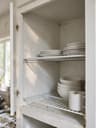
This is the single best dollar-store buy for cabinets, full stop. A wire shelf riser sits on your existing shelf and gives you a second level, so plates live on top and bowls slide underneath instead of stacking into a wobbly tower. Measure the height first: you need enough clearance for the tallest thing going under it, usually a dinner plate stack or a cereal bowl. Two risers side by side can split a wide cabinet into four usable spots. If the riser wobbles, it is too wide for the opening — swap it, do not live with the wobble. For the rest of the cupboards, our kitchen cabinet organization ideas cover the bigger picture beyond the bargain aisle.
Zone the Cabinet With Small Plastic Bins

Small bins are how kitchen cabinet organization on a budget actually holds up, because they turn one big messy shelf into three small honest ones. One bin for snacks, one for baking packets, one for the random pouches that used to drift everywhere. The trick is keeping the bins shallow enough that you can see inside without lifting them out. Label them if your household needs the nudge — masking tape and a marker beat a label maker here, since you will change your mind about the zones in a month. Pull the whole bin out, grab what you need, slide it back. That is the entire system, and it survives teenagers.
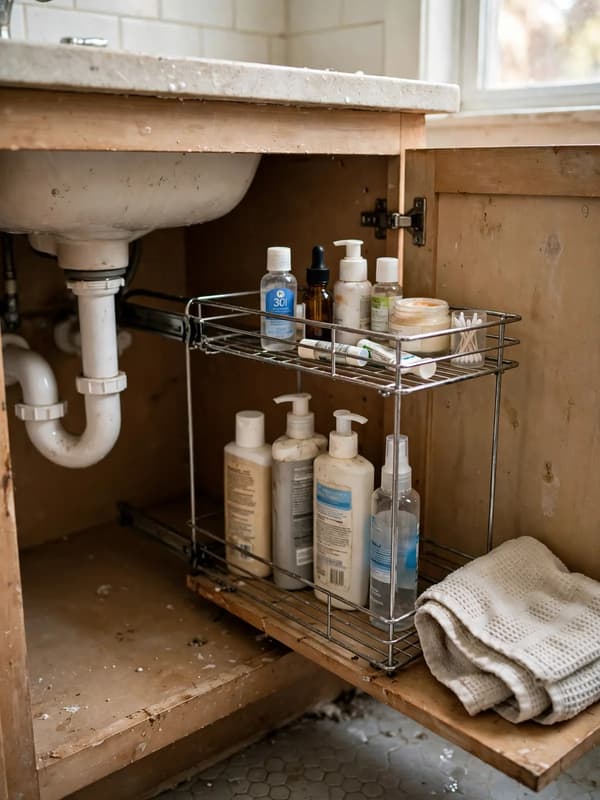
Hang Spray Bottles From a Tension Rod

Under the sink is the cabinet everyone gives up on, thanks to the pipes eating half the space. A tension rod across the top of that cabinet changes it completely: hang spray bottles by their triggers from the rod and the whole floor opens up for a caddy and a spare sponge bag. Twist the rod until it is properly snug — a loose rod drops a bottle at 2 a.m. and you will hear it. Keep the rod high enough that bottles clear the shelf below, and keep the heaviest bottles nearest the ends where the rod grips hardest. If your under-sink chaos runs deeper than bottles, our under-sink organization ideas take it from here.
Drop a Lazy Susan Into the Corner Cabinet

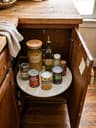
Corner cabinets are where good jars go to be forgotten. A plain turntable fixes the geometry: one spin brings the back row around to the front, no kneeling, no knocking things over. The dollar-store versions are smaller than the fancy ones, which is actually a point in their favor — a 10-inch turntable fits cabinets the big ones cannot. Keep it to one layer of jars, because a stacked turntable turns into a merry-go-round the first time you spin it fast. Put the everyday cooking oils and sauces on it, and leave the once-a-year stuff for the top shelf where it belongs.
Hook a Wire Basket Over the Cabinet Door

The inside of the door is the most ignored storage in the whole kitchen, and an over-door wire basket puts it to work in ten seconds. Foil rolls, wrap boxes and small packets stand upright in it, right where you reach for them, instead of sliding around a drawer. Check two things before you buy: the basket hooks must clear your door thickness, and the basket must not hit the shelf when the door swings shut. Test it slowly the first few times. This is kitchen cabinet organization diy at its simplest — no screws, no damage, and it comes off clean when you move out.
Measure twice, buy once
Two numbers save you the return trip: your cabinet opening width, and the height between shelves. Risers need clearance, turntables need diameter, and door baskets need door thickness. Write all three on your phone before you leave the house. Dollar Tree does not always restock the same sizes, so the piece you skip today may not be there next week.
Screw Cup Hooks Under a Shelf for Mugs

Mugs eat shelf space because they are wide, tall, and somehow always multiplying. A row of small cup hooks under a shelf hangs five mugs in the dead air below it, freeing the shelf above for plates or bowls. The hooks cost almost nothing and go in with a few twists by hand — no drill needed if your shelf is plain wood. Leave a finger-width gap between mugs so they do not clink every time you grab one. Keep the chipped favorite and the giant soup mug on the hooks too; this is not a display shelf, it is a working cabinet, and the mugs you actually drink from deserve the easy spot.
File Baking Sheets Upright in a Wire Sorter

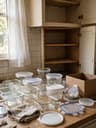
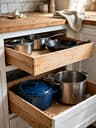
Baking sheets stacked flat are a special kind of misery: you need the one at the bottom, so the whole pile comes out and goes back in a slightly worse order. Stand them upright in a wire file sorter instead, like books on a shelf. Cutting boards and muffin tins file the same way, and suddenly you can pull one sheet without disturbing anything else. The sorter needs to sit where it will not slide when you tug — a bit of shelf liner underneath does the job. If your pans are the ones causing the pile-up, our pots and pans organization ideas sort the heavy stuff next door.
Stand Cans in Clear Bins So You See What You Own

Cans lined up loose on a shelf hide each other, and that is how you end up with five tins of tomatoes and no beans. Clear bins fix the count at a glance: beans in one, tomatoes in another, soup in a third, and you can see the gaps before you shop. Stand the cans upright and keep one bin per category, not one giant bin for everything — a big bin just becomes a new hiding place. Slide the whole bin out like a drawer when you cook. When a bin is half empty for two weeks running, that is your shopping list writing itself.
Stick Adhesive Hooks Inside the Door for Measuring Cups

Measuring cups are small, but they vanish into drawers like they are paid to do it. A row of small adhesive hooks on the inside of a cabinet door gives each cup its own spot, in size order, at eye level. The hooks hold fine on a clean, dry door — wipe the spot with a dry cloth first and press for thirty seconds. Keep the spoons on the same door if there is room, smallest at the front so your hand learns the order. When the hooks eventually give out, they peel off without a mark, which is exactly what you want in a rental.
Stand Wrap Rolls Upright in a Magazine Holder

Foil, parchment and cling wrap are long, round, and determined to roll out of every drawer you put them in. A cheap magazine holder stands them upright in a tall cabinet or on a deep shelf, and the roll you want comes out without the other two following it. Cut the holder down if it is taller than the rolls — a pair of scissors does it in a minute. This also works for the tall reusable bottle brushes and the rolling pin that never fits anywhere. If your food containers are the ones rolling around instead, our food container organization ideas give lids a home of their own.
The $25 starter haul
If you buy nothing else, buy this: two shelf risers, four small bins, two tension rods, one turntable, and a pack of adhesive hooks. That is roughly $25, and it covers the five cabinets most people complain about. Start with the cabinet that annoys you most, not the one that photographs best.
Label Two Bins for Baking, and Stop Decanting Everything

Baking supplies are the worst for half-open bags: flour dust on the shelf, sugar in a torn bag, cocoa somewhere behind both. Two labeled bins — one for flours and sugars, one for the extras like cocoa, baking powder and chocolate chips — end the bag shuffle without a full decanting project. You do not need matching glass jars for this to work. The bags stand inside the bins, the bins slide out, and the shelf stays clean because the mess is contained. Write the label on tape so you can change it when your baking habits change, because they will.
Use Stackable Wire Baskets for Potatoes and Onions

Potatoes and onions should not live in plastic bags on a shelf — they sweat, they sprout, and they make everything around them damp. Open wire baskets let air move around them, and stacking two baskets uses the height of a deep cabinet instead of wasting it. One basket for potatoes, one for onions, and never both in the same basket, since onions make potatoes sprout faster. Keep the baskets where you can reach them without moving anything else, because these are everyday ingredients, not pantry backup. A quick wipe of the basket once a month keeps the dirt from migrating to the shelf.
Build a Tiered Spice Step From a Small Riser

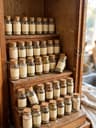
Spices in a single row are a guessing game — you read the front labels and hope the cumin is not hiding behind the chili. A small stepped riser turns one row into three visible rows, and every jar gets a front seat. The dollar-store risers are short, so this works best in an upper cabinet where the shelf above is close. Put the daily spices at the front of each step and the rare ones at the back. If your spice collection has outgrown one riser entirely, our spice organization ideas cover the full drawer and door versions too.
File Pot Lids Upright Beside the Pots

Pot lids are the baking sheets of the lower cabinets: stacked flat, they slide, they clang, and the one you want is always underneath. File them upright in a wire rack right beside the pots they belong to, biggest at the back, smallest at the front. The rack does not need to be fancy — the plain wire sorters from the same aisle do this job fine. Keeping lids next to their pots matters more than keeping them pretty: the moment lids live in a different cabinet from the pots, pairing them becomes a chore and the stack comes back. This is the one fix that makes cooking feel calmer the very same night.
Do One $25 Haul, Then a Five-Minute Weekly Reset

Here is where most budget makeovers fall apart: the system is fine, but nobody maintains it. So make the deal with yourself now. One haul, roughly $25, covers the risers, bins, rods, turntable and hooks in this list. Then pick a weekly moment that already exists — while the kettle boils on a Sunday — and give the cabinets five minutes. Bins that drifted go home, lids get re-filed, and anything that crept back in without a home leaves. Five minutes is short enough to do tired, and that is the whole point. Skip a week and nothing collapses. Skip a month and you are back to the avalanche, so tie it to the kettle and let it ride.
A calm cabinet does not need a matching set or a renovation. It needs a riser where the plates stack too high, a bin where the snacks drift, and a hook where the measuring cups vanish. That is the whole secret of the dollar aisle: small pieces, placed where the friction actually is.
Start with the cabinet that annoys you most, measure it, and buy for that one cabinet only. Once it works, the rest of the kitchen starts looking fixable too — and it will cost you about the price of a takeaway dinner to get there.
Dollar Tree Kitchen Cabinet Organization FAQs
Expert answers & styling advice
Are Dollar Tree organizers sturdy enough for everyday cabinets? ▼
For light and medium loads, yes. Wire risers, small bins, turntables and hooks handle plates, cans, jars and mugs without trouble. They are not the right pick for cast iron or a full set of heavy stoneware — keep the heavy stuff low, on the shelf itself, and let the dollar pieces organize the lighter things around it. If a riser flexes under your plates, swap in a shorter, wider one rather than loading it heavier.
How much should I budget for a whole kitchen from Dollar Tree? ▼
Most kitchens land between $25 and $50. The $25 starter haul in this article covers the five worst cabinets, and a second trip for the remaining shelves usually adds $15 to $25 more. Measure first and buy per cabinet, not per aisle — the fastest way to overspend is grabbing one of everything because it looks useful in the store.
What sizes do I need to measure before I shop? ▼
Three numbers: the width of each cabinet opening, the height between shelves, and the depth of the cabinet. Width decides whether a riser or turntable fits, height decides what can stand underneath a riser, and depth tells you whether a bin will slide all the way in or stick out past the door. Write them on your phone, with the cabinet name beside each one.
Do adhesive hooks damage cabinet doors? ▼
On painted or laminate doors, good adhesive hooks peel off clean if you pull the tab slowly downward as directed. On raw wood or a damaged finish, the adhesive can lift a flake, so test one hook in a hidden corner first. If you are renting, over-door baskets and tension rods are the safest no-damage options of all, since nothing sticks or screws in.
What is the first Dollar Tree buy if I can only pick one? ▼
A wire shelf riser. It fixes the most common cabinet complaint — one tall shelf with a wobbly stack on it — for about $1.25, and it works in upper cabinets, lower cabinets and even under the sink. Buy two if your cabinet is wide, and measure the clearance for the tallest item going underneath before you leave the store.